
The short answer
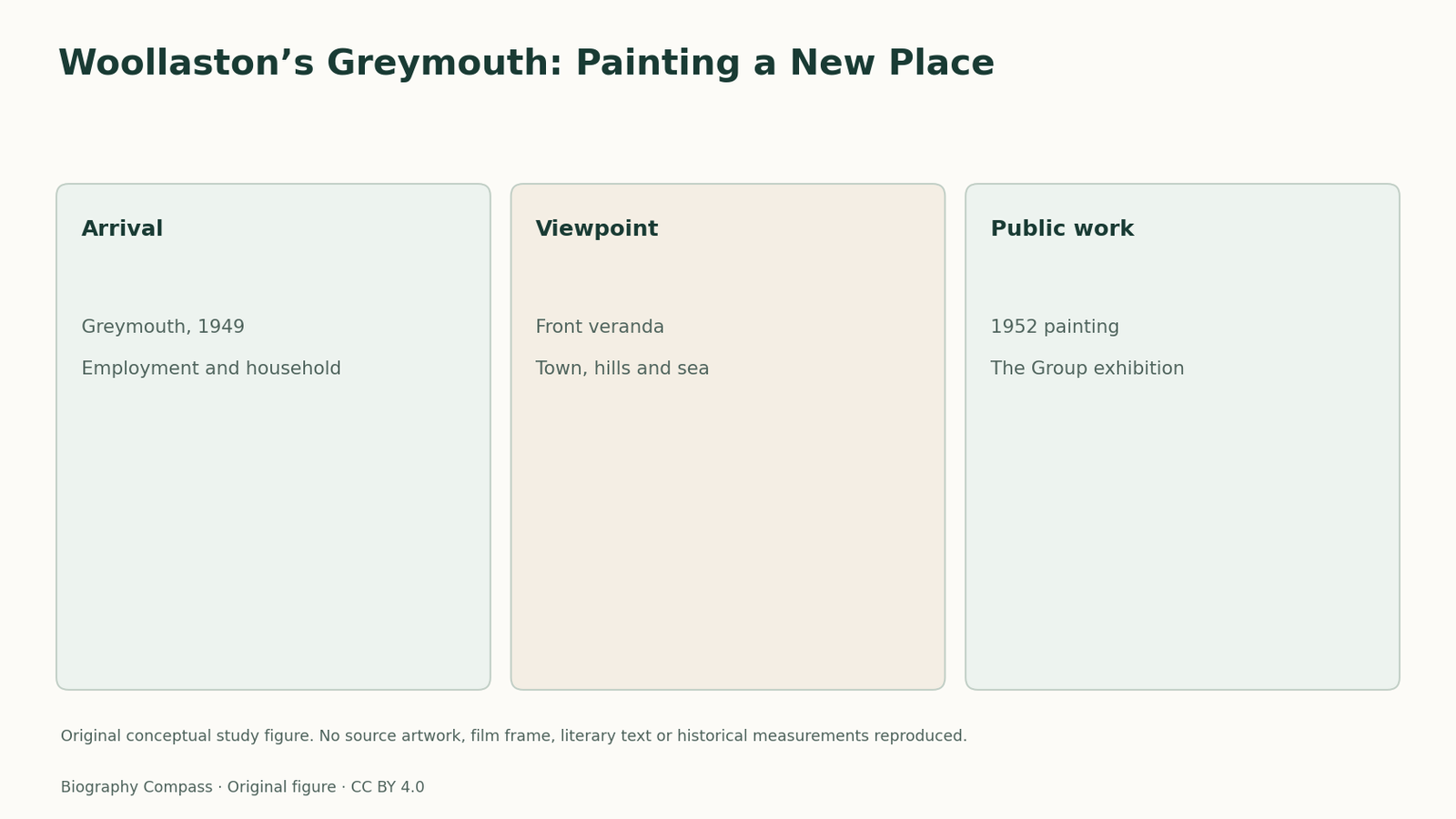
Read the 1952 Landscape with Tower through the move for work, a veranda viewpoint and changing responses to a town.
Read the evidence
Sources, interpretation and production roles
The records answer different questions about this work. The final exercise is an original teaching model.
| Record or question | Supported reading | Boundary or contrast |
|---|---|---|
| Arrival record | A work-related move preceded the painting. | A quoted letter is not the painting’s complete meaning. |
| Object record | The 1952 view was painted from a home veranda. | Domestic location does not make the work incidental. |
| Original familiarity model | Keeps objects constant while changing relations noticed. | It does not reconstruct the artist’s thoughts. |
A town picture made from a home
Landscape with Tower, Greymouth is a 1952 oil painting on ivory board in Christchurch Art Gallery. The museum identifies the view with Woollaston’s front veranda, looking across the town toward the sea. That setting is unusually useful: it places the picture at the intersection of dwelling and looking. The artist did not need to leave ordinary life behind to find a subject. An established viewpoint at home could become a working position for a new painting.
Sources for this section: [2]
Arrival and the later picture are separate moments
The gallery quotes Woollaston’s first response to Greymouth after he moved there for work in December 1949. He was struck by the angular relation of buildings and hills, while not yet feeling the place was his to paint. By 1952 the tower landscape was sent to The Group’s exhibition. The change does not require a claim that one picture resolves every feeling about a town. It establishes a sequence in which arrival, repeated living and a public painting belong to different moments. The underlying letter was not independently inspected for this guide.
Sources for this section: [2]
Town and terrain can make one pictorial problem
The work’s title names a built landmark within a landscape. In this guide’s reading, that pairing makes it productive to ask how a tower might compete with or connect to the hills around it. The question is not whether the town contaminates an otherwise pure landscape. Buildings and land can supply different directions, scales and intervals within one construction. Woollaston’s wider interest in planes and tensions gives the comparison a professional context, without turning a general statement of method into a complete explanation of this particular object.
Original exercise: one place, two kinds of familiarity
Invent a town seen from a doorway. Name three things noticed on the first day: a tall structure, a ridge and a strip of distant water. Then write a second account after a year of repeated use of the same doorway. Keep the named objects constant but change the relationships that receive attention. A reference answer can move from listing unfamiliar things to comparing their angles, distances or intervals. This is one possible account of growing familiarity, not a universal psychological rule or a reconstruction of Woollaston’s private thoughts. Now make a simple plan with three labelled areas rather than copying the painting. Explain how a job-related move could supply a sustained viewpoint even when it did not originate as an artistic expedition. Return to the 1952 work by connecting its documented veranda position and exhibition history with the interpretive question of making a place pictorially usable. The exercise preserves the distinction between where the artist lived, what the record says he first wrote and what a later picture can invite a viewer to consider.
Continue the chronology
Related history guides
Biography context
Explore New Zealand through connected lives
Connected biographies
People and related creative practices
1910–1998
Toss Woollaston
New Zealand painter and writerToss Woollaston developed a modern painting practice through work, family life and repeated encounters with the landscapes of Nelson and the West Coast.Read biography1919–1987
Colin McCahon
Painter, gallery worker and art teacherColin McCahon was a New Zealand painter whose work joined landscape, religious questions and written language. Employment in galleries and teaching ran alongside an evolving practice that drew on local places and international art.Read biography1916–1990
Doris Lusk
New Zealand painter, potter and art teacherDoris Lusk combined painting, pottery and teaching while developing landscapes in which buildings, infrastructure and terrain share a forceful presence.Read biographyQuick answers
Common questions
- Is Landscape with Tower a Māpua view?
- No. The museum identifies Greymouth and the artist’s veranda there.
- Was the 1952 painting made on arrival in 1949?
- No. The guide distinguishes arrival from the later exhibited work.
Primary and institutional sources
How this history was checked
Sources include production records, institutional collections and the specifically identified passages discussed here. Interpretations and teaching models are distinguished from credits and publication facts. This article was reviewed on 8 November 2026.