
The short answer
How do the buildings and ordered fields make human labour part of Lusk’s landscape rather than an interruption?
Read the evidence
Sources, interpretation and production roles
The records answer different questions about this work. The final exercise is an original teaching model.
| Record or question | Supported reading | Boundary or contrast |
|---|---|---|
| Shared holiday | Two artists painted the same setting. | Shared travel does not establish identical solutions. |
| Recorded comparison | Lusk includes the valley; McCahon emphasises hills. | Spatial difference need not be a ranking of quality. |
| Original two-plan task | Changes the role of land use within a fixed place. | Neither invented plan copies a source image. |
A particular holiday produced more than one picture
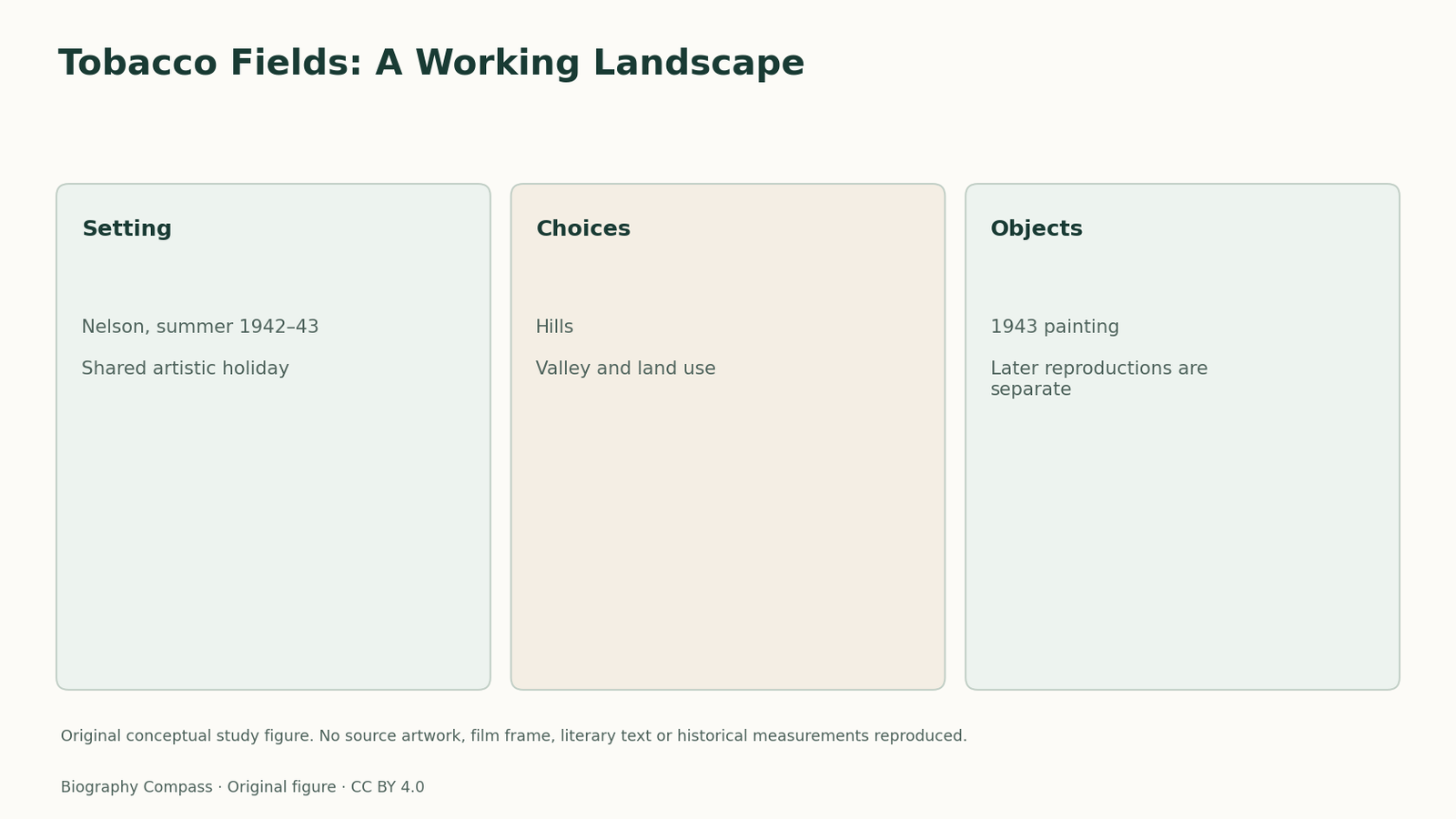
Tobacco Fields, Pangatotara, Nelson is Lusk’s 1943 oil painting on cardboard, held by Auckland Art Gallery. NZHistory places its making during a summer holiday in 1942–43 with Colin and Anne McCahon. Colin also painted the scene. This makes a specific comparison possible: two works can begin from shared terrain and shared travel without being copies of each other. The record is not evidence that either artist required the other to choose the same solution.
Sources for this section: [2]
The valley changes the account of the place
The inspected commentary contrasts McCahon’s attention to undulating hills with Lusk’s inclusion of the valley and more conventional spatial organisation. That is the documented basis for comparison here. In this guide’s reading, including the valley can change the relation between broad terrain and the activities situated within it. The viewer is invited to consider how land is used as well as how its contours are shaped. This argument does not depend on treating a conventional depth system as automatically less inventive than a flatter or more compressed one.
Sources for this section: [2]
An industrial landscape is not an accidental category
Lusk repeatedly returned to structures and infrastructure, later making paintings such as The Pumping Station and imagined industrial projects. These works make useful context for the tobacco scene. They show a continuing artistic problem: how a building or productive use of land can become a strong pictorial presence. They do not prove that the early painting already contains a complete programme for the later career. A more precise reading recognises continuity while allowing the medium, arrangement and degree of invention to change over time. The valley comparison is especially useful because it concerns selection within a shared setting, allowing a reader to explain difference without inventing a rivalry between the painters.
Continue the chronology
Related history guides
Biography context
Explore New Zealand through connected lives
Connected biographies
People and related creative practices
1916–1990
Doris Lusk
New Zealand painter, potter and art teacherDoris Lusk combined painting, pottery and teaching while developing landscapes in which buildings, infrastructure and terrain share a forceful presence.Read biography1919–1987
Colin McCahon
Painter, gallery worker and art teacherColin McCahon was a New Zealand painter whose work joined landscape, religious questions and written language. Employment in galleries and teaching ran alongside an evolving practice that drew on local places and international art.Read biography1910–1998
Toss Woollaston
New Zealand painter and writerToss Woollaston developed a modern painting practice through work, family life and repeated encounters with the landscapes of Nelson and the West Coast.Read biographyQuick answers
Common questions
- Did McCahon paint the same scene?
- The institutional account says that he did, while making a different selection of landscape forms.
- Is the 1982 reproduction the original painting?
- No. The original is the 1943 oil painting; printed reproductions have their own dates and materials.
Primary and institutional sources
How this history was checked
Sources include production records, institutional collections and the specifically identified passages discussed here. Interpretations and teaching models are distinguished from credits and publication facts. This article was reviewed on 8 November 2026.