
The short answer
How do musical teaching, stylised design and divided production credits come together in Toot, Whistle, Plunk and Boom?
Compare the records
Different records answer different questions
The distinctions below follow the identified sources.
| Record | What it establishes | Limit of the conclusion |
|---|---|---|
| Disney production entry | Names co-directors, release date, format and background designer. | Does not allocate every image to an individual artist. |
| Academy 1954 record | Identifies the winning cartoon and producer. | Does not turn the cartoon award into a directing award. |
| Museum design account | Names additional design collaborators and stylistic experimentation. | A later workshop is not the original production process itself. |
A musical lesson built around memorable actions
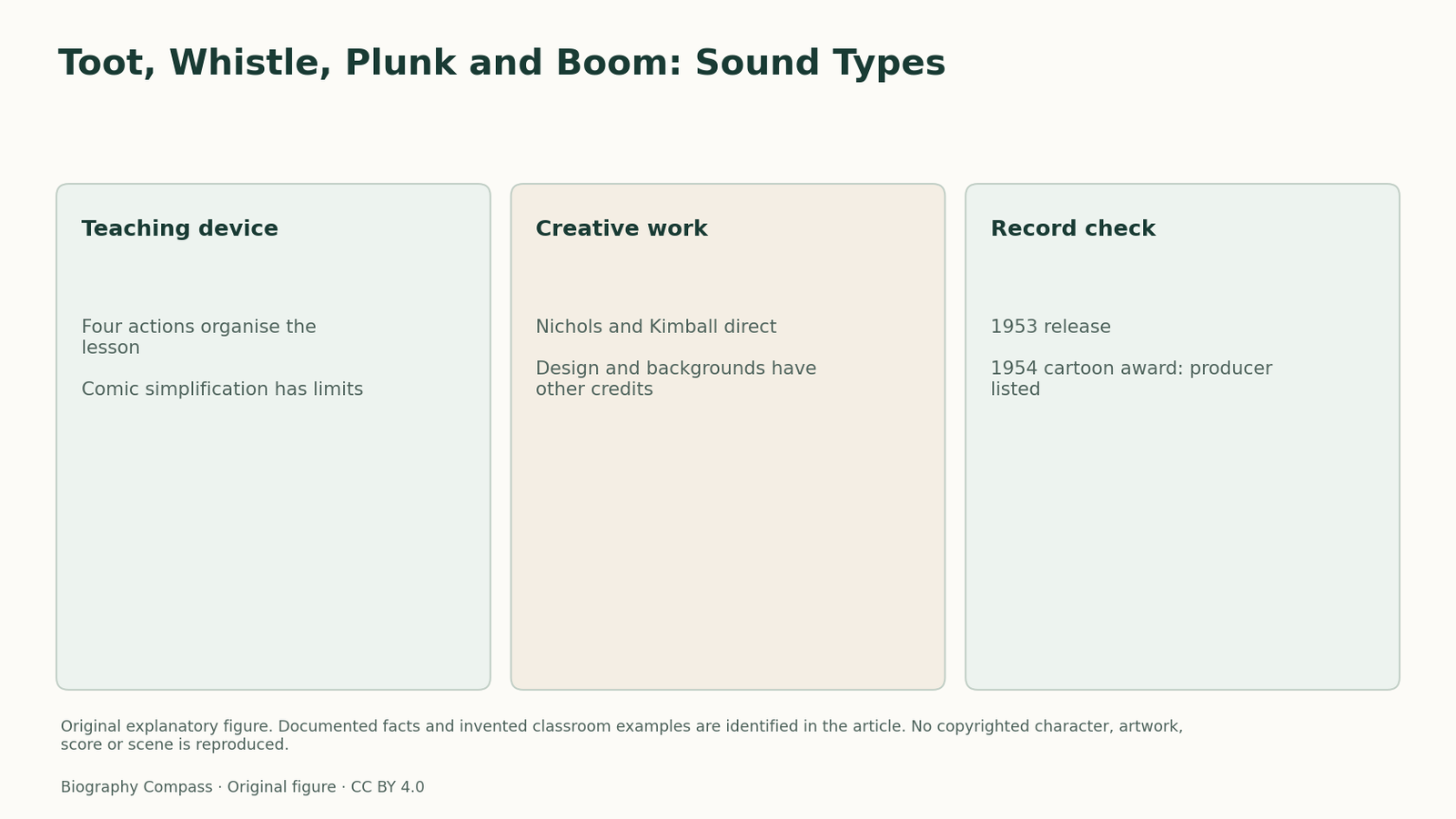
Toot, Whistle, Plunk and Boom was released on 10 November 1953. Disney’s production entry describes Professor Owl explaining musical instruments to a class through the actions named in the title, moving from imagined early examples toward modern instruments. The device turns a large subject into a small set of memorable sound-producing ideas. It is a cartoon’s explanatory framework, not a documented universal history of instrument invention. Readers should distinguish the film’s comic simplification from a claim that every musical tradition fits neatly within its classroom scheme.
Sources for this section: [3]
Graphic design is part of the explanation
The Family Museum places the short within Kimball’s experiments with stylised design and limited animation. Its educational workshop credits Tom Oreb and Marc Davis with helping develop the project’s graphic approach, while the Disney catalogue identifies Eyvind Earle’s backgrounds. These are complementary responsibilities rather than competing claims that one artist made everything. Shapes, staging and background organisation could communicate relationships without requiring the continuous naturalistic movement associated with some feature productions. CinemaScope also supplied a wide frame, but the format itself did not determine who designed a character, animated a movement or directed the completed short.
The award record answers a different question
The Academy’s 1954 record lists the film as winner in Short Subject, Cartoon, and identifies Walt Disney as producer. Disney’s film entry names Charles Nichols and Ward Kimball as directors. Both can be accurate because an award listing and a production-credit record are organised for different purposes. Reading only the former would erase the directing collaboration; reading only a director biography could obscure the producing credit and wider design team. The date also needs care: a cartoon released in 1953 appears at the following year’s ceremony. This guide checks written records rather than claiming a new viewing of the complete film.
Credit exercise with an answer
Make four boxes labelled release, direction, design and award. Enter the 1953 release in the first; Nichols and Kimball in the second; the individually documented design contributions in the third; and the Academy’s 1954 producer listing in the fourth. Then test this statement: Kimball alone made the film and won an award for directing it. The defensible answer rejects both shortcuts. His directing contribution is documented, but so are a co-director and several visual collaborators, and the cited award category is not a directing category. The exercise teaches a reusable distinction through this particular film’s records, without inventing an undocumented division of every shot or every musical phrase.
Continue the chronology
Related history guides
Biography context
Explore United States through connected lives
Connected biographies
People and practices to explore
1914–2002
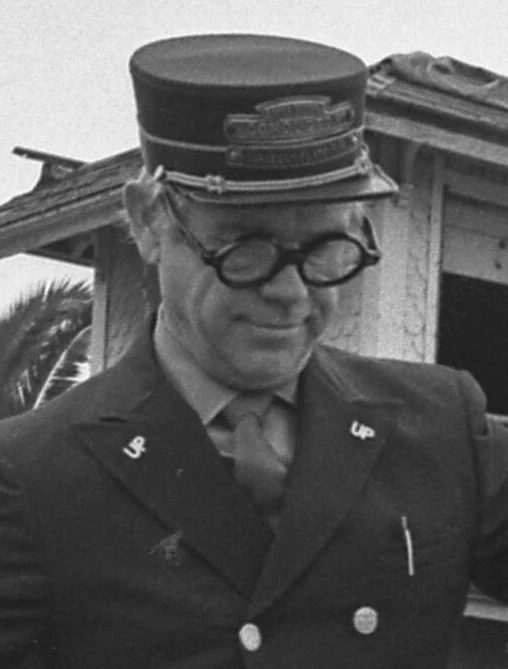
Ward Kimball
Animator, director and musicianWard Kimball developed comic character animation, directed adventurous musical and educational films, and combined studio work with a sustained interest in jazz and railroads.Read biography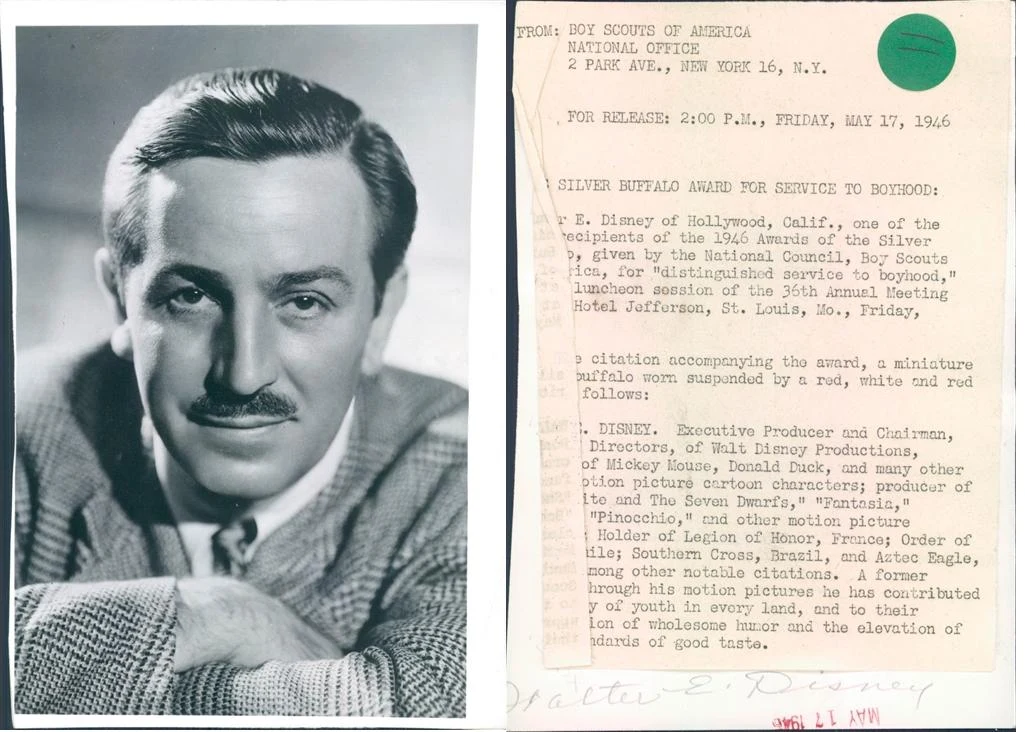
1901–1966
Walt Disney
Animation producer and entertainment entrepreneurWalt Disney was an American animation producer and entrepreneur who built an entertainment business with his brother Roy. His work ranged from silent cartoon production to Mickey Mouse, animated features, television and Disneyland, with essential contributions from artists, performers and business partners.Read biography1901–1971
Ub Iwerks
Animator and photographic-effects innovatorUb Iwerks helped shape the earliest Mickey Mouse films before running his own animation studio and later returning to Disney as a technical specialist. His career moved from drawing characters to developing ways of combining and reproducing images.Read biographyQuick answers
Common questions
- Why do the film credits and Oscar listing name different people?
- They document different roles. The film record names Charles Nichols and Ward Kimball as directors; the Academy lists Walt Disney as producer for the winning cartoon.
Primary and institutional sources
How this history was checked
Written catalogues, production records and interviews are distinguished from our own learning exercise. No complete film viewing, song listening or full-novel reading is claimed where only the identified written material was inspected. This article was reviewed on 7 November 2026.