
The short answer
How did Tyrus Wong’s visual development for Bambi differ from character animation and finished background painting?
Compare the records
Different records answer different questions
The distinctions below follow the identified sources.
| Record | What it establishes | Limit of the conclusion |
|---|---|---|
| Museum lecture recap | Documents concept paintings, Codrick and atmospheric design. | Does not identify the maker of every completed background. |
| Otis career profile | Separates Disney inspirational work from later live-action production illustration. | A career credit is not an individual-shot attribution. |
A concept establishes a visual problem
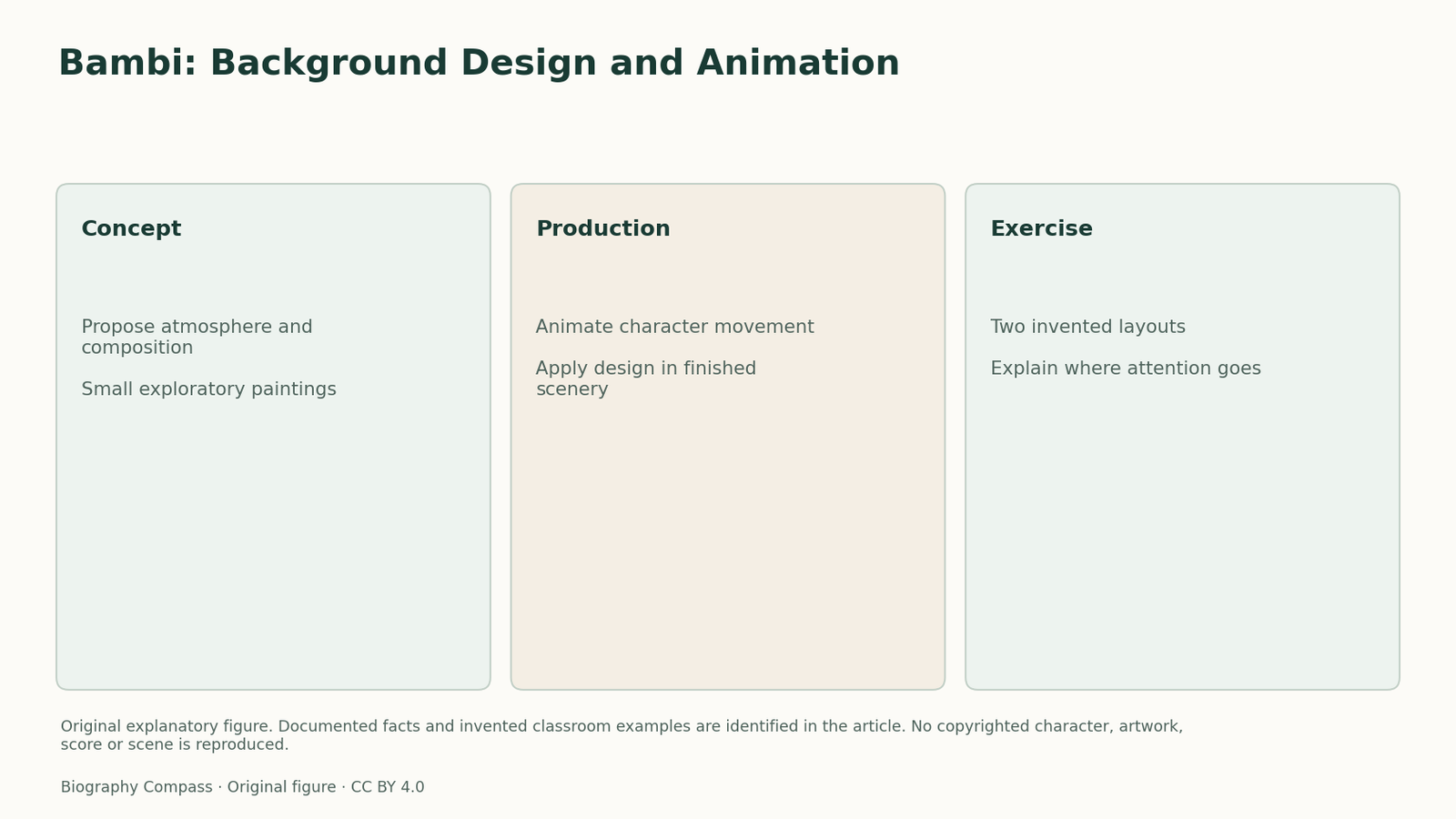
Tyrus Wong’s contribution to Bambi began with paintings made to propose a direction, not with the completion of every forest background. The Walt Disney Family Museum describes small images whose selective detail, soft atmosphere and Chinese landscape references caught the studio’s attention. Its 2011 lecture recap names Tom Codrick in the process by which Wong became a visual designer. This sequence matters: an exploratory image can guide later production while remaining a different object from the background ultimately photographed for a scene. The contribution is substantial without requiring a claim of sole authorship.
Separate design, movement and finished scenery
Wong had first worked as an inbetweener, supplying drawings between principal character poses. Visual development answered another question: what kind of world should surround those moving characters? Finished backgrounds required that approach to be applied within the collaborative demands of an actual shot. A credit to visual design therefore does not automatically identify the maker of an individual background or the animator of the deer appearing against it. The museum and Otis records describe these different responsibilities, while the Museum of Chinese in America locates their author within a larger career extending into live-action illustration.
Atmosphere can depend on leaving things out
The museum’s written account connects Wong’s approach with Song-dynasty landscape traditions and with an ability to place a few significant details rather than render every surface sharply. As an editorial interpretation, that suggests a practical distinction between descriptive quantity and dramatic usefulness. A forest crowded with equally crisp forms may compete with a small moving figure; a less insistent environment can direct attention through contrast, colour and spacing. This is not a shot-by-shot analysis of a film viewed for this guide, nor a rule that Chinese landscape painting has one uniform style. It is a design question grounded in the documented account of Wong’s work.
Design exercise and a defensible answer
Draw two original rectangles containing the same simple dot as a stand-in for a moving subject. In the first, fill every region with equally dark, narrow marks. In the second, group a few marks and leave a quieter area beside the dot. Ask which layout gives the subject a clearer focus, and which production roles would still be needed to turn either layout into a moving scene. A supported answer explains how contrast and empty space redistribute attention; it does not claim that less detail is always better. It also names separate work in character animation and background execution. The rectangles are invented teaching diagrams, not copies of Wong’s paintings or Bambi frames.
Continue the chronology
Related history guides
Biography context
Explore United States through connected lives
Connected biographies
People and practices to explore
1910–2016
Tyrus Wong
Artist and film production illustratorTyrus Wong connected Chinese landscape traditions with American film design, shaping Bambi’s visual atmosphere before a long career in live-action production illustration.Read biography
1901–1966
Walt Disney
Animation producer and entertainment entrepreneurWalt Disney was an American animation producer and entrepreneur who built an entertainment business with his brother Roy. His work ranged from silent cartoon production to Mickey Mouse, animated features, television and Disneyland, with essential contributions from artists, performers and business partners.Read biography1911–1978
Mary Blair
Concept artist, color designer and illustratorMary Blair was an American artist whose color and composition shaped animation concept work, illustrated books and three-dimensional attractions. Her career moved between studio employment and independent design, carrying a recognizable visual approach across different media.Read biographyQuick answers
Common questions
- Did Tyrus Wong animate every scene in Bambi?
- No. His major contribution was visual development that guided the film’s atmosphere. Character animation and the execution of individual backgrounds involved other production responsibilities.
Primary and institutional sources
How this history was checked
Written catalogues, production records and interviews are distinguished from our own learning exercise. No complete film viewing, song listening or full-novel reading is claimed where only the identified written material was inspected. This article was reviewed on 7 November 2026.