
The short answer
What changed between field observation and the larger studio construction of The Jack Pine?
Read the evidence
Sources, interpretation and production roles
The records answer different questions about this work. The final exercise is an original teaching model.
| Record or question | Supported reading | Boundary or contrast |
|---|---|---|
| Object identities | A 1916 sketch and a 1916–17 canvas survive. | Different supports are not one continuous object. |
| Documented development | Colour and surrounding bands change while a pine remains. | The canvas is not described as a mechanical enlargement. |
| Original anchor model | Keeps a near form stable while changing surrounding relations. | The model supplies an argument, not a facsimile. |
Two objects give the question a precise form
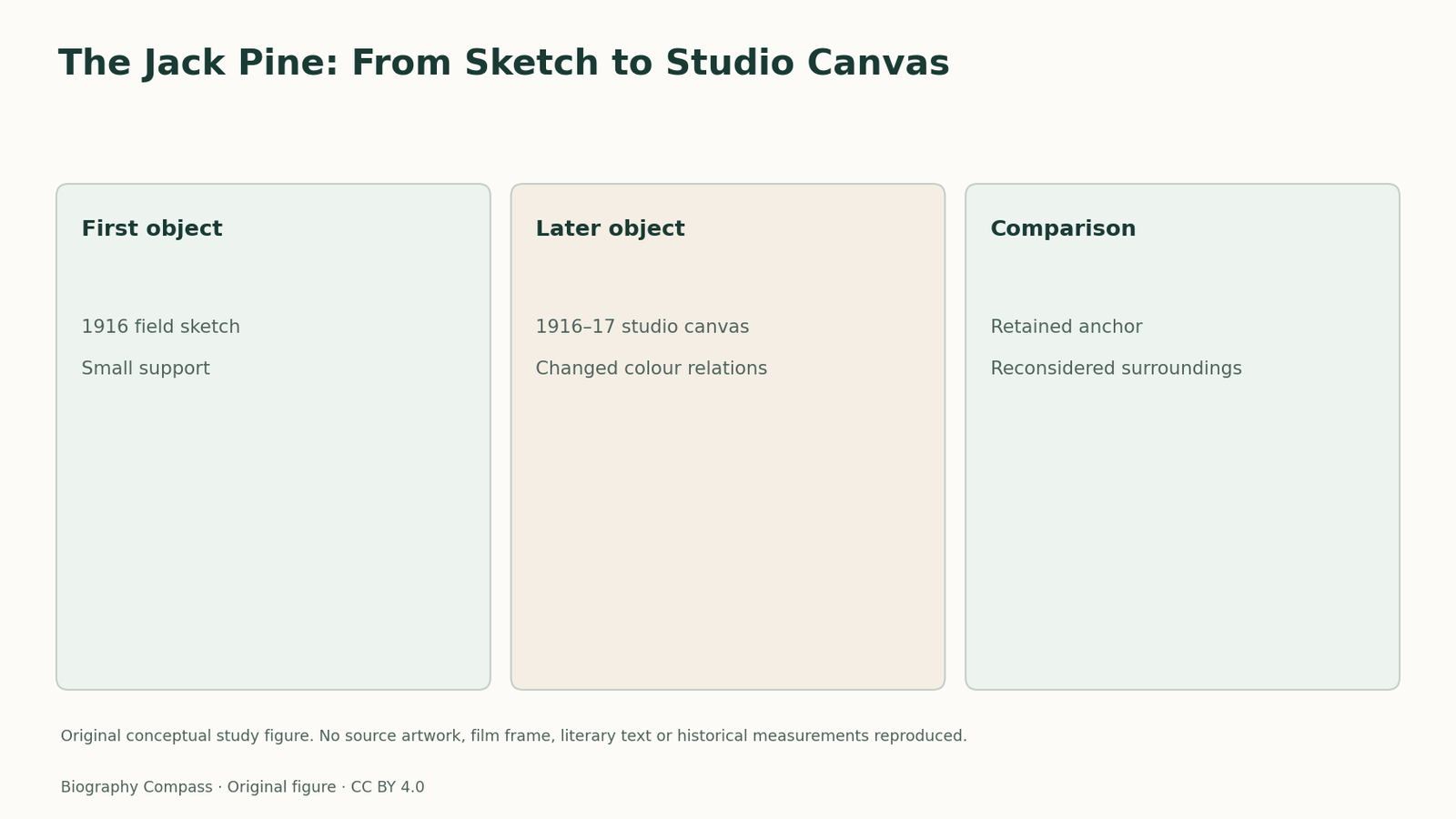
The Jack Pine exists as a small 1916 sketch, held by RiverBrink, and a larger 1916–17 canvas in the National Gallery of Canada. The Art Canada Institute discussion identifies each separately. This permits a concrete question: what changed when a field encounter became a studio picture? The dates overlap a period of development; they do not establish that the two supports record one uninterrupted painting session. Their different scale is only the beginning of the comparison.
A retained structure does not mean an unchanged image
The inspected account describes the canvas retaining the basic pine while brightening the foreground and reorganising water and sky into coloured bands. Those changes are the useful evidence here. In this guide’s interpretation, the tree can remain a recognisable anchor while surrounding intervals make the image feel more deliberately held together. A sketch-to-canvas account should therefore ask what the later work does with its starting point. Calling the sketch spontaneous and the canvas finished would name two familiar categories without explaining this particular transformation.
Sources for this section: [1]
The studio is part of the landscape practice
Thomson’s chronology documents commercial-art experience, friendships, Algonquin journeys and Toronto studio arrangements. Together they make a more informative setting than the idea of an artist working entirely alone in the forest. The Jack Pine comparison does not show that outdoor observation was unimportant. It shows that observation could remain active through later decisions about colour, spacing and format. The change in support allows a subject to be reconsidered for a different scale of viewing. That is an artistic operation rather than a failure to preserve the first impression exactly. For the viewer, the interval between trunk and distant bands can matter as much as the inventory of natural things. The comparison turns attention from identifying a pine to explaining how a picture sustains it.
Sources for this section: [2]
Original exercise: keep an anchor, change the relations
Make two written plans for an invented landscape with one upright form, a near strip of ground, water and sky. Keep the upright form in the same place. In the second plan change only the brightness of the near ground and the intervals dividing the distant areas. A reference answer explains that a stable anchor can coexist with a new rhythm of surrounding bands. The subject inventory remains similar, but the relations among its parts have changed. Now ask which plan could count as the more useful first record of an outdoor encounter and which could support a sustained distant view. There is no compulsory ranking: explain the purpose chosen for each. Return to Thomson’s two objects by naming one documented change and one interpretive consequence. This separates the collection record, the account of visual development and the reader’s own argument. The model uses invented shapes and arrangements, reproducing neither the pine silhouette nor the protected wording of a modern art-historical description.
Continue the chronology
Related history guides
Biography context
Explore Canada through connected lives
Connected biographies
People and related creative practices
1877–1917
Tom Thomson
Canadian painter and commercial artistTom Thomson moved from commercial design into an intensive landscape practice, making outdoor studies and studio paintings before his death in 1917.Read biography1885–1970
Lawren Harris
Painter and art theoristA Canadian painter and writer whose landscapes and later abstractions joined formal experimentation with a search for spiritual meaning.Read biography1882–1974
A. Y. Jackson
Canadian landscape painter and official war artistA. Y. Jackson connected Montreal and Toronto artistic circles before developing a long travelling practice and an influential role in Canadian landscape painting.Read biographyQuick answers
Common questions
- Are the sketch and canvas identical apart from size?
- No. The inspected discussion identifies changes in colour and the organisation of surrounding areas.
- Does this guide reproduce the original painting?
- No. Its teaching model uses an invented landscape arrangement.
Primary and institutional sources
How this history was checked
Sources include production records, institutional collections and the specifically identified passages discussed here. Interpretations and teaching models are distinguished from credits and publication facts. This article was reviewed on 8 November 2026.
- Art Canada Institute, David P. SilcoxTom Thomson: Life and Work, The Jack Pine
- Tom Thomson Catalogue Raisonné, Joan MurrayChronology
- Dictionary of Canadian Biography, Ann DavisThomson, Thomas John
- Tom Thomson Memorial Art Gallery, archived by Library and Archives CanadaTom Thomson biography, page 1
- National Gallery of Canada institutional shopThe Jack Pine, institutional collection identification