
The short answer
How a near maple and moving water create relations of colour and scale in Jackson’s studio canvas.
Read the evidence
Sources, interpretation and production roles
The records answer different questions about this work. The final exercise is an original teaching model.
| Record or question | Supported reading | Boundary or contrast |
|---|---|---|
| Sketch and studio account | A 1914 river study informed a Toronto canvas. | The two objects should not be assigned one material identity. |
| Formal description | Leaves and branches interrupt the view of rapids. | A national reading requires a further historical argument. |
| Original near-form model | Changes attention without changing the named objects. | It does not reproduce Jackson’s composition. |
A river encounter made into a studio painting
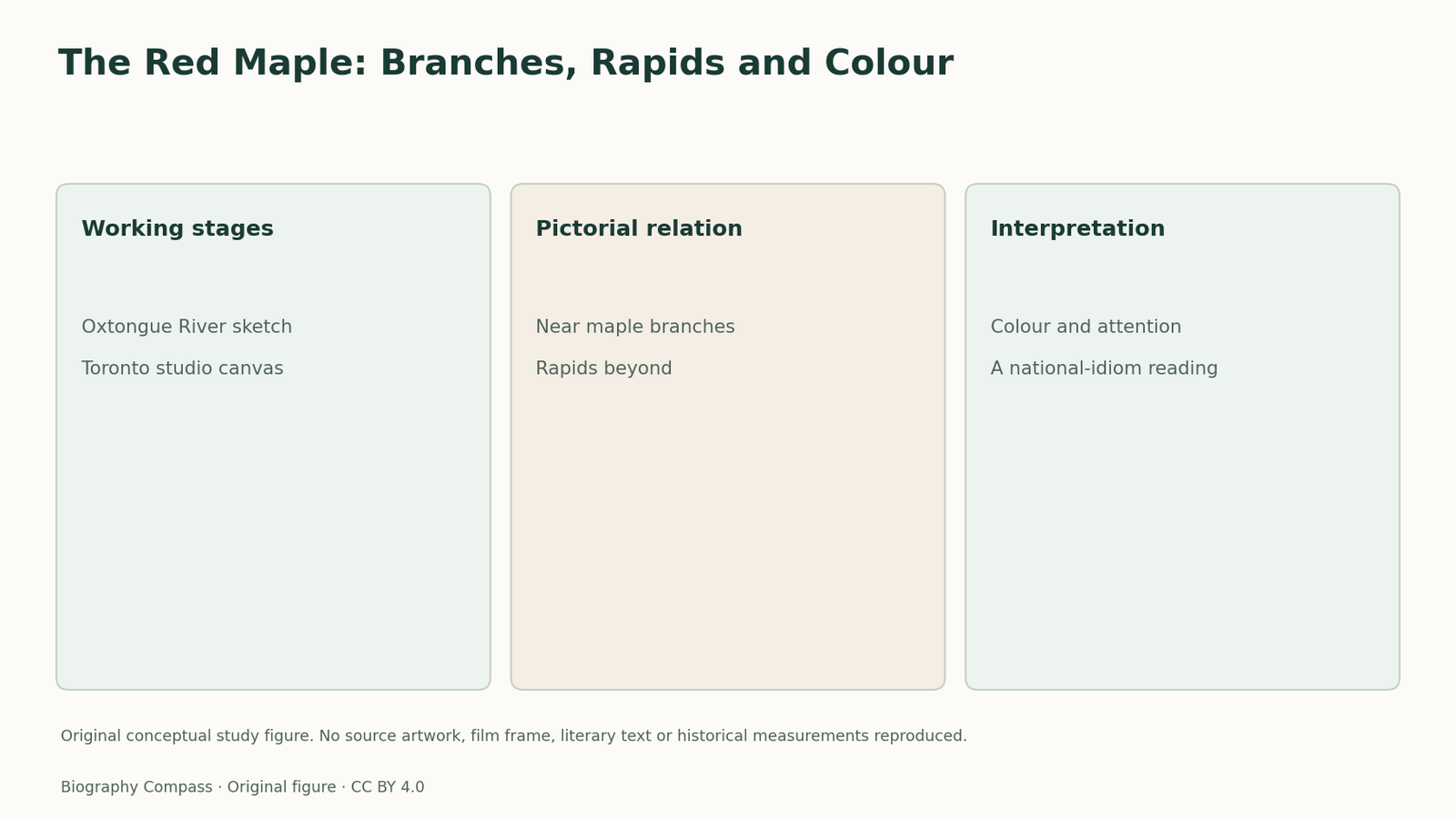
The Red Maple was painted in Jackson’s Toronto studio in November 1914, using a sketch made along the Oxtongue River. The inspected scholarly passage distinguishes the richer colour of the canvas from the sketch’s outdoor working conditions. This is a specific account of development between objects, not an assumption that every Jackson painting followed an identical routine. The finished work belongs to the National Gallery of Canada; related sketch records have their own identities and supports.
A small tree controls a larger encounter
The scholarly description emphasises young maple branches and red leaves against churning rapids. The tree is not simply a label attached to an otherwise complete landscape. It provides a near structure through which the viewer encounters the moving water beyond. In this reading, the contrast between delicate branches and forceful rapids gives the scene a relationship of scale as well as colour. Red can attract attention while the branches make a visual interruption. The composition lets the viewer attend to a local detail and a larger environment at once.
Sources for this section: [4]
National meaning requires a separate argument
Gapp’s study discusses the maple as a national idiom and relates the canvas to the cultural circumstances of 1914. That interpretation is worth distinguishing from the direct description of branch, leaf and water. A plant does not become a national symbol merely because it has been painted accurately. The meaning develops through selection, presentation and a history of reception. Jackson’s position within a circle of artists concerned with Canadian painting helps explain the context, but it does not make every colour a predetermined political code. The formal and historical questions remain connected without becoming identical.
Original exercise: looking through a near form
Imagine an invented river scene with a thin near branch and a broad band of moving water behind it. Describe two arrangements: one with the branch at the edge, and one with it crossing the central view. A reference answer explains that the second makes the viewer look around or through the near form, while the first leaves the water more continuously open. Now add a bright colour only to the branch. Explain how attention could change without changing the objects represented. Finally, write a separate claim that the branch has come to represent a region. What additional evidence would support that claim? A useful answer names titles, exhibition history or a documented discussion of identity rather than inferring politics from colour alone. The exercise gives the specific Red Maple description an analytical use: it connects near and far, colour and interruption, while preserving the distinction between how a picture is organised and what it later means to a public.
Continue the chronology
Related history guides
Biography context
Explore Canada through connected lives
Connected biographies
People and related creative practices
1882–1974
A. Y. Jackson
Canadian landscape painter and official war artistA. Y. Jackson connected Montreal and Toronto artistic circles before developing a long travelling practice and an influential role in Canadian landscape painting.Read biography1885–1970
Lawren Harris
Painter and art theoristA Canadian painter and writer whose landscapes and later abstractions joined formal experimentation with a search for spiritual meaning.Read biography1877–1917
Tom Thomson
Canadian painter and commercial artistTom Thomson moved from commercial design into an intensive landscape practice, making outdoor studies and studio paintings before his death in 1917.Read biographyQuick answers
Common questions
- Was The Red Maple painted entirely beside the river?
- The inspected account identifies a studio canvas based on a river sketch.
- Does the maple automatically establish nationalism?
- No. The guide distinguishes the visual organisation from an attributed historical reading of national identity.
Primary and institutional sources
How this history was checked
Sources include production records, institutional collections and the specifically identified passages discussed here. Interpretations and teaching models are distinguished from credits and publication facts. This article was reviewed on 8 November 2026.
- Roberts Gallery / National Gallery of Canada dictionary biographyA.Y. Jackson
- Ottawa Art GalleryAlec’s Life Before Ottawa
- Ottawa Art GalleryA.Y. Jackson: Art and Life in the Ottawa Valley
- University of York / White Rose, Isabelle GappA Circumpolar Landscape
- National Gallery of Canada institutional shopThe Red Maple small poster