
The short answer
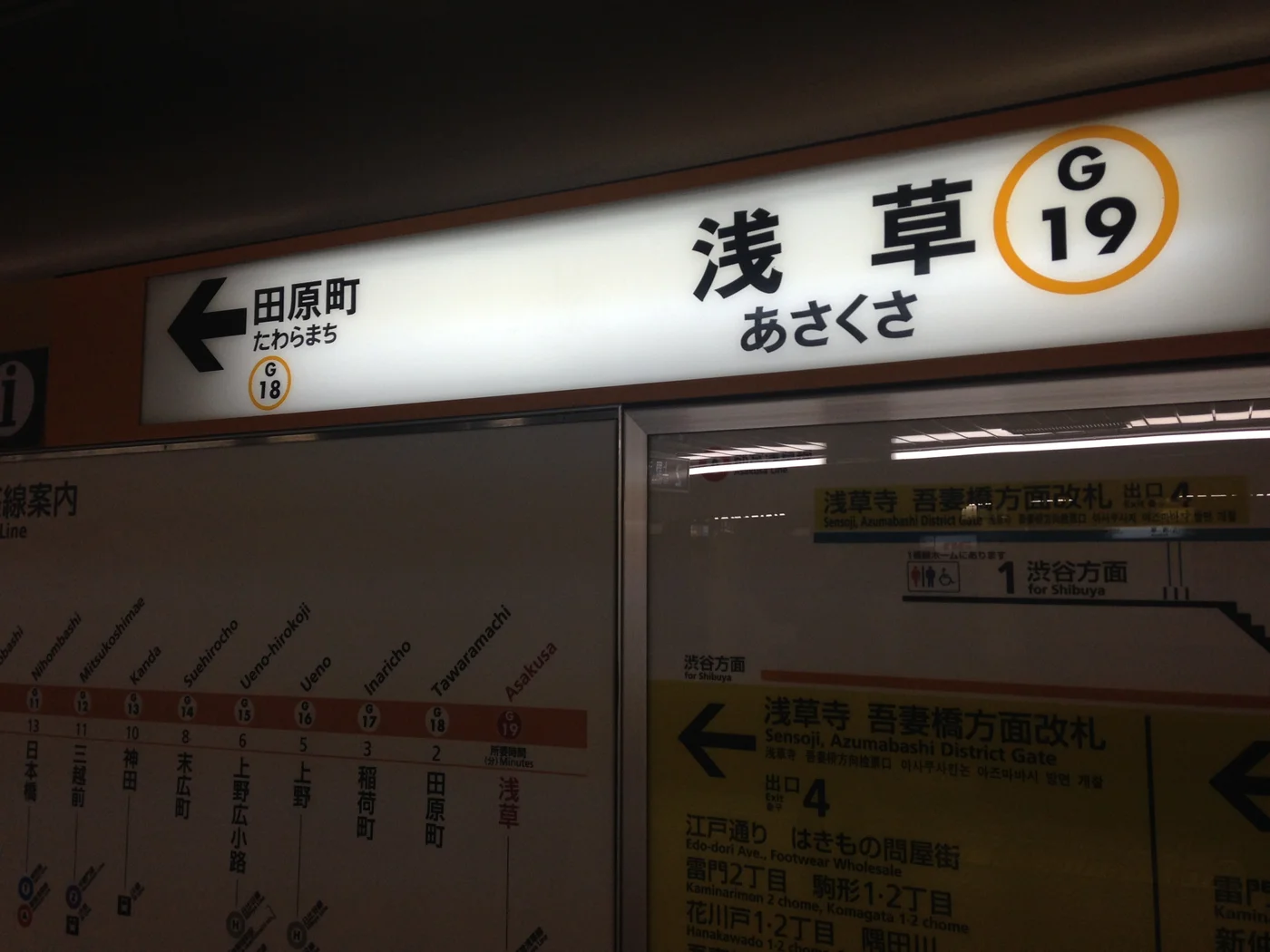
A passenger can recognise Tokyo Metro’s Asakusa station on the Ginza Line by the code G19. The letter connects the station to the line, while the digits distinguish it from the other stops. Tokyo Metro dates the introduction of its numbering to its 2004 launch. The convention took its place within a broader revision to the way stations directed passengers.
Reading a station code
Three cues for a Tokyo Metro trip
The Ginza Line illustrates how colour, letter and number can work together.
| Cue | Ginza Line example | What to check |
|---|---|---|
| Colour | The Ginza Line’s orange colour | Use the letter as another way to recognise the line. |
| Letter | G for Ginza Line | Match it when transferring between services. |
| Number | G01 Shibuya and G19 Asakusa | Make sure the code and station name agree with your route. |
Chronology
A timeline of the turning points
An early sign system is tested and adopted
The predecessor operator tests signs on the Chiyoda Line at Otemachi before formal adoption in 1974.
Tokyo Metro starts operations
The operator introduces station numbering around the same time it sets a revised sign standard.
Revised station signs are deployed
Tokyo Metro progressively applies the new specifications.
How 1973 and 2004 fit together
Tokyo Metro’s account takes the older sign system back to a trial at the Chiyoda Line section of Otemachi in 1973. The predecessor operator adopted that system the following year. Those dates describe a programme of station signage before the later numbering convention. As the network grew and transfers became more complex, Tokyo Metro developed a revised standard around its own launch in 2004 and rolled the updated signs out from 2005.
Reading the code from Asakusa to Shibuya
On the Ginza Line, G19 identifies Asakusa and G01 identifies Shibuya. The operator’s passenger guide explains the combination of line colour, identifying letter and station number. The number belongs with its letter because other lines have their own series. At an interchange, a traveller therefore checks the code for the line they plan to board before using a platform direction or transfer sign.
Why names and exits still matter
A code is short enough to search for and simple enough to compare across a map and a sign. Someone following directions also needs to know which passage to take and which exit leads to the correct area outside. Tokyo Metro’s sign history describes those broader functions alongside numbering and multilingual guidance. The code gives a rider a consistent reference that other messages can build on.
Continue the chronology
Related history guides
How the Nagano Shinkansen Opened Before the 1998 Olympics
Trace a different kind of rail development in Japan before the Nagano Winter Games.
Read the timeline1968–1969How Mexico City’s Metro Gave Each Station an Icon
Compare Mexico City’s station-by-station images with Tokyo’s line letters and numbers.
Read the timeline1966–1970What New York’s 1970 Subway Sign Manual Standardised
Compare a New York manual that standardized where guidance should appear.
Read the timeline1975–1979Why New York Replaced the Vignelli Subway Map in 1979
See how a shared colour in New York carries a different kind of route information.
Read the timeline2019–2020How Singapore Redesigned MRT Wayfinding for the TEL
Follow Singapore’s application of repeated directions and confirmation signs.
Read the timeline1920–1939How Tokyo’s First Subway Opened from Asakusa to Ueno
Read the opening history of the first stretch of what became the Ginza Line.
Read the timelineConnected biographies
People connected to this history
Quick answers
Common questions
- When did Tokyo Metro introduce station numbering?
- Tokyo Metro’s Ginza Line history dates its introduction to the operator’s launch in 2004.
- Which Tokyo Metro station is G19?
- G19 identifies Asakusa on the Ginza Line.
Primary and institutional sources
How this history was checked
Dates, legal milestones and historical claims are checked against the official and institutional records below. This article was reviewed on 19 November 2026.