
The short answer
How can the same observed brightness support different conclusions about a galaxy? Use selected parts of Tinsley’s 1968 paper to separate model inputs, predicted light and cosmological interpretation, then test the distinction with two declared teaching examples.
Original source comparison
What kind of evidence is each statement?
Keep a computational choice, an observable and an interpretation in separate columns of the reasoning.
| Country | What the evidence supports | What it does not establish |
|---|---|---|
| Chosen formation rule | Defines how this model generates stellar populations. | A uniquely measured history of every galaxy. |
| Model light and gas output | Can be compared with observational constraints. | A guarantee that no alternative model can fit. |
| Simplified remnant treatment | A stated historical approximation. | A current claim that every star ends the same way. |
| Cosmological discussion | Explores how luminosity evolution changes inference. | A final proof that the universe is infinite. |
| Toy gas ledger | Conserves the declared 100 mass units. | A reproduced stellar-population code or spectrum. |
Chronology
A timeline of the turning points
Received
The printed paper records the initial receipt date.
Revised
A separate editorial milestone.
Published
The ApJ paper presents model sequences and comparisons.
Yale appointments
Later appointments belong to the career chronology, not the paper’s date.
Start with the question rather than a modern legend
Evolution of the Stars and Gas in Galaxies asks how the changing contents of a galaxy affect its observable properties. The paper was received in March 1967, revised in June and published in February 1968. Those are separate editorial milestones, not three discoveries. Its purpose was partly to improve the interpretation of distant elliptical galaxies. The useful historical question is how an evolving source changes an inference, rather than whether one researcher settled every aspect of cosmology. The source scope here is the accessible journal-scan text in selected opening and cosmological sections; the numerical programme has not been reproduced.
Draw an input-to-output map before evaluating the conclusion
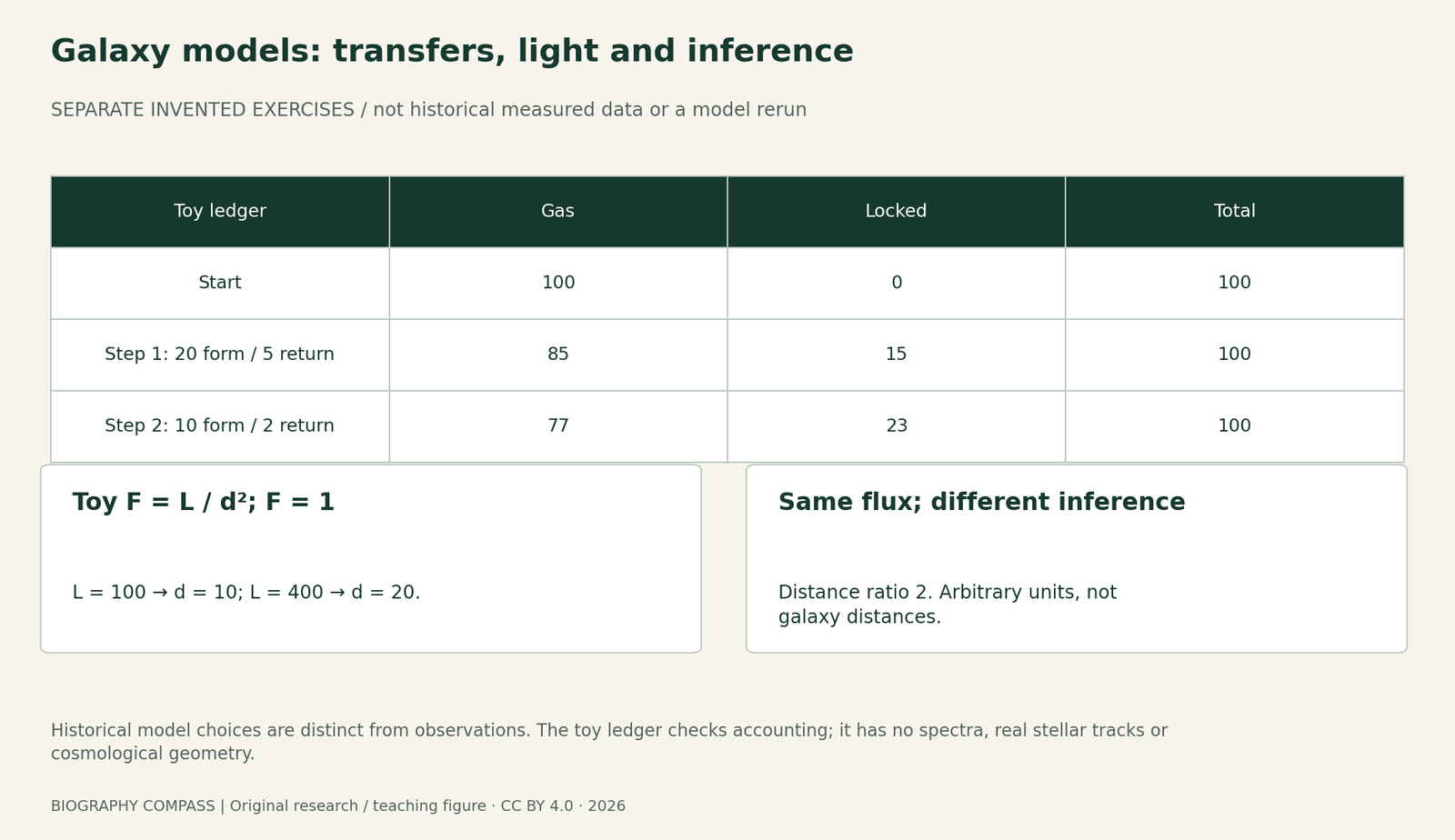
The calculation starts from a gas population, assigns a rule for forming stars and follows a chosen set of stellar masses over time. It then compares predicted integrated properties with observations. The important distinction is between assumptions supplied to the calculation and quantities used to test it. A parameter selected by an investigator is not itself a new observation. Nor does a reasonable match guarantee that only one history could generate the output. The teaching figure gives a qualitative workflow and a separate gas ledger; it is newly drawn, not a copy of an original paper figure.
Sources for this section: [1]
Historical simplifications need historical labels
Tinsley’s opening specifies thirteen stellar masses and billion-year time steps, with simplified composition and remnant assumptions. These choices made a particular calculation possible; they are not universal physical laws. The paper excludes dynamical evolution, so a resemblance to an observed galaxy type should not be read as a full simulation of its shape or motion. A useful source-reading habit is to annotate a claim with the model that produced it. Without that qualifier, a computational approximation can become an inaccurate statement about how every real star or galaxy must behave.
Sources for this section: [1]
Exercise one: audit a closed toy gas ledger
This invented ledger uses arbitrary mass units and no physical stellar lifetimes. Start with 100 units of gas and 0 units locked in stars or remnants. During step 1,20 units enter stars and 5 return immediately to gas. During step 2,10 units enter stars and 2 return. Assume no inflow, outflow or other component. Find the gas and locked mass after each step. Does adding the returned material increase the system’s total mass? Finally, identify one reason why this two-step exercise cannot reproduce a galaxy’s spectrum or establish the age of the universe.
Sources for this section: [1]
Reference answer: track transfers without counting them twice
After step 1, gas is 100−20+5=85 and locked mass is 20−5=15. After step 2, gas is 85−10+2=77 and locked mass is 15+10−2=23. Each total remains 100. Returned gas is a transfer from a component already counted, not extra matter created outside the ledger. The example leaves out masses, ages, chemical abundances and spectra of individual stellar populations. It therefore checks accounting only. Treating its correct total as a successful reproduction of Tinsley’s calculation would confuse a small teaching test with validation of a research model.
Sources for this section: [1]
Exercise two: separate luminosity from received brightness
Use a second, independent toy relation F=L/d², with constants absorbed into declared arbitrary units. The observed F is 1. Under model A, intrinsic luminosity L is 100; under model B, it is 400. Calculate d for each. Then decide whether the observation F alone determines which model is correct. This is deliberately not a distance-redshift calculation: it leaves out wavelength shifts, observational corrections and cosmological geometry. Its purpose is to expose one dependency that can be hidden when a source is casually treated as a lamp of known, unchanging brightness.
Sources for this section: [1]
Reference answer: changing the source model changes the inferred distance
The distances are 10 and 20 in the specified units, a ratio of 2. A fourfold change in assumed luminosity gives a twofold distance change in this toy setup. F=1 alone does not choose between the models. Additional evidence about the source and propagation is needed. Do not report either value as a measured distance to an actual galaxy or convert the example into proof of a particular cosmic history. The calculation is original teaching material, while the motivation comes from the historical problem of accounting for galaxy evolution when interpreting light.
Sources for this section: [1]
Use the record to bound the conclusion
The paper compares evolving galaxy models and discusses consequences for the magnitude-redshift relation. That supports an account of changing inference, not a claim that the existence of external galaxies was discovered in 1968. Yale’s professional obituary places this work in a wider career in stellar populations, chemical evolution and research organisation. The comparison below distinguishes a journal model from a retrospective career assessment. For further study, identify which missing observation could best discriminate two histories that produce similar light. That is a research question; increasing the number of decimal places in the toy ledger is not.
Continue the chronology
Related history guides
Conducting Polymers in 1977: Measurements, Doping and Scientific Credit
Compare a different research record, its evidence and its limits.
Read the timeline2007–2012Koobi Fora in 2012: Specimens, Reconstruction and Species Claims
Compare a different research record, its evidence and its limits.
Read the timelineConnected biographies
People behind the work
1941–1981
Beatrice Tinsley
Astronomer and researcher in galaxy evolutionBeatrice Tinsley studied how changing populations of stars alter a galaxy’s light and chemical composition. Educated in New Zealand and later a professor at Yale, she showed why interpreting distant galaxies requires models of their history as well as measurements of their brightness.Read biographyQuick answers
Common questions
- Are the figures copied from Tinsley’s paper?
- No. They are original qualitative and synthetic teaching material, not historical observational data.
- Has the 1968 numerical model been rerun?
- No. This guide reads selected original text and checks two separately declared toy examples.
Primary and institutional sources
How this history was checked
Read the precise source scopes and limits below. Comparisons, teaching ledgers, questions and reference answers are original editorial work. This article was reviewed on 27 October 2026.
- Beatrice M. Tinsley; American Astronomical Society, NASA ADS scanEvolution of the Stars and Gas in Galaxies, ApJ 151,547–565, February 1968
- Richard B. Larson and Linda L. Stryker; Yale UniversityBeatrice Muriel Tinsley, obituary reprint: QJRAS 23,162–165,1982
- Yale University LibraryBeatrice Muriel Tinsley: Women in Science and Engineering at Yale