
The short answer
What do the dates 2007, 2015, 2016 and 2024 each tell us about The Vegetarian? They mark the Korean book, an English edition, a translated-work award and recognition of Han Kang’s wider career. Keeping the sequence visible also brings the work of translators and editors into view.
Book, edition and award
What does each date establish?
This original table keeps publication history and recognition on separate lines.
| Date | Event | People and scope |
|---|---|---|
| 2007 | Korean volume | Han Kang’s connected three-part work. |
| 2015 | Portobello UK edition | English translation by Deborah Smith; editorial and publishing work. |
| 2016 | Man Booker International Prize | Award for the translated work, shared by Han and Smith. |
| 2024 | Nobel Prize in Literature | Recognition of Han’s broader literary achievement. |
Chronology
A timeline of the turning points
An earlier story
Han later identifies The Fruit of My Woman as a precursor.
Korean volume
The Vegetarian brings three connected sections into book form.
English acquisition
Deborah Smith gives editor Max Porter a translation sample at London Book Fair, according to Porter.
UK publication
Portobello publishes Smith’s English translation.
International Booker
The translated work wins the prize shared by author and translator.
Nobel Prize in Literature
Han receives recognition for her wider literary achievement.
The form begins with more than one viewpoint
The Vegetarian is a work in three connected parts, first published as a Korean book in 2007. Yeong-hye’s refusal of meat becomes the centre of a family’s increasingly troubled responses. The structure moves through her husband, brother-in-law and sister, with limited access to Yeong-hye’s own voice. Different perspectives turn the attempt to understand another person into part of the reader’s task.
Calling it a novel and describing it as linked stories need not be contradictory. The labels emphasise the assembled whole and the separately shaped sections. The author’s site classifies the volume as a novel; the Booker guide records its connected novella origins. Neither label should make the three parts disappear.
A comparison the author herself makes
In her Booker interview, Han connects the book to The Fruit of My Woman, a story from 1997. She identifies a husband’s unreliable perspective and a woman’s partially heard voice as formal continuities. But she also distinguishes the earlier supernatural transformation from the darker, materially grounded situation in The Vegetarian.
This comparison offers a useful entry into the book’s development without reducing it to a position on diet. The refusal of meat opens questions about violence, innocence and being human. The sister’s presence adds another relation of identification and concern. These are the author’s explanations of her questions and changes, rather than a claim that every reader must arrive at one approved interpretation.
Sources for this section: [3]
How a sample reached an editor
Max Porter recalls meeting Deborah Smith after a London Book Fair panel in 2013. She handed him seven pages of translation. His account follows the sample into acquisition and a commission for a full English manuscript at Portobello. That chain is concrete publishing work: a translator proposes a text, an editor reads it, and a publishing team commits resources.
Porter also recalls that another sample by another translator had previously circulated through an agent. His discovery was therefore not the book’s first existence or its first attempt to reach English publishers. The 2015 UK edition belongs within an earlier Korean career and a network of translation, rights representation and editorial decisions.
Translation creates choices that can be discussed
Deborah Smith’s translation had to sustain distinct voices and an overall unity across the sections. The Booker guide preserves her account of working with author and editor over tone and word choice. Such decisions are especially consequential where sexuality and violence can be made more sensational by a small change in language.
Han’s later interview acknowledges errors that were corrected and describes reading the initial proof while absorbed in Human Acts. Porter remembers editorial exchanges and revisions. These recollections illuminate the work from different positions; they are not a substitute for comparing specific passages. This guide has consulted those records and publishing descriptions, rather than pretending to have read and collated the entire Korean and English books.
What the 2016 award recognised
The English-language publication won the 2016 Man Booker International Prize. The official book record names Han as author and Smith as translator, identifies Korean as the original language and gives Portobello’s UK publication date as 1 January 2015. The award was shared between author and translator under the translated-book format introduced that year.
That recognition does not turn the English publication into the original Korean edition. It identifies a particular work reaching readers through translation. Recording Smith beside Han is consequently a factual part of the award’s history, not an optional courtesy. Likewise, publication in one territory may precede another edition, so an American publication date should not overwrite the UK record.
Sources for this section: [5]
Why the 2024 Nobel belongs on another line
The 2024 Nobel Prize in Literature recognised Han’s poetic prose and its engagement with historical trauma and the vulnerability of human life. The Academy’s biobibliography discusses several works, including Human Acts and The White Book. The award belongs to an author’s literary achievement, not to a new 2024 publication of The Vegetarian.
Try arranging four cards: Korean book, UK translation, translated-work prize and Nobel recognition. The order is 2007, 2015, 2016 and 2024. Now attach the collaborators: Han to the Korean writing, Smith and the publishing team to the English edition, author and translator to the 2016 award. The exercise makes a compact publication history while leaving room to study the work itself in an authorised edition.
Continue the chronology
Related history guides
Connected biographies
Read the connected biography
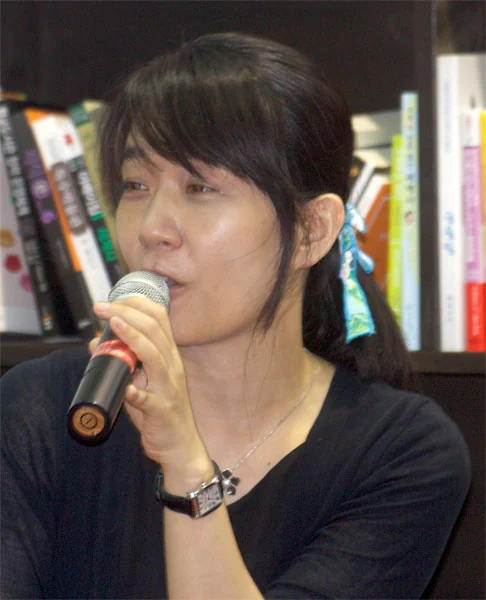
1970–
Han Kang
Novelist, short-story writer and poetHan Kang is a South Korean writer whose fiction and poetry explore violence, memory, grief and the limits of understanding another person. The Vegetarian reached English readers through Deborah Smith’s translation; her wider body of work received the 2024 Nobel Prize in Literature.Read biographyQuick answers
Common questions
- Is The Vegetarian one continuous first-person narrative?
- No. Its connected sections use different perspectives, and Yeong-hye is not the sole narrator.
- Who translated the award-winning English edition?
- Deborah Smith. The 2016 International Booker recognised the translated work and was shared by author and translator.
- Did The Vegetarian win the Nobel Prize in 2024?
- Han Kang received the Nobel Prize in Literature for her literary achievement. That is distinct from the 2016 award for The Vegetarian in translation.
Primary and institutional sources
How this history was checked
Primary and institutional records were compared with the access and provenance limits listed below. The explanations and comparison are original to this guide. This article was reviewed on 27 October 2026.
- Han KangThe Vegetarian: 2007 novel and language editions
- Booker Prize FoundationReading guide: The Vegetarian by Han Kang, translated by Deborah Smith, 3 July 2023
- Han Kang / Booker Prize FoundationInterview: I never imagined The Vegetarian would find so many readers
- Max Porter / Booker Prize FoundationPublishing The Vegetarian: acquisition, translation and editing, 3 July 2023
- Booker Prize FoundationThe Vegetarian: author, translator, UK publication and 2016 award record
- Nobel Prize OutreachHan Kang: official 2024 Literature Prize facts
- Swedish Academy / Nobel Prize OutreachThe Nobel Prize in Literature 2024: biobibliography