
The short answer
The number twenty appears in both sets of body cells. The difference becomes clear when the ledger keeps size classes separate.
Evidence at a glance
Why did equal totals support different chromosome combinations?
Read each observation alongside the particular inference it supports.
| Record or example | Observation | Interpretation |
|---|---|---|
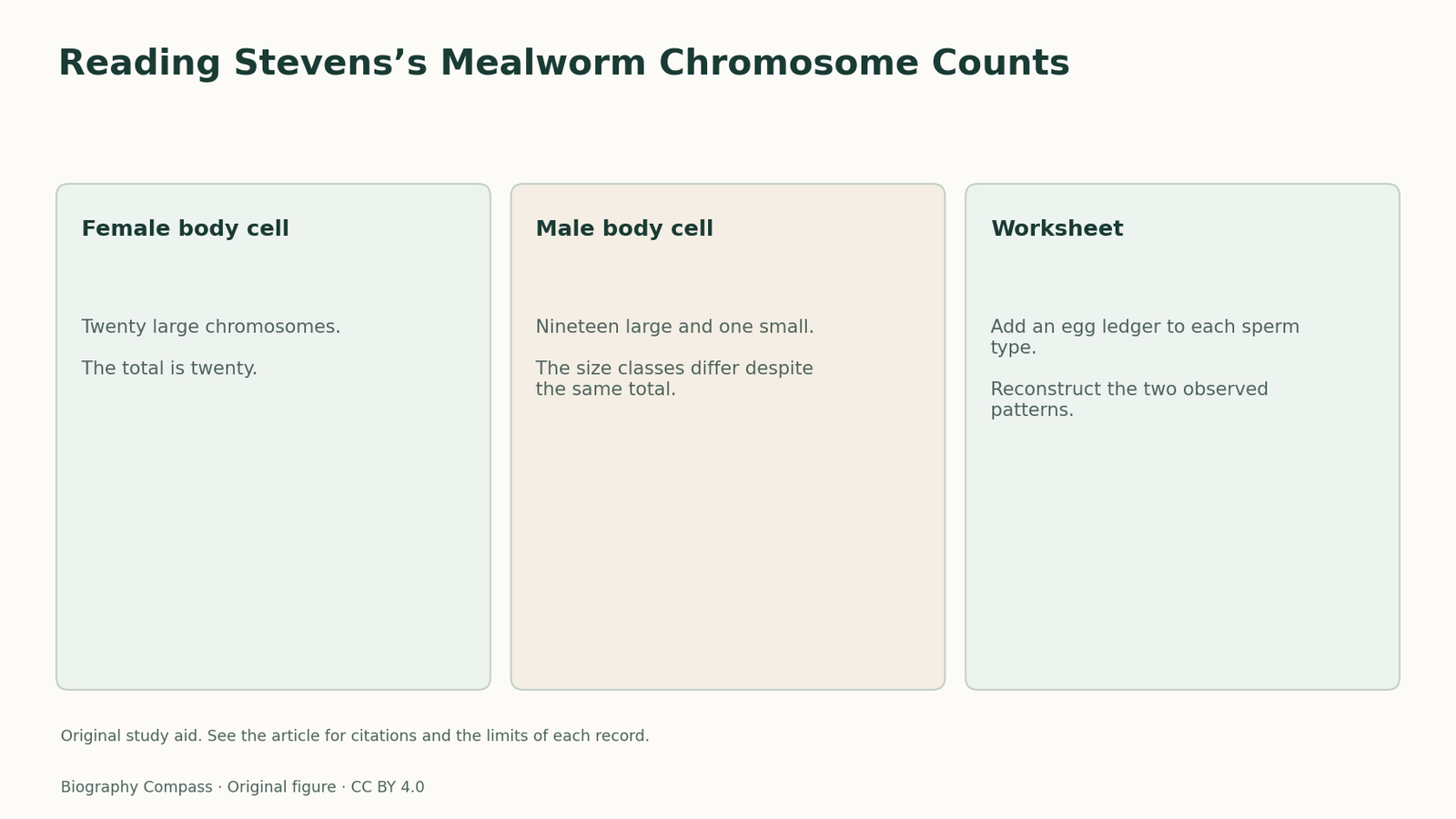
| Female body cell | Twenty large chromosomes. | The total is twenty. |
| Male body cell | Nineteen large and one small. | The size classes differ despite the same total. |
| Worksheet | Add an egg ledger to each sperm type. | Reconstruct the two observed patterns. |
Make a ledger by size class
In Stevens’s Tenebrio description, the male cells under comparison contain nineteen large chromosomes and one small chromosome. Female body cells contain twenty large chromosomes. Both counts add to twenty. A ledger with a single column for total would discard the feature that allows the sets to be distinguished.
Sources for this section: [1]
Follow the pairing through sperm formation
The description follows the unlike pair through cell division. In a simplified ledger, give both sperm types nine large chromosomes outside the unlike pair. Type A receives the large member and thus has ten large ones; type B receives the small member and has nine large and one small. The distinction follows a member of a pair, while the total count in the two types remains ten.
Sources for this section: [1]
Reconstruct the two additions
Give the egg ten large chromosomes in the original worksheet. With A, addition yields twenty large. With B, it yields nineteen large and one small. Compare the modeled results with the observations above. The worksheet gives the reader a compact way to reconstruct Stevens’s inference without copying her plates or replacing the evidence from her staged cells.
Sources for this section: [1]
Test a tempting generalization
Suppose a different insect has males and females with the same totals and no obvious size distinction under the microscope. The Tenebrio ledger offers a method for organizing observations, but it supplies no chromosome identity for that second species. Its sex-determination system would have to be investigated on its own terms. Stevens’s choice to examine several forms is a reminder that an explanation has a scope.
Continue the chronology
Related history guides
Biography context
Explore United States through connected lives
Connected biographies
The researcher behind the records
1861–1912
Nettie Stevens
Cytologist and geneticistStevens followed chromosomes through developing cells in insects.Read biographyQuick answers
Common questions
- Why write separate columns for large and small chromosomes?
- The composition differs between the two body-cell records while the total is unchanged.
Primary and institutional sources
How this history was checked
The notes distinguish period evidence, later interpretation, and original exercises. This article was reviewed on 5 November 2026.