
The short answer
The 1880 Tay Bridge inquiry revisited tests carried out before the bridge opened. Yolland and Barlow recorded six coupled locomotives crossing during the February 1878 inspection, with satisfactory observed behaviour under those conditions. The inspecting officer nevertheless recommended a speed limit and continuing attention to foundation scour, and wished to observe a train during high wind. These are different statements: a completed test, an operating qualification and an observation still desired. Reading them together explains why an inspection should not be recast as proof against every later failure mode.
A worked comparison
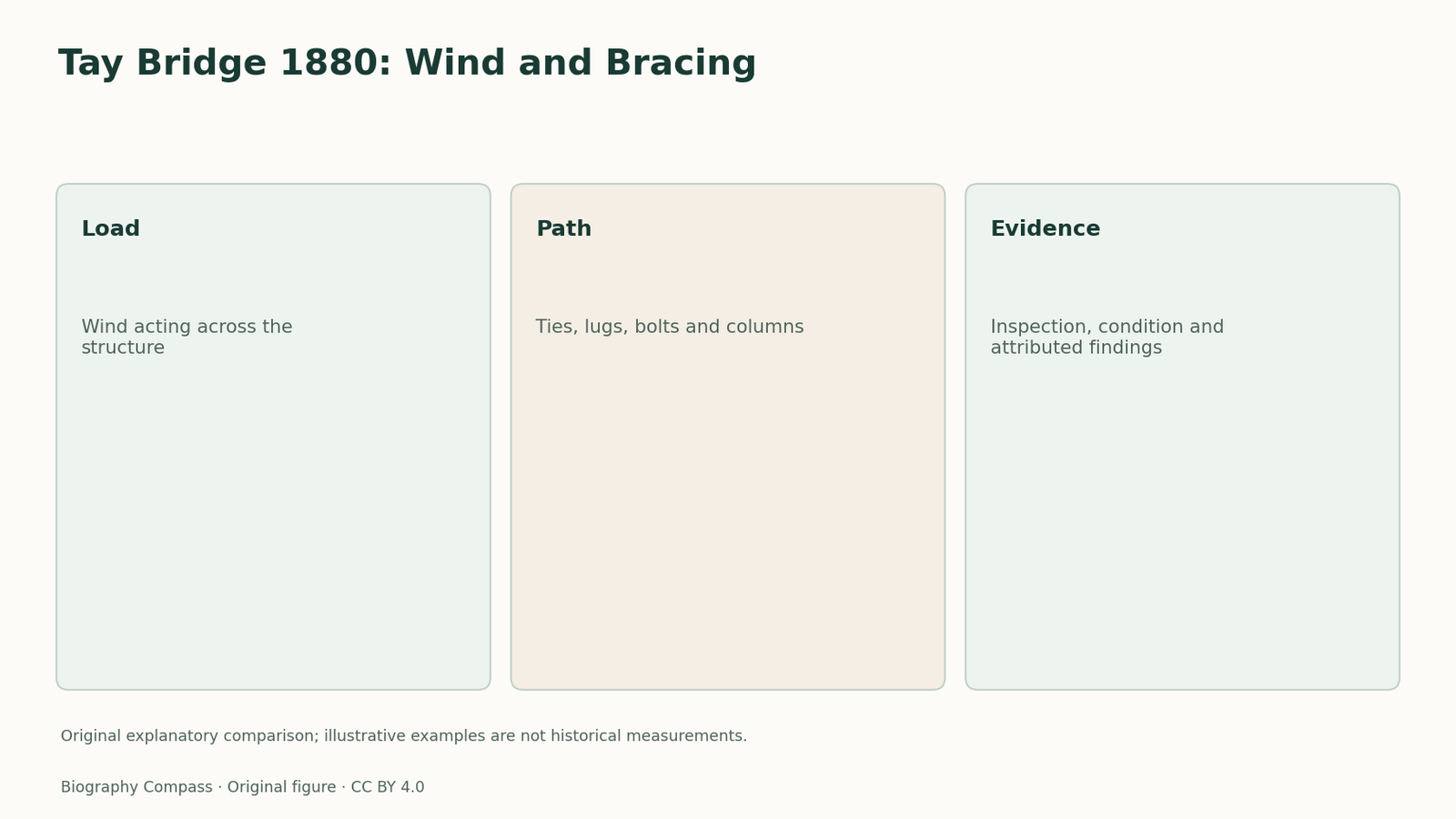
What each part contributes
Use the specific distinctions developed in the study.
| Part or record | What it establishes | Why the distinction matters |
|---|---|---|
| Inspection test | Behaviour under recorded conditions | Does not replace continuing inspection |
| Wind ties and connections | A path for lateral forces | Capacity depends on parts and connections |
| Inquiry reports | Attributed findings and reasoning | Not every conclusion was stated jointly |
What did a successful inspection actually establish?
The 1880 Tay Bridge inquiry revisited tests carried out before the bridge opened. Yolland and Barlow recorded six coupled locomotives crossing during the February 1878 inspection, with satisfactory observed behaviour under those conditions. The inspecting officer nevertheless recommended a speed limit and continuing attention to foundation scour, and wished to observe a train during high wind. These are different statements: a completed test, an operating qualification and an observation still desired. Reading them together explains why an inspection should not be recast as proof against every later failure mode.
Sources for this section: [2]
The structure needed a continuous path for sideways forces
Rothery’s report described defects in the cast-iron columns, their lugs, bolt holes and wind ties. The ties and their connections formed part of the means by which the columns supported one another against lateral movement. A strong-looking girder did not make that lower system irrelevant. Once a connection failed, force could be redistributed to adjacent parts, leaving the columns without the intended restraint. The report’s causal argument therefore concerned an interacting structure, not wind acting upon an otherwise unspecified object.
Sources for this section: [2]
Observed damage and a proposed sequence are different evidence
The report identified loose ties and defective connections, then proposed how racking during the gale could have increased strain. It expressly left uncertainty over whether particular lugs or bolts failed first. Preserving that distinction makes the explanation stronger: evidence can support a failure mechanism without resolving the order of every individual break. Yolland and Barlow’s narrative also used signal entries, witness accounts and wreck positions to reconstruct the train’s movement. Those records locate events, while material examination and structural reasoning address how support was lost.
Responsibility was considered through more than one task
Rothery distinguished design responsibility from supervision of construction and continuing inspection. He also explained that his colleagues differed about whether assigning blame belonged within the instructions given to the inquiry. The new bridge and later engineering practice should not be used to erase that contemporary distinction. A useful reading records who made each finding, what evidence it concerned and whether it was a direct observation or an inference. It also keeps the project’s management history connected to the physical condition of its components.
Force-path exercise and checked answer
Take a fictional panel exposed to a uniform sideways pressure of ten pounds per square foot over two hundred square feet. Its total force in that simplified calculation is two thousand pounds of force. Does the figure establish that a supporting connection is safe? No: connection capacity, geometry and how the force reaches it must also be known. These are illustrative quantities, not a reconstruction of the Tay wind. Now ask whether a successful earlier train test answers the same question as checking a loosened tie. It does not. The checked answer separates applied load, the structural path carrying it and the condition of the parts along that path.
Continue the chronology
Related history guides
Forth Bridge: Hydraulic Tools and Erection
Study Arrol’s Forth Bridge erection work through hydraulic tools, changing utility lines and temporary loads, with evidence from the 1890 construction account.
Read the timeline1876–1890Plimsoll 1876: Reading the Load-Line Act
Read the 1876 Merchant Shipping Act’s original load-line provisions, ship scope and paperwork, keeping an owner’s stated limit distinct from later rules.
Read the timelineBiography context
Explore United Kingdom through connected lives
Connected biographies
People and wider context
1822–1880
Thomas Bouch
railway engineer and transport-system designerThomas Bouch was a railway engineer and transport-system designer, known for railway ferries, economical branch lines and the first Tay Bridge.Read biographyQuick answers
Common questions
- Did the inquiry determine whether every lug or bolt broke first?
- No. Rothery described a connected failure mechanism while expressly leaving uncertainty over which of those parts first gave way.
Primary and institutional sources
How this history was checked
Read the cited original records, institutional accounts and later interpretations. The comparison and exercise explain the specific evidence used in this study. This article was reviewed on 8 November 2026.
- Dictionary of National Biography, original nineteenth-century entryBouch, Thomas
- William Yolland and William Henry Barlow, HMSO 1880; excerpt preserved by Victorian WebTay Bridge: address to the Board of Trade, pages 8–9
- Henry Cadogan Rothery, HMSO 1880; excerpt preserved by Victorian WebTay Bridge inquiry: Rothery report, pages 40–44 and 48
- National Records of ScotlandRailway records in private papers