
The short answer
How did the initial capital subscription and the later emergency security address different needs at Tata Steel?
Read the records together
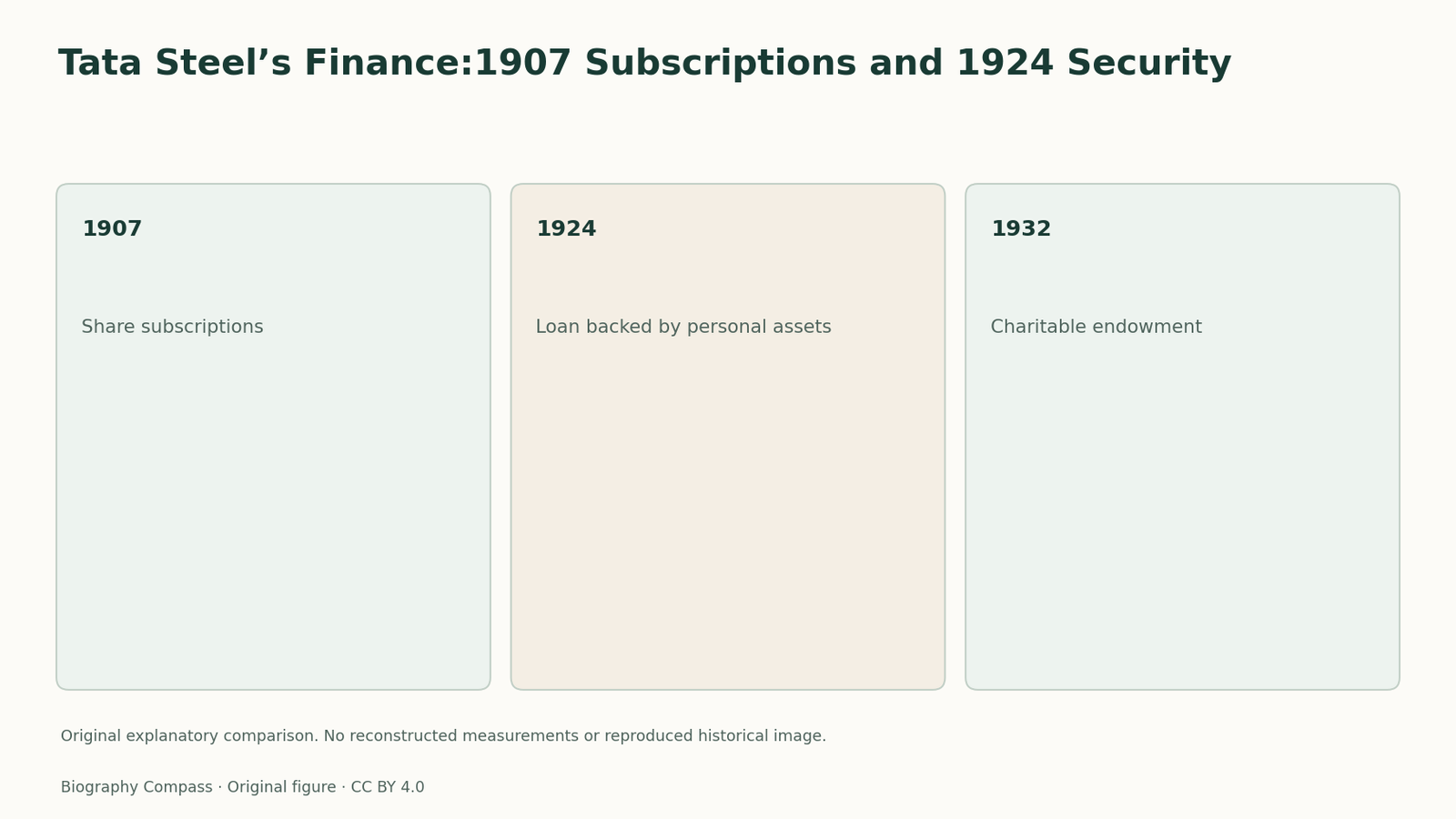
Evidence, functions and interpretation
Compare the particular records and mechanisms discussed in this study.
| Record or mechanism | What it establishes | The distinct question |
|---|---|---|
| 1907 centenary account | Describes a share subscription and ownership capital. | It is a retrospective account, not a newly read register. |
| 1924 biography | Describes personal assets pledged for a loan. | Security is different from an outright sale. |
| 1932 trust account | Identifies an endowment for charitable purposes. | Trustees and beneficiaries differ from company creditors. |
The 1907 issue assembled ownership capital
Tata Steel’s centenary annual report describes the initial share issue as attracting about 8,000 people and nearly 232 lakh rupees within three weeks. This is the company’s later account, not a new transcription of the original subscription register. The mechanism matters more than a heroic financial slogan. Subscribers supplied capital through shares and acquired an ownership interest. That differs from a lender advancing money to be repaid under borrowing terms. The 1907 event belongs to establishing the industrial undertaking’s financial base.
Sources for this section: [3]
The 1924 problem concerned an existing enterprise
The group’s biography describes a later crisis following expansion, rising costs and market difficulties. It says the company reached a point at which wages were difficult to meet. The venture already had a plant, investors and continuing obligations. A shortage of accessible money in that setting was therefore a different problem from raising the initial capital for a proposed company. Reading the two dates together makes the institutional development visible: starting an enterprise and sustaining it through a crisis require different financial actions.
Sources for this section: [1]
Personal assets supported borrowing
The 1924 account identifies Dorabji’s personal fortune and Meherbai’s jewellery as assets pledged to obtain a loan. A pledge is security for borrowing; it should not automatically be described as an outright sale or a direct donation to the workforce. That distinction also clarifies the nature of personal risk. Assets outside the company were used to support finance for the business. The account establishes that intervention, while the exact loan documentation and every condition of the transaction would require separate archival inspection.
Sources for this section: [1]
The later trust was a third kind of arrangement
Tata Trusts describes the 1932 endowment as comprising shares, property and jewellery for charitable purposes. Those assets overlap in kind with the personal wealth discussed in the crisis account, but the institutional use was different. An endowment supports a continuing purpose through trustees; a security pledge supports a borrowing obligation. Treating all three events as the founder giving money to his company would erase the distinction among shareholders, creditors and charitable beneficiaries. The record is more interesting when the different relationships remain visible.
Sources for this section: [2]
An original three-instrument comparison
Consider three invented transactions: a person buys shares in a new company, a bank lends to an operating business against pledged property, and a donor transfers assets to a charitable trust. Who receives an ownership interest, who expects repayment and who administers a charitable purpose? The checked answers are shareholder, lender and trustees respectively. The example does not reconstruct Tata’s contracts or offer investment advice. It provides a way to read the 1907,1924 and 1932 accounts without confusing subscription, security and endowment or claiming that every later account is an original financial record.
Continue the chronology
Related history guides
Hindustan Aircraft 1940–1942: Capital, Expertise and Control
Trace the Bangalore aircraft venture through Mysore investment, American technical participation and government management, separating formation from later HAL.
Read the timeline1940s–1972Godrej at Vikhroli: Factory and Township
Examine how Godrej’s Vikhroli move linked factory expansion, worker housing and later remembrance, comparing archival records with an original planning exercise.
Read the timelineBiography context
Explore India through connected lives
Dorabji Tata
Dorabji Tata was an industrialist and philanthropic institution-builder, known for developing Tata’s steel and power enterprises and supporting research, education, sport and enduring charitable trusts.
Explore the biographiesWider contextJamsetji Tata
Read Jamsetji Tata’s industrialist, tata founder and educational benefactor career as a separate contextual comparison.
Explore the biographiesConnected biographies
People and wider context
1859–1932
Dorabji Tata
Industrialist and philanthropic institution-builderDorabji Tata was an industrialist and philanthropic institution-builder, known for developing Tata’s steel and power enterprises and supporting research, education, sport and enduring charitable trusts.Read biography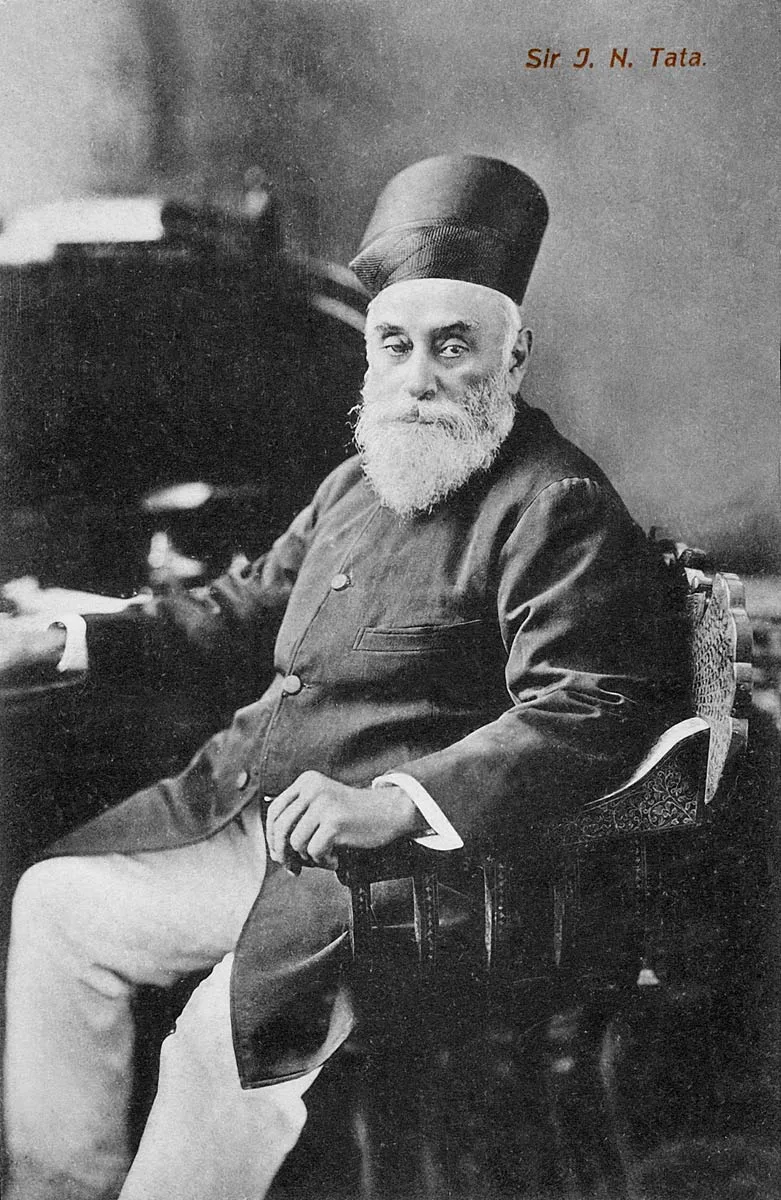
1839–1904
Jamsetji Tata
Industrialist, Tata founder and educational benefactorJamsetji Tata was an Indian industrialist who moved from international trading into textile manufacturing and developed projects in steel, electricity and scientific education. Several of his best-known ambitions became operating institutions after his death, through the work of his successors and many other participants.Read biography
1937–2024
Ratan Tata
Tata chairman, industrialist and philanthropic trusteeRatan Naval Tata was an Indian business leader who reshaped the Tata group through consolidation, overseas acquisitions and new products. His career also encompassed setbacks, a disputed succession and long service as a philanthropic trustee.Read biographyQuick answers
Common questions
- Did Dorabji obtain his degree at Cambridge?
- He studied there, then returned to India and completed his B.A. at St Xavier’s College in 1882.
- Was the 1924 pledge the same as the 1907 share issue?
- No. The initial subscription raised ownership capital; the later pledge supported borrowing during a crisis.
Primary and institutional sources
How this history was checked
Primary records, institutional catalogues and historical interpretation answer different questions. The comparison and worked example are original editorial analysis. This article was reviewed on 8 November 2026.