
The short answer
How were an ancestral temple’s family origins and wider clan functions related?
Read the records together
Contributions,evidence and scope
Different records illuminate different parts of this particular undertaking.
| Record | What the record establishes | What remains distinct |
|---|---|---|
| Museum biography | Identifies family business and temple support. | Surname alone does not prove immediate kinship. |
| Heritage trail | Describes institutional uses across time. | Later school activity is not a founder’s personal act. |
| Preservation record | Dates modernmonumentrecognition 1974. | Recognition date is not construction date. |
A household and a surname clan are different scales
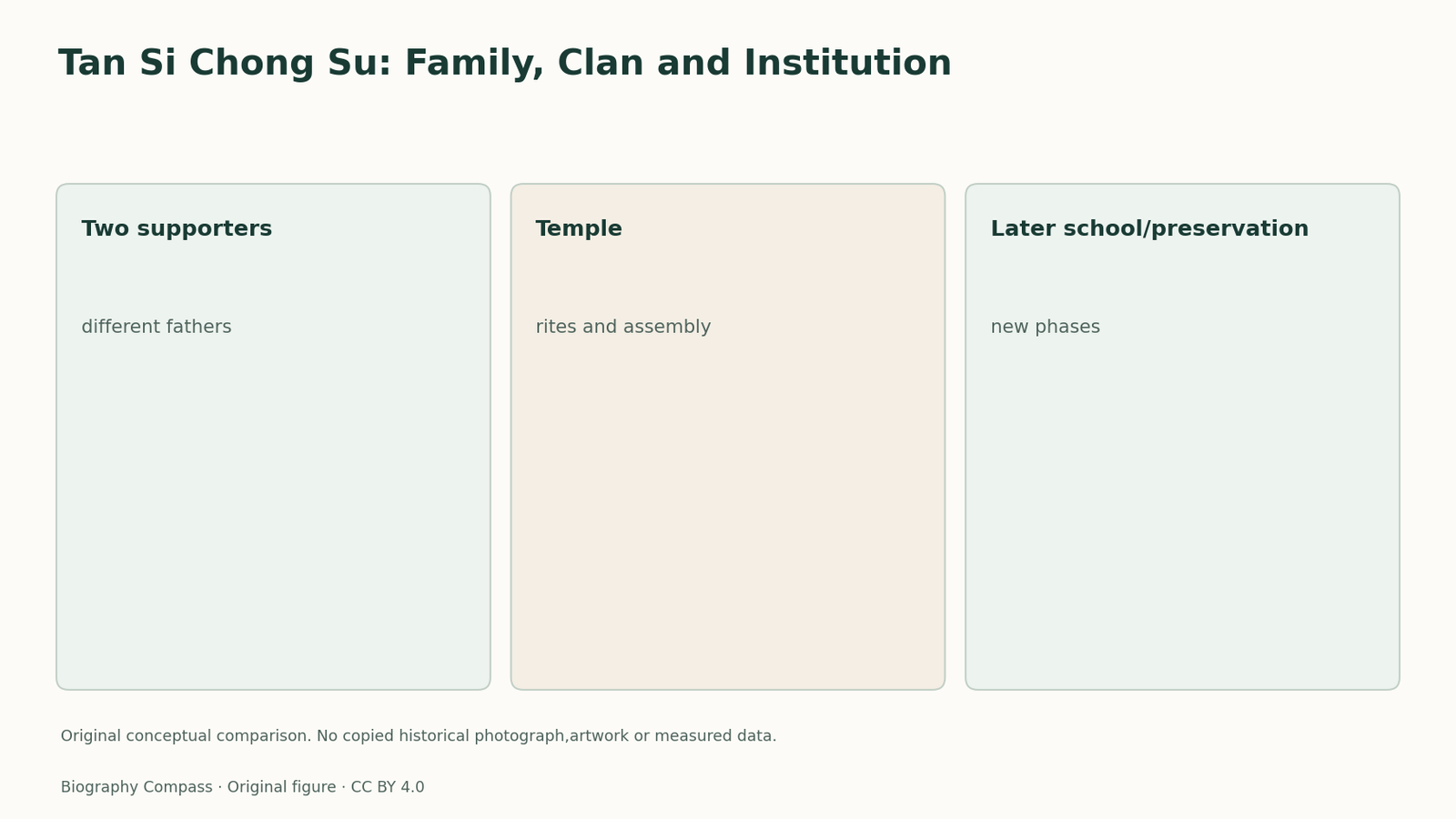
Tan Si Chong Su was supported by Tan Beng Swee and Tan Kim Ching. Their fathers were different prominent merchants, Tan Kim Seng and Tan Tock Seng, respectively. The shared Tan surname connects the temple’s ancestral and clan identity, but it does not by itself prove that the two supporters were brothers or members of one immediate household. Starting with this distinction makes the collaboration more accurate. It also prevents similar-looking names from being merged into one biography or a supposed single family enterprise that the inspected records do not establish.
The building supported more than one function
Heritage descriptions identify an ancestral temple and assembly hall. The river-walk account also records a boys’ school in the left wing from 1889 to 1949. These uses show how a community building could support ritual, organisation and education across time. The school period began after Tan Beng Swee’s death, so it should not be described as a classroom he personally managed. The physical continuity of a building and the continuity of one person’s work are different things. A later use can extend an institution’s public role without becoming an event in the founder’s own lifetime.
Preservation is another layer of the history
URA dates preservation of Tan Si Chong Su to 19 November 1974. That official recognition belongs to the modern management of a surviving building, not to its original construction. It also need not resolve every disagreement among later summaries about early dates. The strongest account identifies what each record establishes: the museum’s biographical and community context, the heritage trail’s functions, and the preservation record’s legal milestone. The separate birth-year conflict is made visible in the source note. This allows the useful story of community collaboration to proceed without creating a falsely exact chronology from inconsistent captions.
Build a people-and-functions map
Draw one box for each supporter and write the correct father beneath each. Connect both supporters to the temple, then add separate branches for ancestral rites, assembly and the later school. Finally, place 1974 preservation on a later timeline row. The checked answer to “does a shared surname prove an immediate-family partnership?” is no. The answer to “did a later school opening occur during every founder’s lifetime?” is also no. This original exercise distinguishes personal biography, clan organisation, building use and modern heritage status. It introduces no invented genealogy or original construction year, and gives readers a practical way to organise the records without merging unlike kinds of relationship.
Continue the chronology
Related history guides
Singapore Medical School 1905: Petition and Funding
Follow the petition, subscriptions and public support behind Singapore’s 1905 medical school, distinguishing founding gifts from recurring operating funds.
Read the timeline1853–1901Cornwall Park 1901: Gift, Trust and Public Use
Trace Cornwall Park’s 1901 gift and endowment, explaining how privately held trust land could support public enjoyment alongside a separately governed domain.
Read the timelineBiography context
Explore Singapore through connected lives
Connected biographies
People behind this work
1828–1884
Tan Beng Swee
Merchant and community institution supporterTan Beng Swee is remembered for continuing Kim Seng & Company and supporting Tan clan institutions in Singapore and Melaka.Read biography1805–1883
Seah Eu Chin
Merchant and Teochew community organiserSeah Eu Chin combined a successful gambier-trading career with Teochew community organisation, helping establish the institution that became Ngee Ann Kongsi.Read biography
1869–1957
Lim Boon Keng
Straits Chinese physician, entrepreneur and educational reformerLim Boon Keng combined medical practice with rubber, banking, publishing and educational work, while navigating the competing political loyalties of a Straits Chinese public figure.Read biographyQuick answers
Common questions
- Were Tan Beng Swee and Tan Kim Ching brothers?
- The inspected records identify different fathers. Shared surname and clan support do not establish an immediate household relationship.
Primary and institutional sources
How this history was checked
The cited records distinguish contemporary accounts,official catalogues and later institutional or scholarly interpretation. The comparison and worked exercise are original editorial material. This article was reviewed on 7 November 2026.
- Peranakan Museum, National Heritage BoardGreat Peranakans: Gallery Guide
- National Heritage BoardSingapore River Walk (2018)
- National Heritage BoardTiong Bahru Heritage Trail
- Urban Redevelopment AuthorityTan Si Chong Su: Monument Record
- National Heritage Board / National Archives of SingaporeMonumental Singapore Heritage Walks (2012)