
The short answer
What changes when an expected family role becomes an independent life?
Read the evidence
Sources, interpretation and production roles
The records answer different questions about this work. The final exercise is an original teaching model.
| Record or question | Supported reading | Boundary or contrast |
|---|---|---|
| Spoken welcome | Presents an affectionate family arrangement. | Speech does not expose every private calculation. |
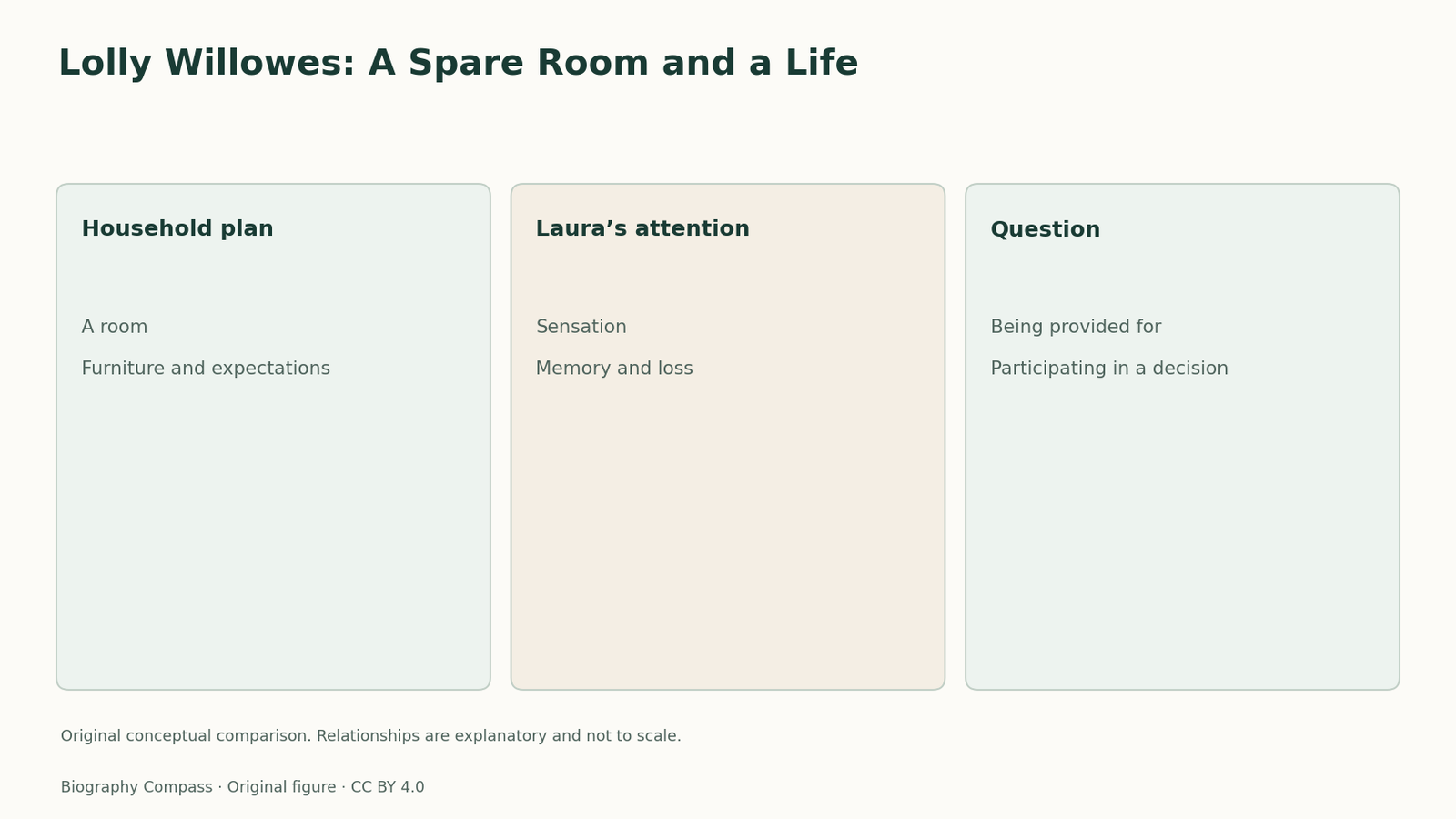
| Different attention | Caroline plans while Laura senses and remembers. | Competence in household management is not the only experience present. |
| Original participation task | Changes who helps decide without enlarging the room. | Goodwill and agency are separate questions. |
A family arrangement begins the novel
Lolly Willowes was first published in 1926. The selected 2020 Penguin sample opens after Laura’s father has died, when her brother’s household prepares to take her in. The discussion initially appears affectionate and practical. A place to live, furniture and family expectations are being arranged. This gives a precise question for the opening: when does providing for a person also become a way of deciding the shape of that person’s life? The passage lets the reader examine the process rather than accept a general statement about oppressive families.
Sources for this section: [3]
Caroline’s practical thoughts extend beyond her words
Caroline speaks warmly while mentally reorganising rooms, furniture and claims to a bureau. The telling gives the reader access to calculations that Laura is not hearing. In this guide’s reading, care and convenience share the same process. The room has a material size and place within a household, but those practical decisions also assign Laura an expected social position. No single action must be cruel for the arrangement to narrow her options. The passage makes that ambiguity available through the distance between spoken welcome and unspoken planning.
Sources for this section: [3]
Laura’s attention follows another path
While the family’s plans accumulate, Laura crushes a flower against her wrist and remembers an earlier reflection. Her attention is not simply a weaker version of Caroline’s competent household management. In this reading, the contrast makes two different experiences of the same moment visible. One person organises an arrival; the other encounters sensation and memory during a loss. The novel’s wider movement toward independence can therefore be approached through a specific opening difference, without turning the first pages into a complete summary of every later development.
Original exercise: provision and participation
Invent a family offering a relative a spare room after a difficult change. Write three kind spoken assurances, then three private practical decisions about the room. Finally, give the arriving person a separate question or remembered object that matters to them. A reference answer explains how goodwill can coexist with a failure to ask what the person wants. It should not assume that all practical planning is coercive or that an unspoken wish is automatically understood. Now revise the scene by letting the newcomer participate in one decision. Identify what changes in the distribution of knowledge and agency while the material room stays the same size. Return to Warner through the inspected bureau, room and flower passages, marking the consequence you propose as an interpretation. The exercise uses no copied dialogue or domestic arrangement. It makes a substantive narrative choice usable: by letting readers know more than one person’s attention, the opening can expose the gap between being accommodated and directing a life. The question belongs to the form of the telling as well as to its family subject.
Continue the chronology
Related history guides
Biography context
Explore United Kingdom through connected lives
Connected biographies
People and related creative practices
1893–1978
Sylvia Townsend Warner
British novelist, poet, musicologist and translatorSylvia Townsend Warner moved from music scholarship into a varied literary career while maintaining political commitments and a long partnership with Valentine Ackland.Read biography
1882–1941
Virginia Woolf
Novelist, essayist, critic and publisherVirginia Woolf was an English novelist, critic and publisher whose experiments with consciousness and time changed modern fiction and feminist literary argument.Read biography1890–1979
Jean Rhys
Dominican-born novelist and short-story writer active in BritainJean Rhys developed a distinctive fiction through Caribbean origins, European work and a late return to publication that renewed attention to her earlier books.Read biographyQuick answers
Common questions
- Does the opening present only one person’s thoughts?
- No. The selected passage contrasts Caroline’s planning with Laura’s attention.
- Is a room’s practical arrangement the same as personal choice?
- No. The guide asks how those matters can overlap while remaining distinct.
Primary and institutional sources
How this history was checked
The close comparison uses the opening pages of the publisher’s Lolly Willowes sample, not a complete novel reading. The reading exercises and comparisons are original analytical models. This article was reviewed on 8 November 2026.