
The short answer
How do different narrators alter a response to an inherited literary character?
Read the evidence
Sources, interpretation and production roles
The records answer different questions about this work. The final exercise is an original teaching model.
| Record or question | Supported reading | Boundary or contrast |
|---|---|---|
| Literary relation | The 1966 novel responds to Jane Eyre. | Response does not mean every detail is mechanically replaced. |
| Selected garden passage | Attraction and unease share an experienced setting. | A plant inventory would not explain the effect. |
| Original two-viewpoint task | Keeps objects fixed while changing experience and expectation. | Neither narrator is required to know everything. |
A response gives a familiar figure another life
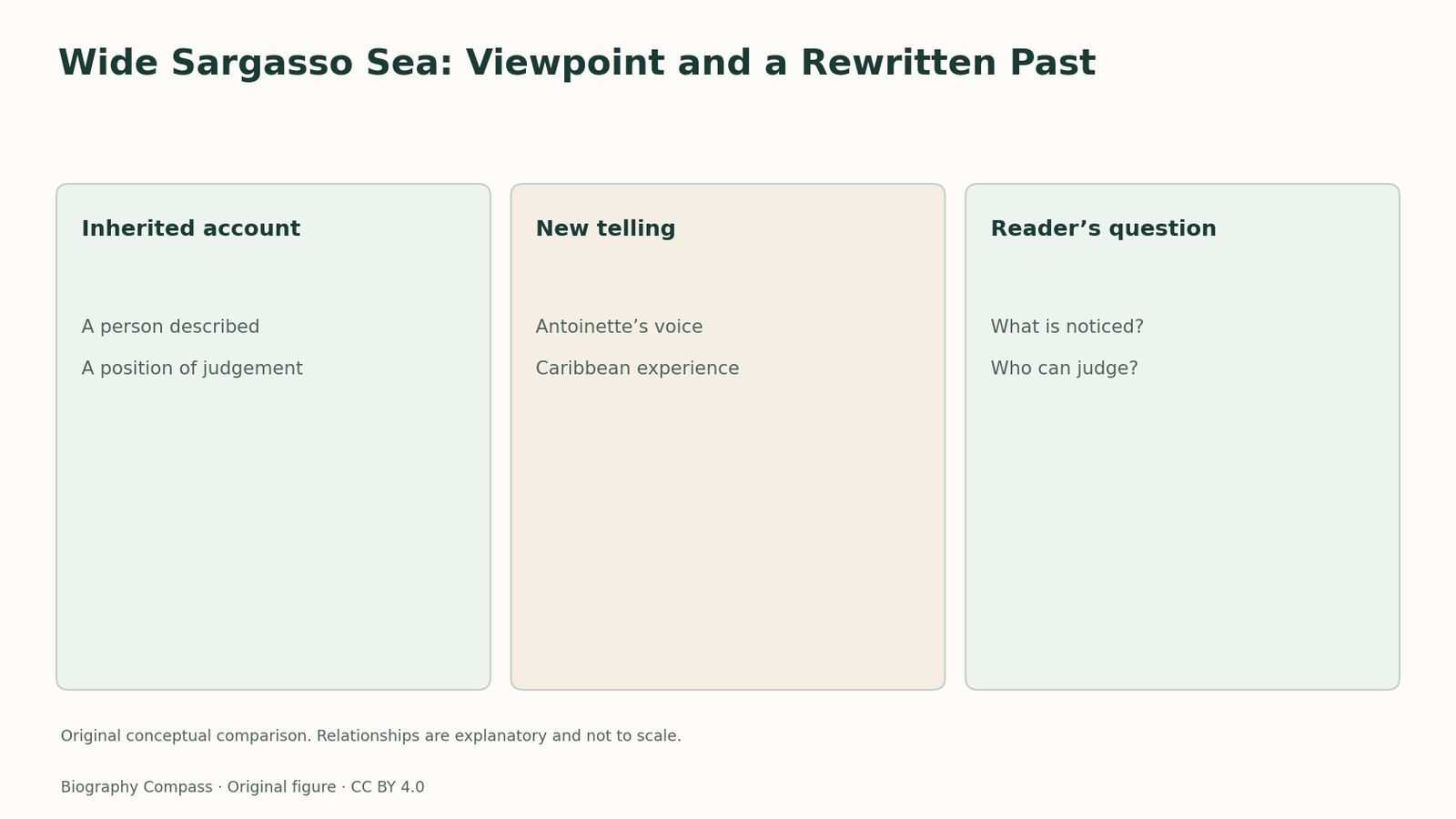
Wide Sargasso Sea was published in 1966. It responds to Jane Eyre through Antoinette Cosway, the Caribbean woman associated with Brontë’s first Mrs Rochester. Norton identifies Jamaica and Dominica as major settings. The connection makes a precise question available: what changes when a figure previously encountered through other people’s accounts receives a narrative position of her own? The answer concerns the organisation of sympathy, knowledge and judgement, rather than a claim that the later novel replaces every fact in the earlier one.
A garden is experienced rather than merely listed
The garden passage quoted in Saywell’s essay brings attractive growth together with decay, distance and reluctance to approach. Its effects do not come only from naming tropical plants. Contrasting sensations make the setting desirable and disquieting at once. In this guide’s reading, that combination prevents Caribbean place from becoming a bright backdrop to a story whose real significance lies elsewhere. Antoinette’s relation to what she encounters helps organise the account. The garden’s density makes belonging and unease matters of perception: the environment can be familiar to one consciousness while unsettling another.
Sources for this section: [3]
A different reader can encounter a different danger
Saywell describes recognising the tropical environment on an early reading and later understanding its strangeness from the English husband’s perspective. Her account is a situated critical response, not a universal rule for every reader. It demonstrates why viewpoint matters: familiarity can make a place legible in one way while distance makes similar forms threatening. In this interpretation, the novel’s response to Jane Eyre changes more than a character’s name or history. It redistributes the positions from which landscape and people can be judged, making the authority of an inherited account a subject for examination.
Sources for this section: [3]
Original exercise: one garden, two accounts
Invent a garden with a covered path, dense leaves and an unfamiliar sound. Write one short account by someone who has tended it for years, then another by a visitor who expects a different environment. Keep the visible objects unchanged. A reference answer explains that the first narrator may distinguish signs the visitor groups together as danger, while the visitor may notice something habit has obscured. Neither person must be correct about everything. Now add a later account describing one of them without allowing that person to speak. Explain what new evidence would become available if the described person narrated in turn. Return to Rhys by separating the documented literary relationship, the selected garden passage and Saywell’s account of changing response. It makes a substantive point about a rewritten past: adding a voice can change the grounds of judgement even when some events remain recognisable. A new perspective is not simply another verdict pasted onto an unchanged story.
Continue the chronology
Related history guides
Biography context
Explore Jamaica and Dominica through connected lives
Connected biographies
People and related creative practices
1890–1979
Jean Rhys
Dominican-born novelist and short-story writer active in BritainJean Rhys developed a distinctive fiction through Caribbean origins, European work and a late return to publication that renewed attention to her earlier books.Read biography
1816–1855
Charlotte Brontë
Novelist and poetCharlotte Brontë was an English novelist and poet whose forceful narrators made education, work, desire and women’s claims to respect central subjects of Victorian fiction.Read biography1893–1978
Sylvia Townsend Warner
British novelist, poet, musicologist and translatorSylvia Townsend Warner moved from music scholarship into a varied literary career while maintaining political commitments and a long partnership with Valentine Ackland.Read biographyQuick answers
Common questions
- How does the novel relate to Jane Eyre?
- Rhys gives a different narrative position to the woman whose past is largely told by others in the earlier novel.
- Does a new viewpoint make a narrator all-knowing?
- No. A situated voice can reveal information and remain limited.
Primary and institutional sources
How this history was checked
The work discussion uses the publicly quoted garden passage and Cherise Saywell’s essay, not a complete reading of the novel. The reading exercises and comparisons are original analytical models. This article was reviewed on 8 November 2026.