
The short answer
The Sydney Harbour Bridge’s two half arches met in August 1930, but that dramatic event did not mean every structural adjustment was complete. Ennis’s 1932 first-person account describes the cable release that brought the halves together and a subsequent upper-chord jacking operation. Comparing those stages answers a concrete question: how did an erection system supported by temporary cables become the completed two-hinged arch? The published account supplies the sequence; it should be read alongside the museum’s chronology rather than reduced to a single photograph of the closing gap.
A worked comparison
What each part contributes
Use the specific distinctions developed in the study.
| Part or record | What it establishes | Why the distinction matters |
|---|---|---|
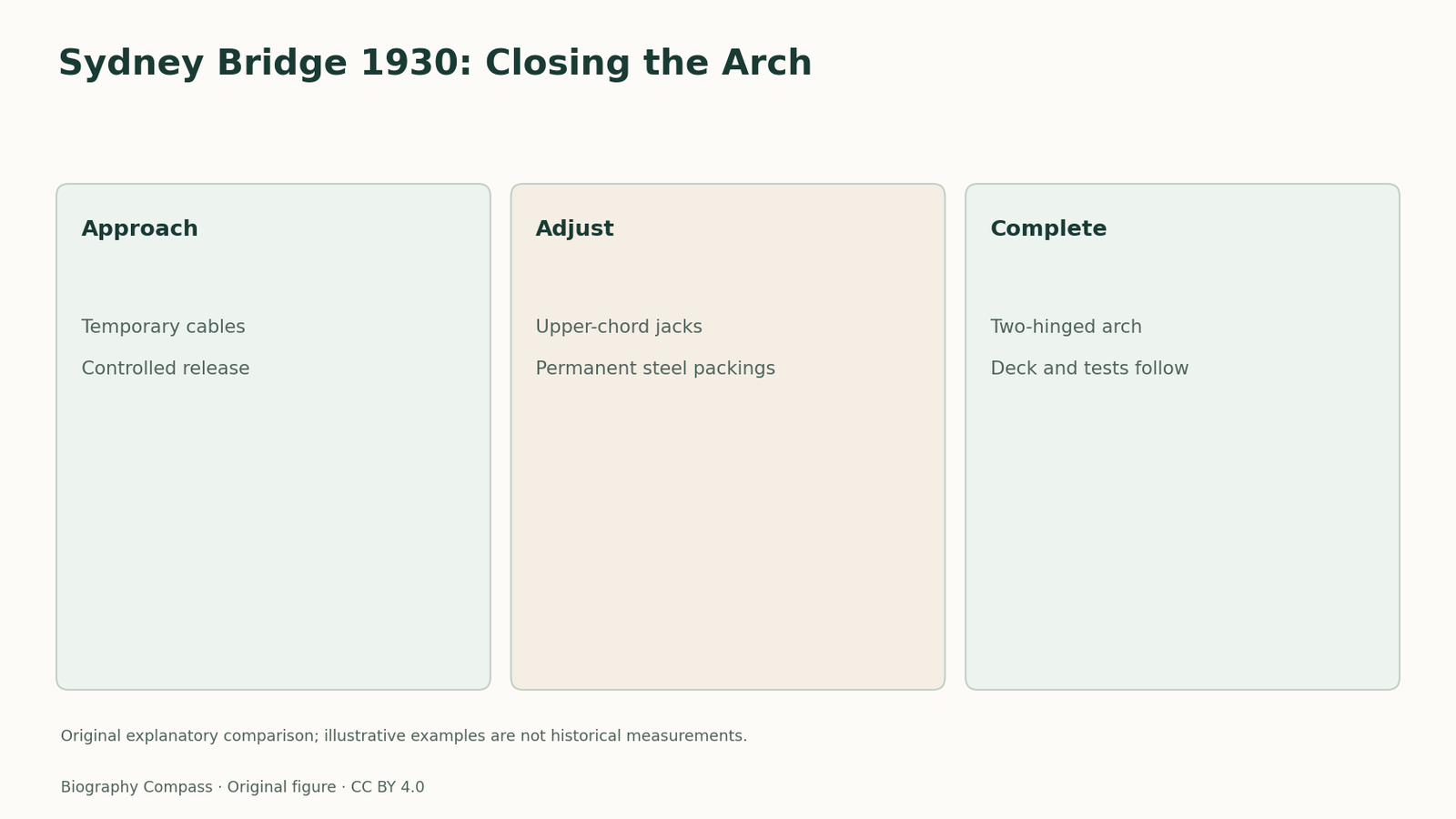
| Cable release | Half arches meet | Temporary support changes |
| Upper-chord jacking | Stress transferred | Packings preserve adjusted geometry |
| Completed arch | Two-hinged condition | Deck and testing still follow |
Meeting at the crown was not the final operation
The Sydney Harbour Bridge’s two half arches met in August 1930, but that dramatic event did not mean every structural adjustment was complete. Ennis’s 1932 first-person account describes the cable release that brought the halves together and a subsequent upper-chord jacking operation. Comparing those stages answers a concrete question: how did an erection system supported by temporary cables become the completed two-hinged arch? The published account supplies the sequence; it should be read alongside the museum’s chronology rather than reduced to a single photograph of the closing gap.
Controlled release of temporary support
Ennis described two large half arches extending from the shores with a gap at the centre. Temporary cables stabilised them during erection. Hydraulic release at the cable attachments gradually reduced the gap until the lower ends met on a central bearing arrangement. This was a change in the structure’s support conditions, not simply workers dropping a final decorative piece into place. The National Museum dates the joining to 19 August 1930. A later online transcription contains a 1931 date within the excerpt, although its following passage refers to August 1930; that inconsistency is disclosed rather than silently adopted.
The upper chord needed a further adjustment
Ennis then describes eight hydraulic jacks, each rated at one thousand tons, placed between the final upper-chord members. They forced the members apart by a predetermined amount to transfer stress, after which machined steel packings held the intended position. The arch thereby reached its completed two-hinged condition. The important mechanism is controlled deformation followed by permanent packing, not a claim that the jacks remained as the bridge’s ordinary support. Ratings identify equipment capacity; the number of jacks alone does not establish an exact load actually applied at every moment.
Sources for this section: [3]
Credit and labour in the construction record
Ennis named Hipwell, Alfred Martin, Freeman and Bradfield among those present at closure. The contractor-sponsored film’s catalogue separately identifies director of construction, government chief engineer, consulting engineer and erection superintendent. Those labels make clear why an account of the operation needs several contributors. The catalogue also describes riveting and dangerous elevated work, but this article has read the catalogue rather than claiming to have watched its complete eighty-two-minute film. The museum’s construction history adds the cost in human lives, reminding readers that engineering success came through hazardous labour.
A capacity exercise with a limit
Eight jacks rated at one thousand tons give eight thousand tons of combined nominal rated capacity by simple addition. That answer does not prove that eight thousand tons was the exact transferred stress: capacity is a limit or equipment specification, while actual load depends on operation and measurement. Ennis’s account describes a transfer between seven and eight thousand tons. This comparison gives the numbers a useful meaning without turning a historical narrative into a modern engineering calculation or assuming an equal load on every jack throughout the operation.
Sources for this section: [3]
Continue the chronology
Related history guides
Sydney Bridge 1924: Comparing Tenders
Read the original 1924 Sydney Harbour Bridge tender report through firms, options, compliance, metalwork and fabrication plans, with a comparison exercise.
Read the timeline1880s–1890Forth Bridge: Hydraulic Tools and Erection
Study Arrol’s Forth Bridge erection work through hydraulic tools, changing utility lines and temporary loads, with evidence from the 1890 construction account.
Read the timelineBiography context
Explore Australia through connected lives
Connected biographies
People and wider context
1871–1938
Lawrence Ennis
construction engineer and industrial managerLawrence Ennis was a construction engineer and industrial manager, known for Directing Dorman Long’s Sydney Harbour Bridge construction.Read biographyQuick answers
Common questions
- Did eight 1000-ton jacks prove an exact 8000-ton load was transferred?
- No.8000 tons is their combined nominal rated capacity. Ennis described an actual transfer between 7000 and 8000 tons; capacity and measured load are different.
Primary and institutional sources
How this history was checked
Read the cited original records, institutional accounts and later interpretations. The comparison and exercise explain the specific evidence used in this study. This article was reviewed on 8 November 2026.