
The short answer
How can a reader audit the calculations in A Modest Proposal without treating a correct result as support for the speaker’s scheme?
Compare the evidence
Keep the speaker, operation and record distinct
Identify what each part of the evidence establishes before extending the claim.
| Record or operation | What it supplies | What follows |
|---|---|---|
| Appointment record | A historical office and named author | Does not make a fictional speaker’s family claims biographical facts. |
| Transaction margin | Price minus an earlier cost | Reconstructs £40,000 using supplied inputs and conversion. |
| Maintenance amount | A separately described annual cost | Gives £50,000; it is not automatically additive with the margin. |
Chronology
A timeline of the turning points
Historical office
The cathedral catalogue dates the deanery patent to 6 May.
Satirical pamphlet
The original text gives the proposer’s figures.
Two operations
Keep the different quantities separate before interpreting the argument.
A historical author is not every first-person speaker
The cathedral collection identifies Jonathan Swift through a real appointment document: Queen Anne’s patent for the deanery in 1713. The 1729 pamphlet presents a different kind of evidence. It constructs a speaker who insists on his public spirit and practical expertise. Put these records beside one another without merging their voices. An institutional appointment helps establish a historical working role; a fictional first-person claim inside satire is not automatically a biographical statement about that officeholder.
The calculation sits inside a deliberately shocking argument
The proposer treats poor children as marketable food and presents the scheme as an economic improvement. The non-graphic summary is enough to identify the moral premise. His apparent precision makes people look like units of production, while the costs of human suffering disappear from the calculation. This is why checking the sums is useful but insufficient. The reader needs to distinguish internal arithmetic, the truth of inputs, the completeness of an economic model and the ethical acceptability of what the speaker proposes.
Sources for this section: [1]
First reconstruct the speaker’s transaction margin
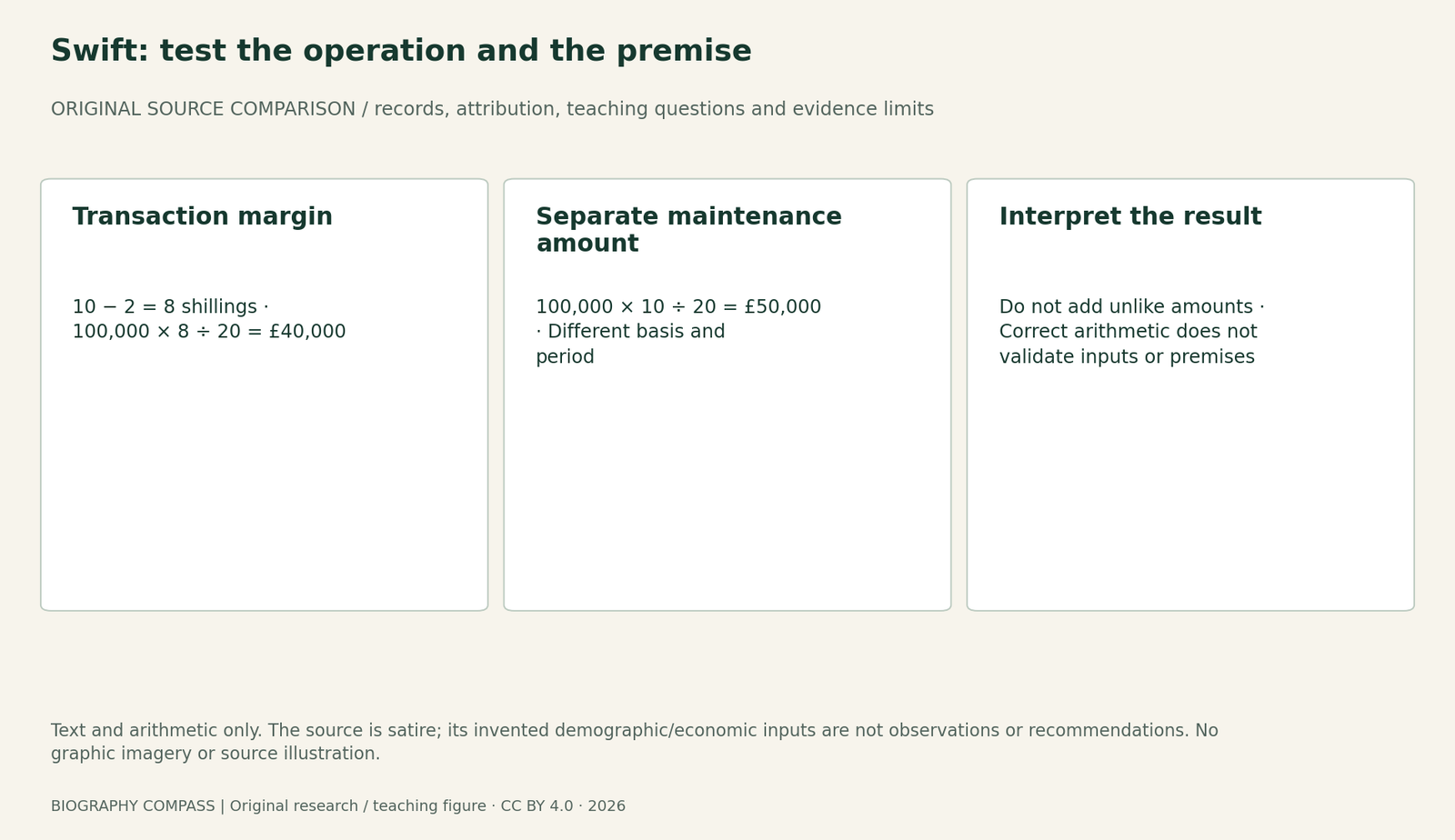
The text supplies a price of ten shillings, an earlier cost of two shillings and a claimed margin of eight shillings. For the exercise, use twenty shillings to one pound. Applied to the speaker’s stipulated hundred thousand transactions, eight shillings each becomes eight hundred thousand shillings, or £40,000. This is our reconstruction of that specified margin. The input quantities are the narrator’s claims, not measured demographic, market or welfare data, and the calculation does not make them true.
Sources for this section: [1]
A separate figure uses a separate basis
The pamphlet’s £50,000 national-stock claim comes from another operation: hundred thousand children, beyond the first year, at ten shillings of annual maintenance each. That is one million shillings, converted to £50,000. The two results need not be an arithmetic contradiction, because they concern differently described quantities and periods. Nor can they simply be added into a verified £90,000 national gain. Transfers between people, changing time horizons and omitted costs would matter to any real accounting model. Here they also expose how readily a confident speaker moves between attractive totals.
Sources for this section: [1]
Exercise: assess an invented reading note
A student writes: “I recalculated both sums and they work, so Swift proved a £90,000 gain and recommended the policy himself.” Correct the note in three steps. Show the two calculations with units, name the basis of each, and explain what the arithmetic cannot establish. Then identify a feature of the text that makes its speaker’s confidence suspect. Use the proposer’s dismissal of other remedies or his closing insistence on disinterest; do not treat that closing family claim as an independently verified fact about Swift’s household.
Sources for this section: [1]
Worked answer: arithmetic is one test, not the verdict
The reconstructed transaction margin is 100,000 × (10 − 2) ÷ 20 = £40,000. The separately described annual maintenance amount is 100,000 × 10 ÷ 20 = £50,000. Correct arithmetic does not justify adding unlike amounts, verify their inputs or remove the scheme’s dehumanising premise. The text’s confident assurances and rejection of other remedies are part of an invented speaker’s performance. A stronger note would say that Swift uses the appearance of economic exactness to make the reader examine an intolerable argument, rather than that he established or endorsed a workable policy.
Sources for this section: [1]
Continue the chronology
Related history guides
Castle Rackrent: Who Speaks in the Preface and Glossary?
Distinguish Edgeworth, Thady Quirk and the editorial frame in selected Castle Rackrent passages, then test what the glossary adds to a reader’s judgement.
Read the timeline1808–1821Irish Melodies: Words, Arrangements and Different Imprints
Read actual Irish Melodies title pages alongside library records to separate words, arrangements, old airs, imprints and changing credits across numbers.
Read the timelineBiography context
Explore Ireland through connected lives
Connected biographies
Writers behind the records

1667–1745
Jonathan Swift
Satirist and Church of Ireland clergymanJonathan Swift combined clerical office with literary and political writing. His career moved between Dublin and England, while his satires challenged the language through which powerful people justified their decisions.Read biographyQuick answers
Common questions
- Is the guide recommending the scheme?
- No. It examines how satire exposes the limits of numerical certainty and a dehumanising premise.
- Does finding two correct sums prove the argument?
- No. Arithmetic does not verify inputs, establish a complete model or make a premise ethically acceptable.
Primary and institutional sources
How this history was checked
Read the selected original material alongside its institutional context, keeping authorial roles, dates and the limits of the comparison visible. This article was reviewed on 29 October 2026.