
The short answer
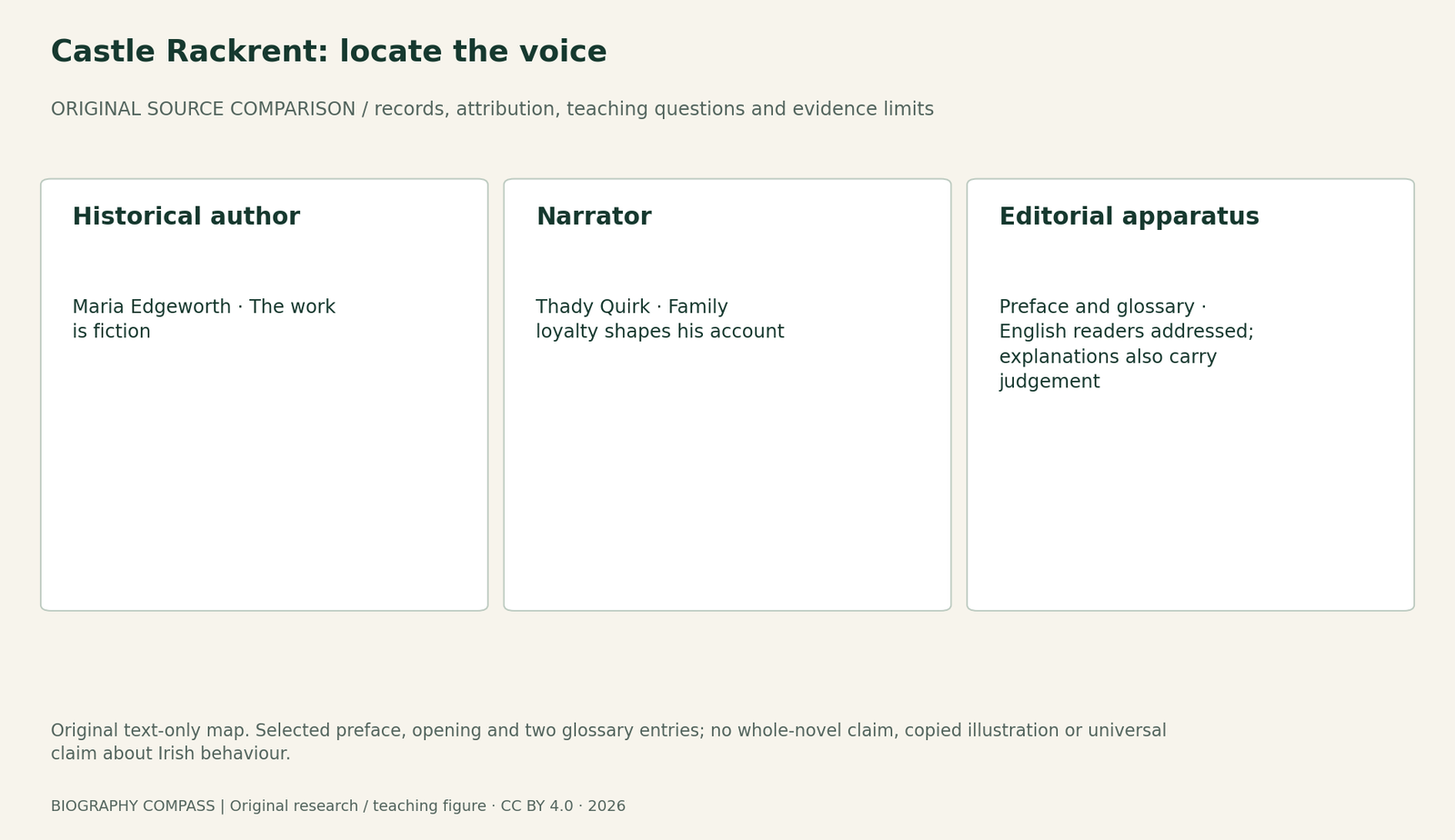
How do the author’s preface and glossary change the way a reader should hear Thady Quirk’s first-person account?
Compare the evidence
Keep the speaker, operation and record distinct
Identify what each part of the evidence establishes before extending the claim.
| Record or operation | What it supplies | What follows |
|---|---|---|
| Historical biography | Edgeworth’s life and authorship | Does not turn fictional voices into personal testimony. |
| Thady’s opening | Self-presentation and family loyalty | Gives a situated narrator whose partiality matters. |
| Preface and glossary | An editorial frame for English readers | Explanations can carry judgements as well as information. |
Chronology
A timeline of the turning points
Author’s preface
The original preface frames the narrative and is dated 1800.
Edition transcribed
The inspected title page names London and New York and a later introduction.
Apparatus and opening
The exercise uses these passages, not a claimed whole-novel reading.
Separate the writer from the voices she constructs
Maria Edgeworth was a historical author whose life joined an English birth and an Irish working home. Castle Rackrent constructs other identities on the page. Its preface introduces an old steward’s narrative and an editor, while the opening identifies Thady Quirk as the first-person speaker. A reader can acknowledge Edgeworth’s authorship without assigning every statement directly to her as personal testimony. The task is to identify which textual voice makes a claim and what that voice asks the reader to believe.
The preface makes partiality part of its invitation
The author’s preface argues for the interest of anecdotes, private conversations and apparently unpolished accounts. Yet it also explicitly identifies the steward’s attachment to the family whose history he tells. The invitation to trust a plain narrative therefore arrives with evidence of partiality. Rather than choosing between “everything true” and “everything false”, ask what a loyal servant notices, excuses or values. The selected opening reinforces that relationship: Thady presents himself through the family’s names for him and through his long connection with its estate.
Sources for this section: [1]
The editor addresses a particular imagined reader
The preface says that explanations are supplied for English readers unfamiliar with Ireland. It considers changing Thady’s idiom into plainer English but retains his characteristic manner. That choice gives language two functions: it carries the story and marks differences between the narrator’s world and the readership being addressed. The editor mediates those differences, but mediation is not neutrality. A voice that explains another speaker can also frame how that speaker and community will be judged.
Sources for this section: [1]
The glossary does more than translate vocabulary
The opening glossary entry explains the narrative’s Monday-morning dating by generalising about the postponement of work. Its next entry treats an idiomatic phrase through grammatical and etymological discussion. These are different explanatory actions, not merely a list of one-to-one translations. The first imports a social judgement; the second displays learned authority. Neither should be copied into an account of Irish life as an independently measured finding. The apparatus itself belongs among the voices a critical reader evaluates.
Sources for this section: [1]
Exercise: annotate a flawed catalogue description
An invented note says: “Maria Edgeworth’s personal memoir records that all Irish workers delay tasks until Monday. Thady’s words and the glossary are a neutral transcript of her experience.” Replace it with a short reading annotation. Identify the historical author, the narrative speaker and the explanatory editor; name the readership the preface imagines; then state one reason to question a glossary claim. Base the annotation only on the inspected preface, opening and first two entries. Do not invent later plot events or claim that the complete novel has been read.
Sources for this section: [1]
Worked answer: retain the layers instead of flattening them
Castle Rackrent is Edgeworth’s fiction, narrated by the steward Thady Quirk and framed by an editorial voice. The preface addresses English readers and makes both the narrator’s loyalty and the problem of interpreting idiom explicit. The glossary’s Monday entry adds a generalisation that requires critical examination rather than automatic acceptance. This annotation preserves the particular voices and their relations. It does not convert a literary construction into Edgeworth’s diary or an empirical survey. Reading the apparatus closely changes how the narrative can be heard, even before the reader proceeds through the rest of the book.
Sources for this section: [1]
Continue the chronology
Related history guides
A Modest Proposal: Correct Arithmetic, Unacceptable Premises
Audit the figures in A Modest Proposal while distinguishing its satirical speaker, different calculations and the moral assumptions no sum can validate.
Read the timeline1808–1821Irish Melodies: Words, Arrangements and Different Imprints
Read actual Irish Melodies title pages alongside library records to separate words, arrangements, old airs, imprints and changing credits across numbers.
Read the timelineBiography context
Explore Ireland through connected lives
Connected biographies
Writers behind the records
1768–1849
Maria Edgeworth
Novelist, essayist and writer on educationMaria Edgeworth was born in England and developed much of her writing life at Edgeworthstown in Ireland. Her work joined educational experiment, family collaboration and fiction addressed to readers across national boundaries.Read biographyQuick answers
Common questions
- Is Thady Quirk the historical author?
- No. He is the narrator constructed within Edgeworth’s fiction.
- Does the glossary automatically settle the meaning?
- It offers explanations, but its generalisations and displays of authority also deserve interpretation.
Primary and institutional sources
How this history was checked
Read the selected original material alongside its institutional context, keeping authorial roles, dates and the limits of the comparison visible. This article was reviewed on 29 October 2026.