
The short answer
A quiet scene can contain a great deal of designed sound. Withholding an emotional score shifts attention toward voices, movement and surroundings; it does not remove the need to decide what an audience can hear.
Compare creative decisions
A choice needs a dramatic job
Use the distinctions to explain a decision rather than attach a label after making it.
| Decision | Useful question | Possible failure |
|---|---|---|
| Sound source | Where does the sound seem to come from? | Calling every offscreen sound a score. |
| Audibility | Which information becomes clear, and when? | Confusing purposeful uncertainty with a missing event. |
| Score | What emotional instruction is added or withheld? | Assuming absence of score means absence of design. |
Chronology
A timeline of the turning points
Festival conversation
The filmmaker discusses the sound approach.
Interview page
The written conversation is republished.
A restriction becomes a creative choice
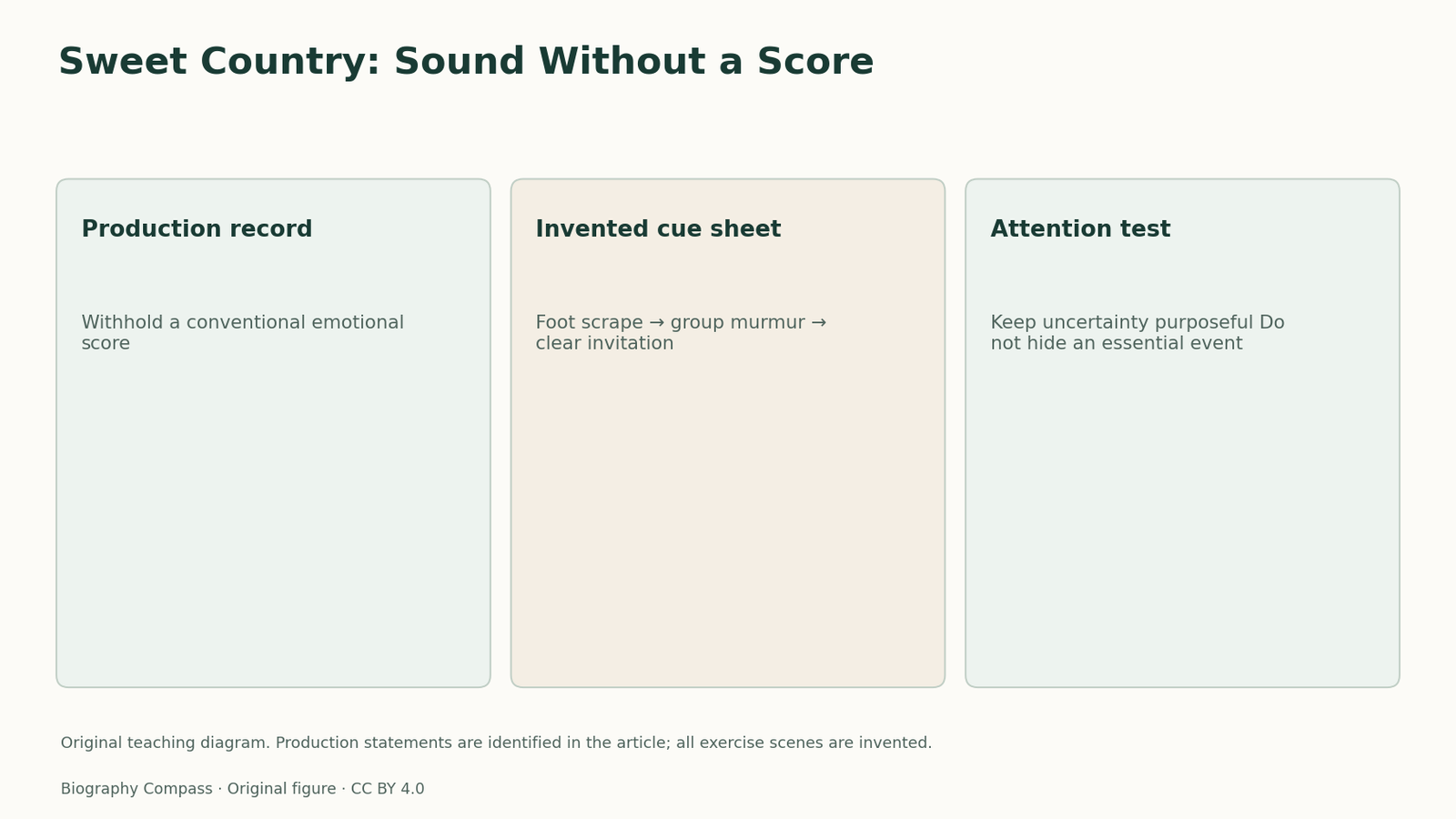
In his Sweet Country interview, Thornton describes rejecting a conventional musical cue that tells the audience how to feel. He also discusses an opening transition from indistinct courtroom murmuring to a clearly heard question.
The BFI’s critical account similarly links the western’s effect to its lack of a soaring score. This is a critic’s reading alongside the filmmaker’s explanation, not a claim that the entire soundtrack contains no music or no sound.
Separate the layers
For this exercise, distinguish sound presented as coming from the scene’s world—such as a door, footsteps or a speaking person—from a score added for the audience. An offscreen sound may still belong to that world. The distinction concerns the sound’s proposed source, not whether the filmmaker recorded it on location or constructed it later.
You can withhold clear words while giving a space an audible social presence. But ambiguity needs a purpose: hiding a crucial instruction from the listener is different from gradually bringing a character into focus.
Original exercise: a listener at a doorway
Invent a scene in which a visitor waits outside a meeting room before being invited in. Use three layers: a nearby physical action, an offscreen group, and one clear spoken cue. Do not add score. Decide which layer first attracts attention, what remains uncertain and what changes when the cue becomes clear.
Write a short cue sheet, naming the sound and its apparent source. Then specify one alternative version that would accidentally reveal too much or obscure an essential event. No audio from Sweet Country is supplied.
Reference answer: guide attention without explaining emotion
A nearby foot scrapes the floor; the group inside remains an indistinct murmur; a chair moves, then one person clearly calls the visitor’s name. The cue changes the visitor’s status from waiting to being addressed. It need not tell us whether the meeting will be friendly.
If the group’s words reveal the whole decision immediately, the intended uncertainty disappears. If the invitation remains inaudible and the visitor suddenly enters, the scene may withhold an action the viewer needs. You could choose either version for a different purpose, but should explain that purpose. Removing score is a constraint on the design, not an automatic guarantee of realism or subtlety.
Continue the chronology
Related history guides
Biography context
Explore Australia through connected lives
Connected biographies
The filmmaker’s wider career
Born 1970
Warwick Thornton
Director and cinematographerHis work connects personal experience and genre.Read biographyQuick answers
Common questions
- Does a scene without score have to be silent?
- No. The original task uses physical, offscreen and spoken sounds while withholding an added score.
Primary and institutional sources
How this history was checked
The filmmaker’s written interview is read beside an independent critical account. Neither replaces listening to the complete film; the cue sheet below is newly invented. This article was reviewed on 31 October 2026.