
The short answer
An action can be carefully choreographed and still become confusing when photographed or edited. A useful plan gives the audience an intention, enough spatial information to follow it and a visible consequence.
Compare creative decisions
A choice needs a dramatic job
Use the distinctions to explain a decision rather than attach a label after making it.
| Decision | Useful question | Possible failure |
|---|---|---|
| Physical plan | What does each performer try to do? | Movement without a clear objective. |
| Coverage | Which view supplies each necessary relation? | Several angles repeating the same information. |
| Consequence | Can the viewer see the action’s result? | A result explained only after it has happened. |
Chronology
A timeline of the turning points
Camera-team account
A production article describes the visual approach.
Director interview
Caro describes the stunt-to-camera process.
Action before camera coverage
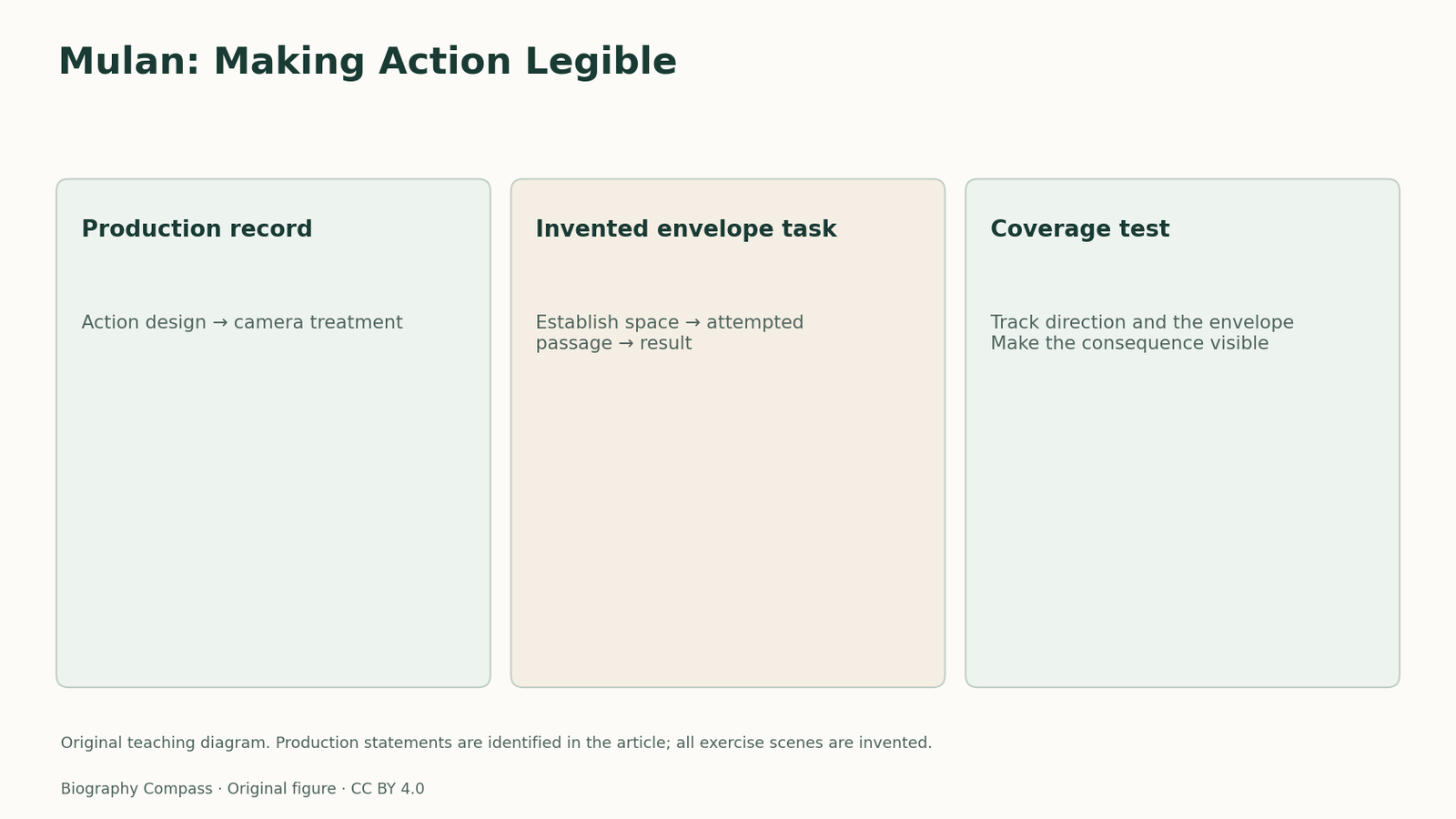
Caro’s Backstage interview describes refining Mulan’s action with stunt coordinator Ben Cooke, then working with cinematographer Mandy Walker on how to shoot it. The process linked a physical plan with a separate camera interpretation.
That sequence helps distinguish two jobs. Choreography organises the performers’ actions; coverage decides what the audience can see of those actions. Neither is automatically a substitute for the other.
Sources for this section: [1]
Precision and flexible coverage
American Cinematographer reports that the team favoured precise, dance-like action rather than a melee of clashing weapons. Walker also describes changing a camera’s assignment on a later take after another camera had already secured the needed material.
A second camera therefore need not simply duplicate the first. It can supply a relationship or reaction that the edit needs. This is not an argument that more angles always improve a sequence: material that changes screen direction without orientation may make the intended action harder to follow.
Sources for this section: [2]
Original exercise: a clear physical objective
Invented, non-combat scene: a performer must carry a sealed envelope from a table on the left to a doorway on the right. A second performer blocks the direct route. Supply three shots: one establishing the objective and space, one showing the attempted passage, and one showing the result. Assume performers walk; do not stage hazardous action.
Mark the envelope’s position and each performer’s direction in every shot. If a close view hides the doorway, explain what earlier image lets the viewer retain the geography.
Reference answer and revision
One answer begins with a wide view including the table, doorway and both performers. A medium view keeps the carrier travelling left to right while the blocker steps into that path. A final view shows the carrier handing the envelope through the doorway after the blocker moves aside. The success is visible rather than announced later.
If the middle shot reverses direction, add an orienting view or deliberately show the change instead of assuming the audience will reconstruct it. Test the plan by describing only what each frame supplies. This exercise demonstrates a coverage decision; it does not reproduce Mulan’s staging, prove a universal camera rule or claim that a written plan has been filmed.
Continue the chronology
Related history guides
Biography context
Explore New Zealand through connected lives
Connected biographies
The filmmaker’s wider career
Living
Niki Caro
Director and screenwriterHer career moves between local stories and studio productions.Read biographyQuick answers
Common questions
- Is this a reconstruction of a Mulan action scene?
- No. The envelope task is invented and non-hazardous; its assumptions are supplied so the coverage can be examined.
Primary and institutional sources
How this history was checked
Selected interviews describe the division between action design and photography. The shot plan is an original exercise, not a reconstruction of a finished sequence. This article was reviewed on 31 October 2026.