
The short answer
A planned flight, an astronaut’s role and a measured scientific outcome are different records. A short document comparison provides context for an original exercise about before-and-after numbers.
Original worked comparison
Compare the stated quantities
The numerical entries below belong to the supplied fictional example.
| Case | Observation or calculation | Interpretation and limit |
|---|---|---|
| Group F | 25→36.25; change 11.25. | Four supplied records; arbitrary response units. |
| Group G | 25→30; change 5. | A comparison label does not establish comparability. |
| Contrast | 11.25−5=6.25. | A difference of mean changes, not every participant’s effect. |
Chronology
A timeline of the turning points
Identify the document stage
Separate the plan from the completed-flight record.
Match before and after
Use all four supplied pairs in each group.
Name missing assumptions
A descriptive contrast is not automatically a causal effect.
A future-tense document and a completed flight
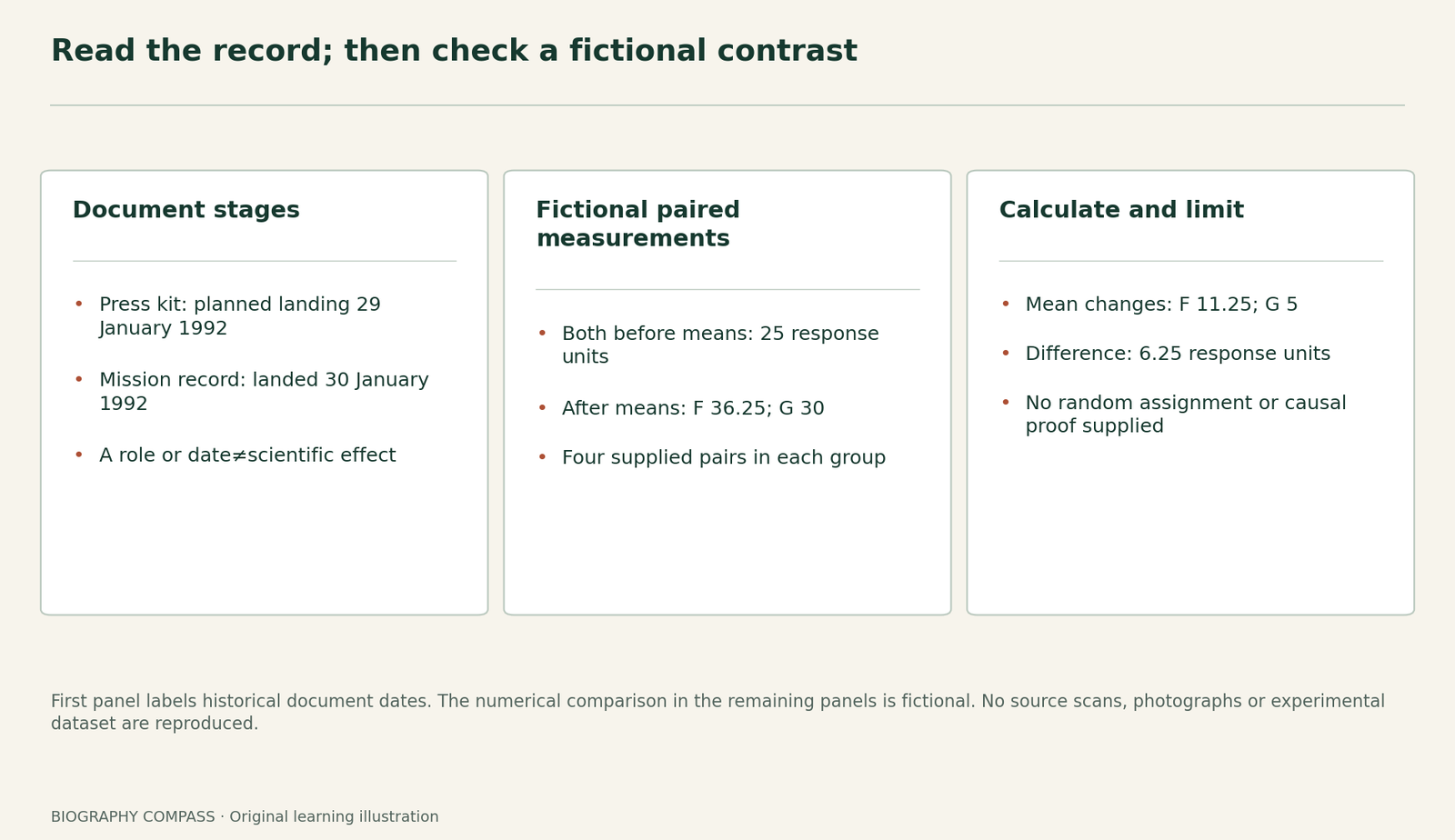
The January 1992 press kit planned a 22 January launch and a 29 January landing, and named Bondar as a payload specialist.
NASA’s mission record gives the completed flight as 22–30 January and describes an international crew working in two research teams.
The difference is not resolved by choosing whichever date fits a preferred story. Read the document stage: a schedule predicts; a mission record reports. Neither is itself a table of measured scientific effects.
Supply a fictional comparison, not astronaut data
For a separate learning exercise, invent two groups, F and G, each with four matched before-and-after sensor records in the same arbitrary response unit. Group F has before values [20,25,30,25] and after values [30,35,45,35]. Group G has the same before values and after values [24,30,36,30]. Keep the observation interval and measuring scale fixed.
These numbers are not Bondar’s measurements, mission results or clinical observations. The labels do not state that either group flew in space. Treat them simply as supplied comparison groups; no random assignment, comparable histories or unchanged background conditions have been supplied.
Calculate within a group before comparing groups
Both before means are 25. Group F’s after mean is 145/4=36.25, giving a mean increase of 11.25. Group G’s after mean is 120/4=30, giving a mean increase of 5. The difference between the two mean changes is 11.25−5=6.25 response units.
The paired changes in F are 10,10,15 and 10; in G they are 4,5,6 and 5. Their means reproduce the group calculations because all four supplied pairs are retained. The number 6.25 is a descriptive contrast in this fixture, not a percentage and not an uncertainty interval.
Sources for this section: [2]
Exercise and reference answer
An invented headline says: “The comparison proves that spaceflight caused an improvement of 6.25 units in every participant.” Correct the headline and identify at least two missing conditions before making the causal claim.
Reference answer: the difference in mean changes is 6.25 in the supplied arbitrary response unit. The data do not identify either group as astronauts, and an average contrast does not describe every person’s change. A causal interpretation would need a justified comparison design and assumptions about group comparability and background changes, together with appropriate measurement and uncertainty analysis. None is supplied here.
The useful habit is to name what a record can establish. A preflight role names an assigned responsibility; a completed-flight date establishes an event; a supplied contrast is a calculation. Scientific conclusions require the relevant investigation, not just the presence of an astronaut or a change in two numbers.
Continue the chronology
Related history guides
Biography context
Explore Canada and international research through connected lives
Connected biographies
People connected with these records

Quick answers
Common questions
- Are these actual spaceflight measurements?
- No. Both groups and every numerical value are invented for the exercise.
- Can a preflight press kit establish an actual result?
- It establishes the stated plan; later event and investigation records are needed for completed events and findings.
Primary and institutional sources
How this history was checked
Compare the selected records and their stated limits. The supplied example and reference answer are original learning material. This article was reviewed on 30 October 2026.