
The short answer
A person can improve on one measure while giving a different result on another. Read the task description before treating all outcomes as a single score called memory.
Original worked comparison
Compare the stated quantities
The numerical entries below belong to the supplied fictional example.
| Case | Observation or calculation | Interpretation and limit |
|---|---|---|
| Task errors | 12/20 to 5/20. | Improvement on the supplied performance measure. |
| Session recognition | 0/10 in each block. | No correct answers on this specified check. |
| Claimed localisation | No anatomical data supplied. | The log cannot locate a mechanism. |
Chronology
A timeline of the turning points
Name the outcomes
Performance errors and session recognition are separate.
Keep the bases
Count change, percentage-point change and relative change differ.
Match the claim
No brain-localisation or population conclusion follows.
Keep the two records in their own time
Scoville and Milner’s 1957 report distinguishes impaired recent memory from other preserved abilities. Its conclusion also notes that the hippocampal region was not removed alone, leaving the amygdala’s separate role unresolved.
The later Rockefeller account describes improvement on mirror tracing without recollection of the practice sessions.
These are related records, not identical measurements. The later task account should not be silently assigned to the earlier paper or used to claim that its surgery isolated one structure’s contribution.
Define two outcomes in an invented log
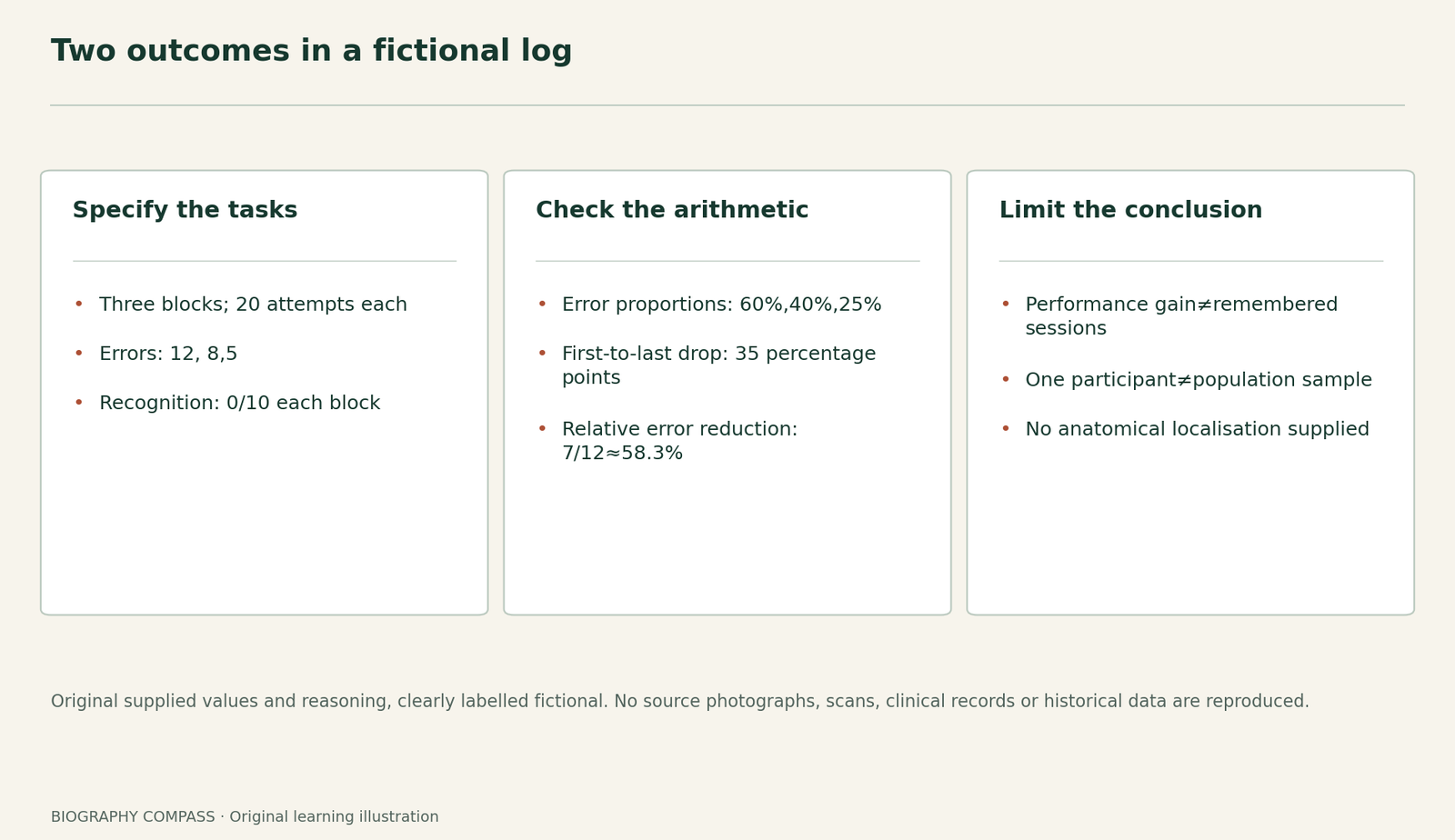
Imagine one fictional participant completing three practice blocks of 20 attempts each at fixed task difficulty. Each attempt is scored once as error or no error. The recorded error counts are 12, 8 and 5. After each block, a separate recognition check has 10 items about the practice session, with zero correct responses each time. Assume these are the supplied scores; do not identify the person with H.M. or any real patient.
An error count measures task performance under the specified protocol. The recognition check measures answers to its own questions. Neither is automatically a measure of every kind of memory. The three blocks are repeated observations of one fictional person, not three independent people.
Calculate change and keep the denominator
The task error proportions are 12/20=60%,8/20=40% and 5/20=25%. From the first to last block, the count falls by 7 errors. The error proportion falls by 35 percentage points. Relative to the first count, the reduction is 7/12, approximately 58.3%. These are compatible descriptions of the same supplied change, using different bases.
The session-recognition results remain 0/10 in each block. Adding them gives 0 correct answers across 30 supplied items, but the item total does not turn one person into a population sample or validate the questions. Do not combine the two task scales into a single percentage without an explicit scoring rule.
Sources for this section: [2]
Exercise and reference answer
An invented caption says: “Memory improved by 58.3%, proving the participant remembered all sessions and locating the change in one brain structure.” Rewrite it using the supplied evidence and identify what extra information its last two claims would require.
Reference answer: errors fell from 12 to 5 across equal 20 attempt blocks, a 58.3% relative reduction in errors; session-recognition scores were 0/10 each time. The log supports an improvement on the specified performance measure, not remembered practice. It supplies no brain measurements or intervention that isolates one structure. The caption changes both the outcome and the level of explanation without evidence.
A fuller investigation would need appropriate comparison conditions, task validity and a design suited to the proposed inference. This is a logical and arithmetic exercise, not a diagnostic test, clinical recommendation or reanalysis of a historical patient’s raw results.
Continue the chronology
Related history guides
Biography context
Explore Canada and international research through connected lives
Connected biographies
People connected with these records
Born 1918
Brenda Milner
Neuropsychologist and teacherMilner investigated human learning and memory.Read biographyQuick answers
Common questions
- Does a performance gain prove remembered practice?
- No. The two supplied checks measure different outcomes.
- Are these H.M.’s scores?
- No. All numbers and the log are invented; no historical task dataset is reproduced.
Primary and institutional sources
How this history was checked
Compare the selected records and their stated limits. The supplied example and reference answer are original learning material. This article was reviewed on 30 October 2026.