
The short answer
Stretching, amplification and compression change different properties of an optical pulse. Keeping the energy ledger separate from duration helps explain the method and exposes common errors in descriptions of it.
Read the evidence
Keep the evidence attached to its claim
The same observation can answer some questions while leaving others open.
| Record or task | What it supports | What remains open |
|---|---|---|
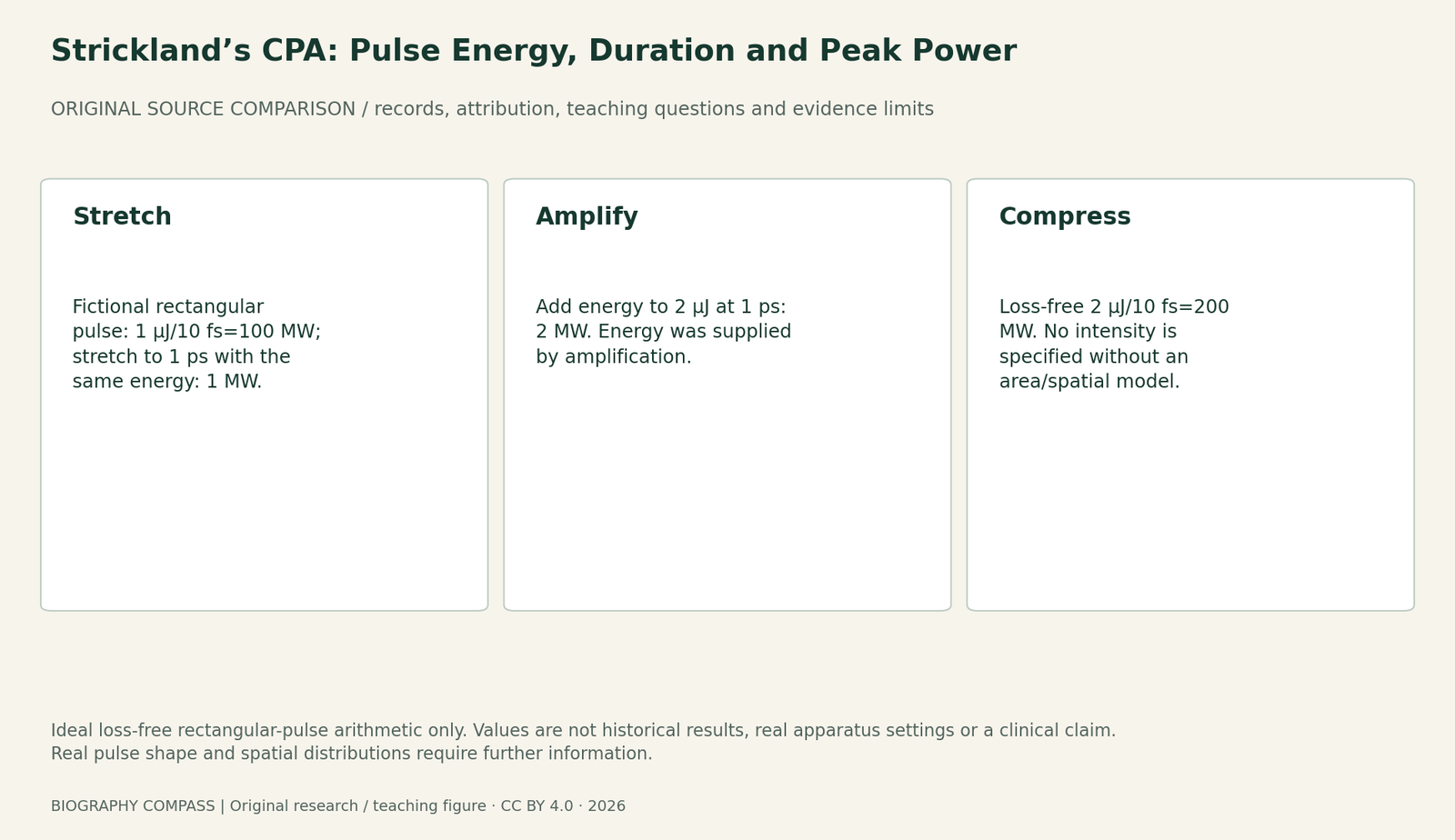
| Stretch 1 µJ,10 fs→1 ps | 100 MW→1 MW under the stated assumptions | A measured loss or actual laser configuration |
| Amplify 1→2 µJ at 1 ps | 1 MW→2 MW; added energy | Energy created by compression |
| Compress 2 µJ,1 ps→10 fs | 2 MW→200 MW with ideal loss-free compression | Intensity without a spatial model |
Chronology
A timeline of the turning points
Research and correction
The inspected December copy records the earlier figure error.
Nobel recognition
Strickland and Mourou were recognised for the method.
Forty-year retrospective
Rochester and Waterloo discussed later development.
Identify the publication version
The inspected copy is the corrected December 1985 paper by Donna Strickland and Gérard Mourou, published in Optics Communications 56,pp 219–221. Its first-page note identifies an earlier volume 55 version with an incorrectly printedFigure 1. Both records concern the same research; they are not two separate inventions.
The abstract reports millijoule-level energy and a 2 ps pulse width. That demonstrated result should stay separate from the paper’s discussion of more ambitious possible performance. Only the first page of this supplied copy was visually inspected.
Sources for this section: [1]
Three stages with different jobs
The method stretches a pulse before amplification and compresses it afterward. At a given energy, distributing the pulse over a longer time lowers its peak power. Amplification adds energy; compression can then concentrate it in time.
Rochester’s retrospective connects this approach to later high-power laser development. Later applications involve further engineering and different systems, rather than every modern result being a direct measurement from the 1985 experiment.
A worked fictional energy ledger
Assume ideal rectangular pulses, no energy loss in stretching or compression and no change in illuminated area. Start with 1 µJ over 10 fs: dividing energy by duration gives 100 MW. Stretch it to 1 ps with the same energy and the value becomes 1 MW.
Now add energy in the amplifier, reaching 2 µJ over 1 ps: the value is 2 MW. Compress to 10 fs without losing energy and it becomes 200 MW. The amplifier doubled the energy. Compression changed how quickly that energy was delivered. These assumed values are an invented arithmetic exercise, not apparatus settings or historical results.
Sources for this section: [1]
Power is not the same quantity as intensity
Question: did loss-free compression create more energy, and do the numbers determine an intensity inW/cm²?
Answer: compression preserved the assumed 2 µJ. It increased power by reducing duration. Intensity also requires the spatial distribution and area, which this example does not supply. For nonrectangular real pulses, energy divided by a quoted duration is not automatically the exact peak power; pulse shape and the definition of duration matter. The exercise isolates the bookkeeping rather than specifying a laser design.
Continue the chronology
Related history guides
Polanyi’s Infrared Chemiluminescence: Reading Product Motion
Learn how Polanyi’s infrared measurements addressed molecular motion, why observation conditions matter, and how to distinguish emission evidence from broader claims.
Read the timeline1950s–2012Brockhouse’s Triple-Axis Spectrometer: Energy and Momentum
Understand triple-axis neutron spectroscopy, energy-transfer signs and wave-vector geometry through inspected NIST records and worked fictional examples.
Read the timelineBiography context
Explore Canada and United States through connected lives
Connected biographies
Researchers and their work
1959–
Donna Strickland
Optical physicistDonna Strickland developed chirped pulse amplification as a doctoral researcher, then pursued ultrafast optics through laboratories in Canada and the United States.Read biographyQuick answers
Common questions
- Does compression itself add pulse energy?
- In the ideal loss-free example it preserves energy while changing duration.
- Why identify the corrected paper?
- Its first-page note explicitly reports an earlier Figure 1 printing error.
Primary and institutional sources
How this history was checked
Compare the inspected records with the question, calculation and stated limits below. This article was reviewed on 29 October 2026.