
The short answer
Three rotations select a scattering measurement; energy and wave-vector transfer describe the physical change.
Read the evidence
Keep the evidence attached to its claim
The same observation can answer some questions while leaving others open.
| Record or task | What it supports | What remains open |
|---|---|---|
| 20→15 meV | +5 meV transferred to the sample | Unique Q or excitation identity |
| Equal 2 Å⁻¹ vectors,60° | Q=2 Å⁻¹ with zero energy transfer | A material’s complete dynamics |
| 2012 BT-7 report | A later instrument implementation | An unchanged 1950s design |
Chronology
A timeline of the turning points
Chalk River development
Brockhouse’s group improved the spectroscopy method.
Technique account
NIST explained selection and transfer variables.
Later instrument report
BT-7 documented expanded operating modes.
What the three axes refer to
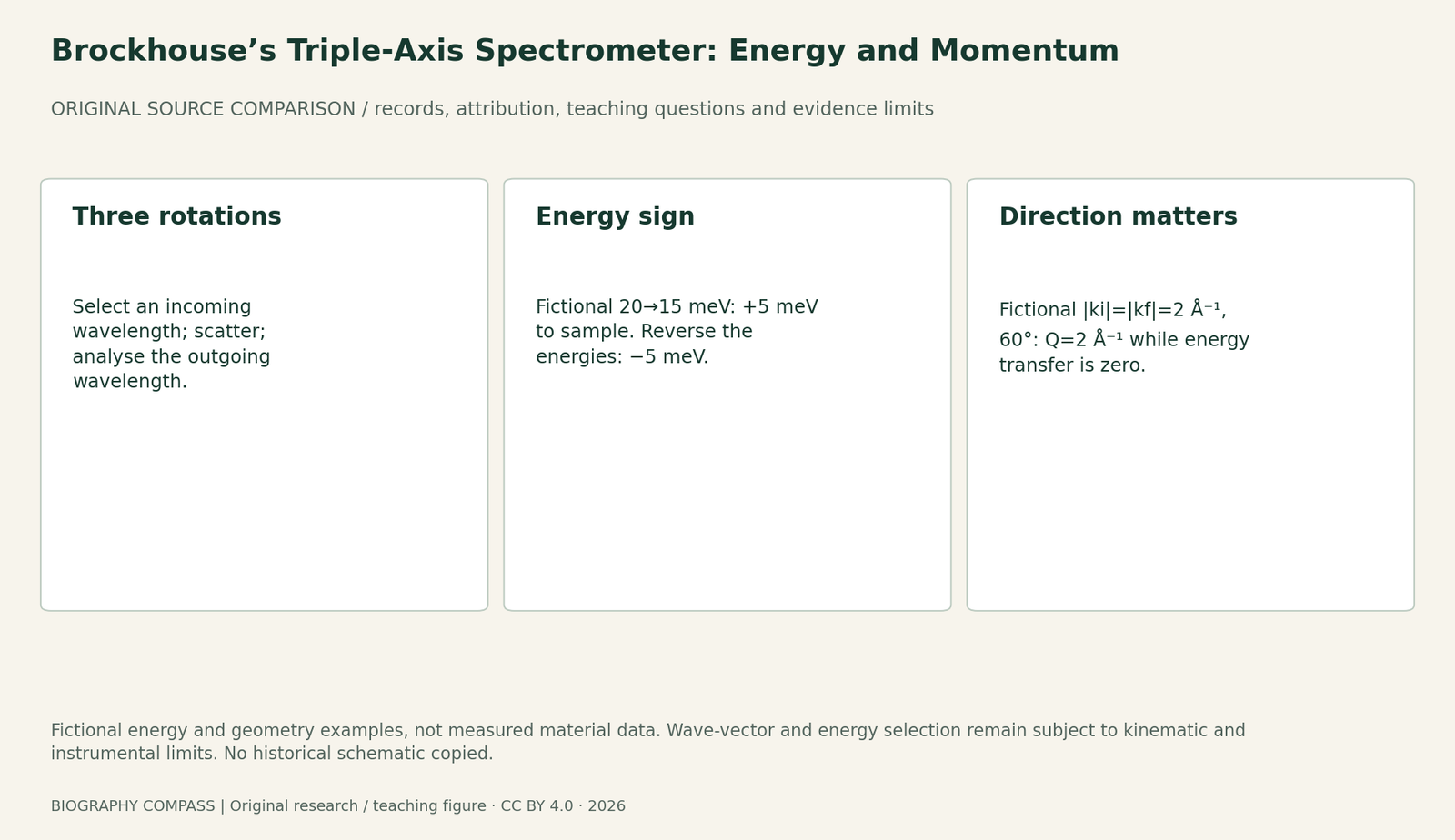
A triple-axis spectrometer selects incoming and outgoing neutron wavelengths through a monochromator, sample and analyser.
Copley’s historical account shows why the instrument developed through improvements in crystals, shielding and control. The 2012 BT-7 report is a later implementation with additional operating modes; it should not be treated as a specification of Brockhouse’s first apparatus.
Energy transfer needs a sign convention
Define transfer to the sample as incoming minus outgoing neutron energy. In a fictional case with 20 meV entering and 15 meV leaving, the transfer is +5 meV. The neutron has lost energy to the sample.
Reverse those energies and the transfer is−5 meV: the neutron has gained energy. These are invented arithmetic cases, not historical measurements. A sign does not identify a particular excitation without the material, geometry and other evidence.
Sources for this section: [1]
Wave-vector transfer also depends on direction
The record defines Q as the incoming wave vector minus the outgoing vector. Direction matters; physical momentum transfer is ℏQ.
Worked example: let both magnitudes be 2 Å⁻¹ and their angle 60°. Then Q²=2²+2²−2×2×2×cos 60°=4 Å⁻², so Q=2 Å⁻¹. Equal magnitudes mean equal neutron energies and zero energy transfer, yet the directional change still produces nonzero Q. The example demonstrates elastic scattering geometry; it is not a simulated material.
Sources for this section: [1]
What cannot be inferred from one number
Question: does the+5 meV case determine Q or a complete phonon-dispersion curve?
Answer: no. The wave vectors and angle are needed for Q; a dispersion relation requires suitable measurements across wave-vector values and a physical interpretation. Instrument resolution also matters. The NIST reports explain selection, geometry and operating limits, not a guarantee that any apparent peak identifies one excitation. A full experimental analysis includes backgrounds and uncertainties.
Continue the chronology
Related history guides
Polanyi’s Infrared Chemiluminescence: Reading Product Motion
Learn how Polanyi’s infrared measurements addressed molecular motion, why observation conditions matter, and how to distinguish emission evidence from broader claims.
Read the timeline1985–2018Strickland’s CPA: Pulse Energy, Duration and Peak Power
Learn chirped pulse amplification through Strickland and Mourou’s corrected 1985 record, a worked pulse-energy example and clear distinctions between power and intensity.
Read the timelineBiography context
Explore Canada through connected lives
Connected biographies
Researchers and their work
1918–2003
Bertram Brockhouse
Experimental physicistBertram Brockhouse developed neutron-scattering methods at Chalk River that revealed atomic and magnetic motion, then built a teaching and research programme at McMaster.Read biographyQuick answers
Common questions
- Does triple-axis mean three Cartesian directions?
- It names three rotations: monochromator, sample and analyser.
- Can energy transfer be zero while Q is nonzero?
- Yes. A direction change can preserve neutron energy.
Primary and institutional sources
How this history was checked
Compare the inspected records with the question, calculation and stated limits below. This article was reviewed on 29 October 2026.