
The short answer
A photograph and a piece of writing can share a subject while making different claims. A collaborative book asks the reader to notice that relationship rather than assume the text simply repeats what the picture shows.
Compare practice and evidence
Keep the decisions distinct
The comparison separates documented premises from the original task.
| Question | Image | Text |
|---|---|---|
| Direct observation | What the supplied view depicts. | Avoid adding an unrecorded cause. |
| Testimony | Cannot independently confirm a speaker’s explanation. | Attribute the supplied note. |
| Interpretation | Can support a visual reading. | Identify the writer’s proposed connection. |
Chronology
A timeline of the turning points
Photography
Luzzara work in the consulted chronology.
Publication
Un Paese appeared with Zavattini’s text.
A mock page
Keep observation, speech and interpretation traceable.
A specific collaboration
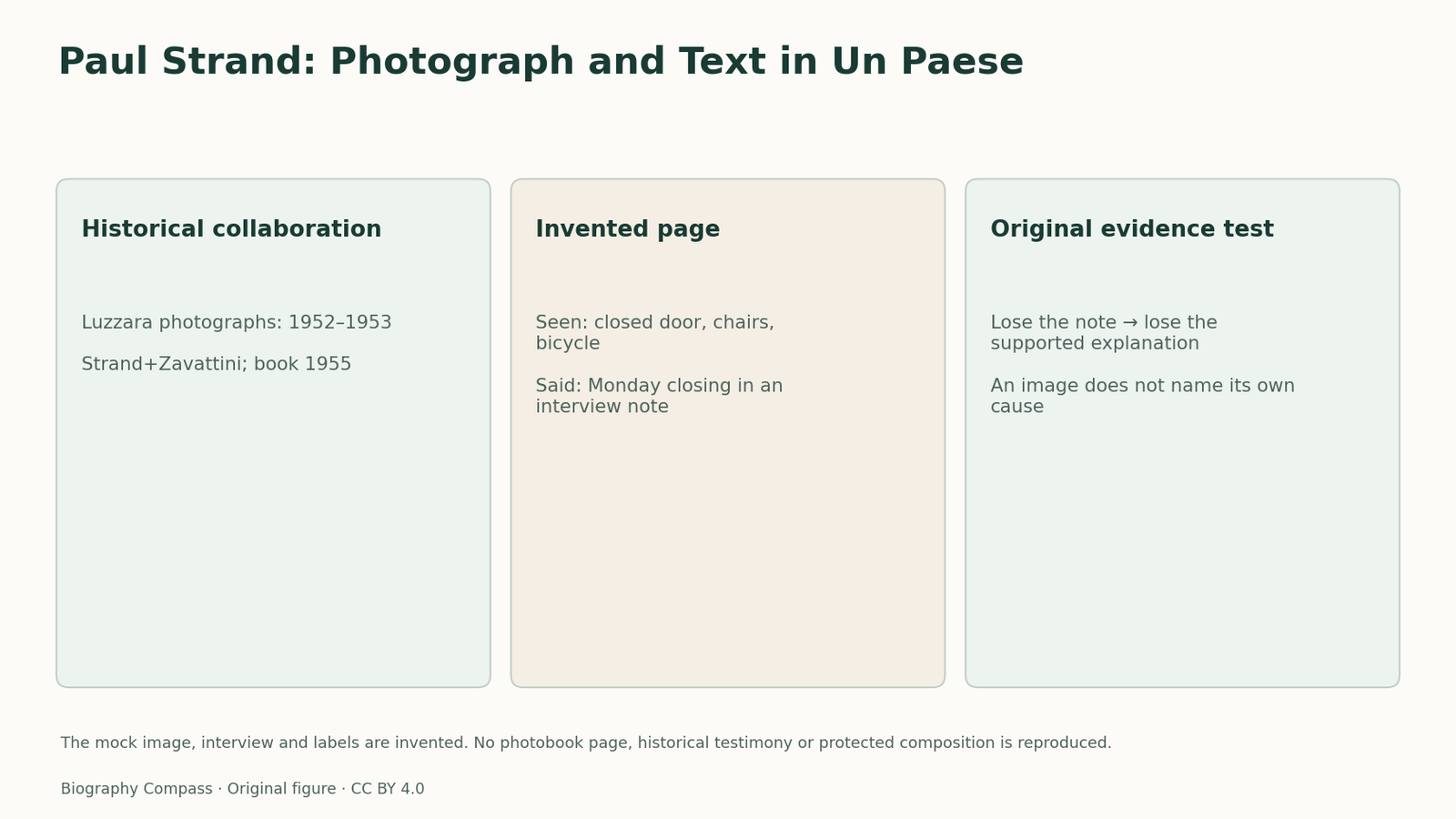
The Philadelphia chronology places Strand’s photography in Luzzara in 1952–1953 and dates the resulting Un Paese, with text by Cesare Zavattini, to 1955.
The Italian archival institution also identifies the 1955 Einaudi book as a collaboration between the photographer and writer.
These records establish a production relationship and a publication date. They do not let us claim to have read every page or to know the origin of every sentence. The study therefore asks a new design question rather than paraphrasing the book’s voices.
Make three layers explicit
Invent a photograph description: a closed shopfront, two empty chairs and a bicycle beside the door. Invent a separate interview note in which the shopkeeper says the business closes on Monday. Finally, propose an interpretation about the street’s rhythm. These are supplied fictional records, not a Strand image or testimony from Luzzara.
Draft a mock page with one line for observation, one for attributed speech and one for the writer’s interpretation. Then imagine that the interview note is lost. Which claims can remain, and which need to be removed or changed?
Reference response: do not make an image speak
The visible closed door, chairs and bicycle can remain in the observation line, subject to the stipulated image description. The Monday closing explanation depends on the interview note. Without it, the image does not establish the day or reason for closure. An interpretation may propose stillness or routine, but it must remain the writer’s reading.
A reference page might label the three lines Seen, Said and Suggested. Such labels are our teaching device, not a description of Un Paese’s actual layout. A strong alternative can weave the lines into fluent prose while preserving who knows what. It should not turn an invented first-person voice into recovered historical testimony.
Keep collaboration visible
Add two credits: who made the photograph and who wrote or selected the language. If another person translated or recorded an interview, give that work its own line. Before publishing a real project, those credits would require actual production evidence.
The exercise’s aim is not to force image and language into permanent separation. Their tension can make a page richer: one can supply something the other cannot. Keeping their claims traceable gives the reader room to assess the collaboration rather than letting a caption’s authority conceal an uncertainty.
Continue the chronology
Related history guides
Biography context
Explore Italy through connected lives
Connected biographies
The photographer’s working life
1890–1976
Paul Strand
Photographer and filmmakerA photographer and filmmaker who made close attention to place part of a sustained collaborative practice.Read biographyQuick answers
Common questions
- Are Seen, Said and Suggested labels from Un Paese?
- No. They are an original teaching framework, and all sample shopfront material is invented.
Primary and institutional sources
How this history was checked
Selected records support the historical comparison; the exercise and reference response are original. This article was reviewed on 31 October 2026.