
The short answer
Putting the same glass before a solution or before the observer produced different effects. That contrast helped Stokes distinguish the light that excited a glow from the light it emitted.
Original evidence comparison
A change of position tests more than brightness
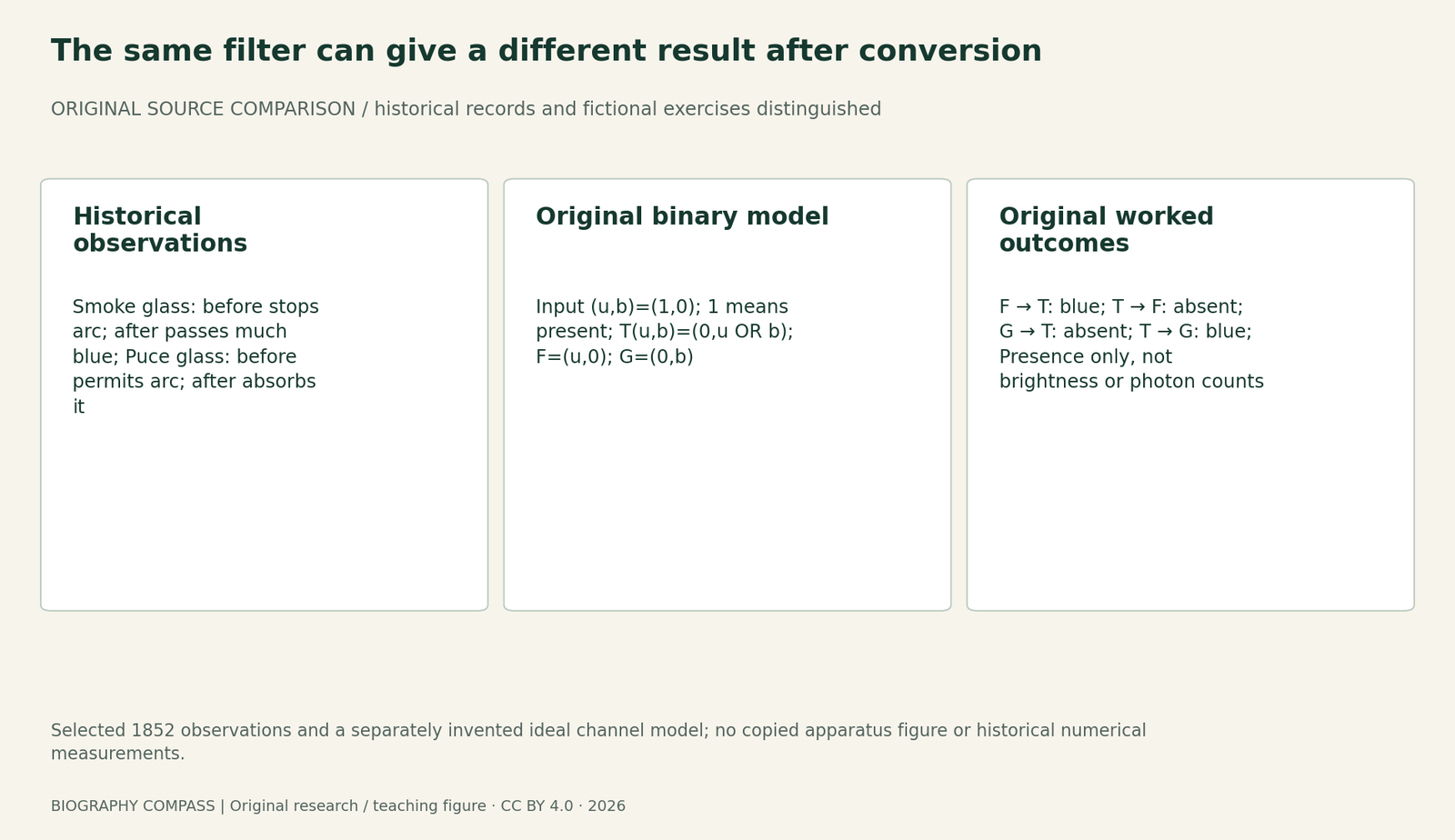
Historical observations paraphrase printed page 467. The F/G/T operations are invented and idealised.
| Record or case | Before the solution | Before the observer | Evidential role |
|---|---|---|---|
| Smoke-coloured glass, historical | Blue arc prevented. | Much arc light transmitted. | Input and emitted light behave differently. |
| Puce glass, historical | Arc can form. | Arc light absorbed. | Opposite behaviour for a different glass. |
| Original F/T model | F then T gives blue. | T then F gives no blue. | Binary teaching model, not historical intensity data. |
| Original G/T model | G then T gives no blue. | T then G gives blue. | The chosen channel transmission matters. |
Chronology
A timeline of the turning points
Received
The paper and manuscript record give the receipt date.
Read
The Royal Society reading date differs from receipt.
Abstract publication
The archive records a later published abstract.
Start with an observation inherited from other researchers
Stokes’s paper begins on printed page 463 by crediting John Herschel’s 1845 quinine observations and David Brewster’s work on internal dispersion. The problem was not simply that a liquid looked blue. It could appear transparent by transmitted light, yet produce a blue region near the surface where light entered. Light passing through part of the solution could lose the ability to produce that same effect elsewhere. Stokes asked what had changed in the light, and whether a change of polarisation or refrangibility offered the better explanation. This history involves a sequence of observations and arguments, rather than one person’s unexplained flash of discovery.
Sources for this section: [1]
Two glasses gave opposite position-dependent results
On printed page 467, a pale smoke-coloured glass prevented the blue arc when placed before the solution but transmitted much of the arc’s light when placed before the eye. A puce-coloured glass behaved differently: the arc could form with the glass before the solution, but was absorbed with the glass before the observer. These are not interchangeable statements that every coloured glass extinguished everything. The position and the selected glass both matter. Stokes interpreted the results on the assumption that a glass removed different fractions of light according to refrangibility.
Sources for this section: [1]
A prismatic test supplied another comparison
The next part of the paper describes moving the solution through a spectrum and finding blue emission even beyond the violet region visible on a screen. Comparison with water also showed that a solution appearing clear to the eye could absorb part of the spectrum strongly. Those observations helped connect the filter-order result to a difference between exciting and emitted light. The paper’s footnote on printed page 479 proposes fluorescence as a name. Its language belongs to nineteenth-century wave optics; it should not be rewritten as if Stokes had already supplied a modern quantum account of molecular energy levels.
Sources for this section: [1]
Original exercise: use a deliberately simple channel model
Let a pair (u,b) record only whether an excitation channel and a blue channel are present: 1 means present, 0 absent. These are not photon counts or energies. Start with (1,0). Our idealised fluorescent element T changes (u,b) to (0,u OR b): excitation can produce blue, and incoming blue remains present. Filter F passes excitation but blocks blue, so F(u,b)=(u,0). Filter G blocks excitation but passes blue, so G(u,b)=(0,b). An observer detects only the final blue channel. Find the result for F then T, T then F, G then T, and T then G. Identify which operations can be exchanged without changing the answer.
Sources for this section: [1]
Worked answers: the order changes the observed channel
With F then T, (1,0) stays (1,0) at the filter and becomes (0,1) at T, so blue is seen. With T then F, it first becomes (0,1), then (0,0), so blue is absent. With G then T, the filter first removes the excitation, leaving (0,0) throughout. With T then G, the conversion supplies (0,1), which G passes. In both pairs, exchanging the two elements changes the result for this input. That is the mathematical point of the exercise. It does not establish that an actual historical glass had our perfectly sharp transmission or that a real sample converted every incoming photon.
Sources for this section: [1]
Keep the observation, model and publication record separate
The toy operations clarify why filtering an input can differ from filtering an output after conversion. They do not reproduce Stokes’s numerical measurements: none have been invented here. Brightness, absorption spectra, efficiency and polarisation require richer descriptions than two presence indicators. The Royal Society catalogue also distinguishes a manuscript received on 11 May and read on 27 May 1852 from an abstract published in 1854. Its 288 manuscript pages are not the same object as the printed paper. For the historical experimental argument, the selected printed pages are the evidence used in this guide.
Continue the chronology
Related history guides
FitzGerald’s 1889 Letter: A Length-Change Hypothesis Is Not Yet a Formula
Read FitzGerald’s original 1889 letter, separate its proposed length change from an exact equation and test two invented square-ratio examples.
Read the timeline1905–1907Alice Perry and Nora Stanton Blatch: What Early Engineering Degree Records Can Establish
Compare Galway’s 1906 Alice Perry record with Cornell’s 1905 Nora Stanton Blatch entry, separating university milestones, world-first claims and employment.
Read the timelineBiography context
Explore United Kingdom through connected lives
Connected biographies
People behind the evidence
1819–1903
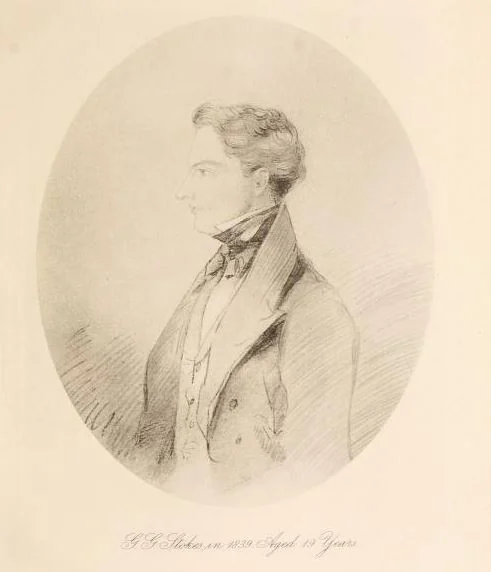
George Gabriel Stokes
Mathematician, physicist and scientific administratorGeorge Gabriel Stokes combined mathematical analysis with experiments on fluids and light. Born in County Sligo, he built a long career at Cambridge, where his research, teaching and Royal Society work helped shape nineteenth-century physics.Read biographyQuick answers
Common questions
- Are u and b measured photon counts?
- No. They record presence or absence in an invented two-channel model. No efficiency or energy balance is calculated.
- Does the paper credit William Herschel with the 1845 quinine observations?
- The original paper explicitly credits John Herschel. A modern biographical account’s different first name is not followed.
Primary and institutional sources
How this history was checked
Selected original printed pages 463–469 and 479 were read, with page 467 and the naming footnote visually checked. The manuscript catalogue supplies dates and physical extent; the complete 288-page manuscript and all 100 printed pages were not read. The channel exercise, comparison and diagram are original. This article was reviewed on 27 October 2026.