
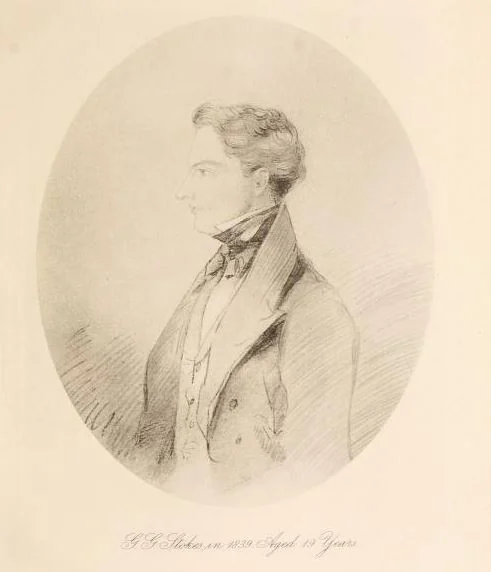
In this biography
Quick facts
- Born
- 13 August 1819
- Died
- 1 February 1903
- Birthplace
- Skreen, County Sligo, Ireland
- Country
- Ireland
- Nationality
- Not independently established
- Known for
- Viscous fluids, fluorescence, physical optics and Cambridge teaching
- Cambridge degree
- Senior wrangler, 1841
- Lucasian professor
- Appointed in 1849
- Fluorescence paper
- 1852
- Royal Society president
- 1885–1890
Why this life matters
His career connects equations with observations, while showing how scientific names can conceal the contributions of several researchers.
Timeline
Key moments
Birth
Born at Skreen on 13 August.
Cambridge
Entered Pembroke College.
Mathematical honours
Graduated as senior wrangler and first Smith’s prizeman.
Lucasian chair
Became professor of mathematics.
Light experiments
Published On the Change of Refrangibility of Light.
Royal Society president
Served after three decades as secretary.
Death
Died in Cambridge on 1 February.
From County Sligo to mathematical Cambridge
Stokes was born at Skreen, County Sligo, on 13 August 1819. His father was a Church of Ireland clergyman, and his early education took place at home before schooling in Dublin and Bristol. He entered Pembroke College, Cambridge, in 1837. Coaching by William Hopkins helped direct his mathematical interests toward physical problems. In 1841 he graduated as senior wrangler and first Smith’s prizeman, then became a college fellow. The Lucasian chair followed in 1849. Teaching remained a substantial part of his work rather than merely a title attached to private research.
Fluid motion with friction included
His early investigations concerned incompressible fluids and the effect of internal friction, or viscosity. A major 1845 paper developed equations for viscous motion, while work presented in 1850 examined how surrounding fluid affected pendulums. This also produced the sphere-drag result associated with his name. These contributions belong to a wider history that includes Claude-Louis Navier and other mathematical investigators. A formula named after Stokes is not evidence that he invented every part of fluid mechanics. His distinctive contribution was to connect mathematical treatment with effects that mattered in measurements and physical experiments.
Light that changed its character
The 1852 paper On the Change of Refrangibility of Light begins by acknowledging John Herschel’s quinine observations and David Brewster’s investigations. Stokes asked why a solution could transmit much visible light while producing blue light near its illuminated surface. Moving coloured glass from before the solution to before the observer changed the result. Prismatic observations supplied further evidence that exciting and emitted light had different refrangibility. He proposed the word fluorescence in a footnote. His contribution was not the first sighting of every luminous effect, but an experimental argument and terminology that connected several observations.
Sources for this section: [3]
A researcher’s name and other people’s work
Stokes also worked on diffraction, polarisation and the interpretation of spectra. Discussions with William Thomson helped develop questions about light and matter. The theorem now commonly called Stokes’s theorem had been communicated to him by Thomson before Stokes used it in a Cambridge examination. Similarly, the Campbell–Stokes sunshine recorder combined John Francis Campbell’s original device with Stokes’s improvements. These examples are useful reminders that a familiar name is a starting point for investigating a collaboration or transmission, not a complete statement of priority. They also reflect how research ideas moved through letters, teaching and practical instruments.
The work of sustaining a scientific institution
Stokes became Royal Society secretary in 1854 and served until 1885, then held its presidency until 1890. Reviewing papers, corresponding with researchers and managing publication absorbed time that might otherwise have gone to his own research. He also advised instrument makers and public bodies. His later public life included service as Cambridge University’s member of Parliament and writing on natural theology, reflecting religious interests that accompanied his physics. He became master of Pembroke in 1902 and died in Cambridge on 1 February 1903. The archive preserves both scientific arguments and the institutional labour that helped those arguments circulate.
Quick answers
Frequently asked questions about George Gabriel Stokes
- Did Stokes first observe the quinine effect entirely on his own?
- No. His original paper explicitly begins with John Herschel’s and David Brewster’s earlier work.
- Was every result called Stokes’s theorem first formulated by him?
- No. The vector-calculus theorem is associated with a result communicated to him by William Thomson and used in a Cambridge examination.
Keep exploring
Lives connected to this story
- George Francis FitzGerald
Compare two Irish-born physicists working with nineteenth-century theories of light.
- George Johnstone Stoney
Read another Irish physics career whose terminology outlasted its original setting.
Sources and further reading
Explore the evidence
These references support the biography and offer further reading. Official records, first-person accounts and independent reporting provide different perspectives; image records document attribution and licensing.
- 1. Dictionary of Irish Biography, Royal Irish AcademyGeorge Gabriel Stokes: Biographical Account
Selected biographical and scientific sections read. Its 1845 quinine reference names William Herschel; the original 1852 paper explicitly credits John Herschel, which is followed here. School-start and family-detail differences are not turned into unnecessary exact claims.
- 2. MacTutor, University of St AndrewsGeorge Gabriel Stokes: Biography
Education, research and later career sections read; quoted reminiscences are not presented as newly inspected archive letters.
- 3. Philosophical Transactions / original scan on Wikimedia CommonsG. G. Stokes: On the Change of Refrangibility of Light (1852), selected original pages
Selected original printed pages 463–469 and 479 read; this is not a claim to have read all 100 printed pages.
- 4. The Royal Society: Science in the MakingStokes’s 1852 Manuscript, PT/45/2: Catalogue Record
Catalogue metadata read: manuscript receipt, reading and later abstract publication are separate records. No whole 288-page manuscript inspection.