
The short answer
How did the 2000 large-subunit structure constrain peptide-bond catalysis, and what does a structure alone not measure?
Read the evidence
Different records within the same investigation
The following comparison distinguishes the specific questions answered by the inspected records.
| Record or test | What it establishes | What remains different |
|---|---|---|
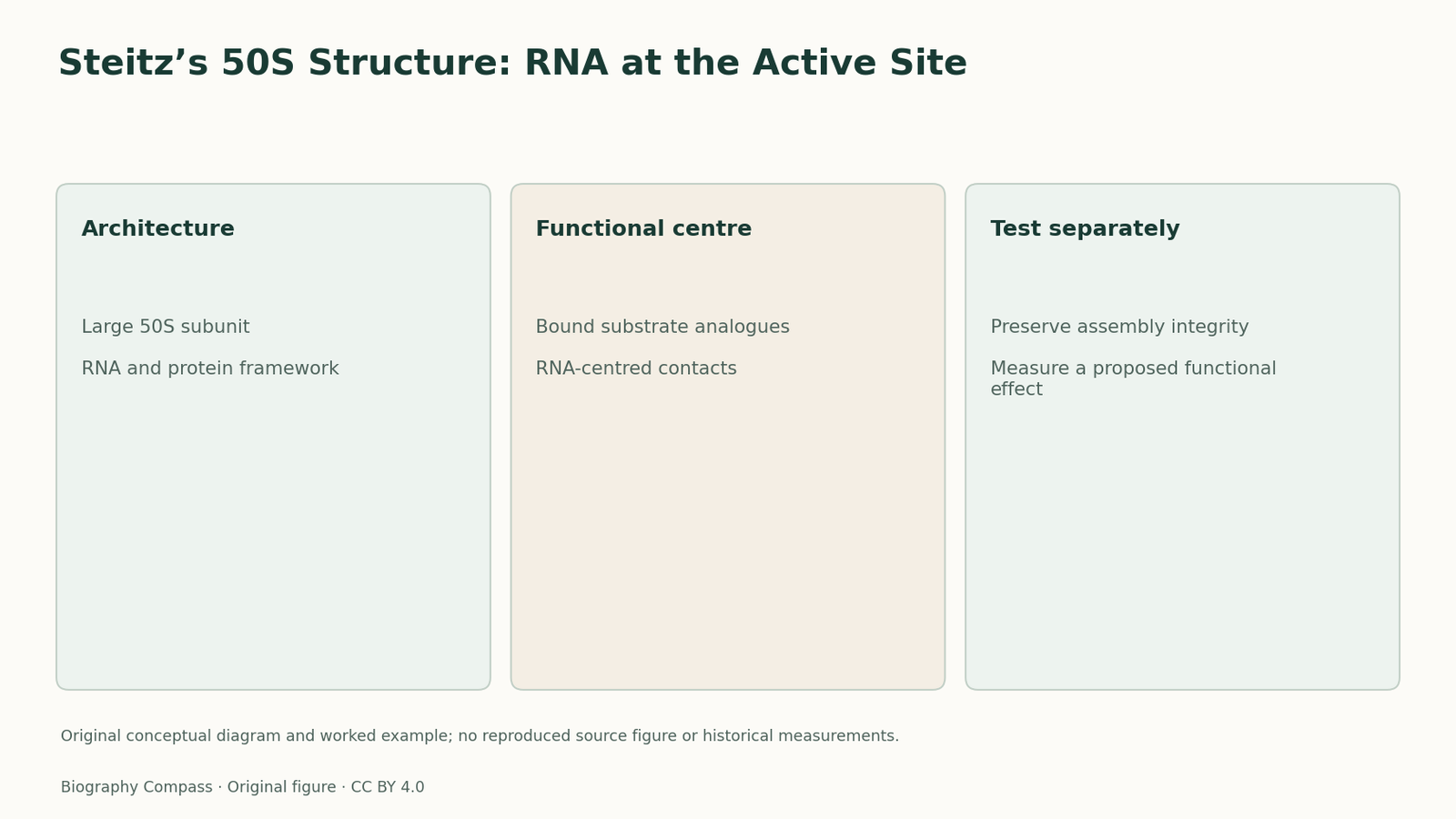
| Overall 50S structure | Locates RNA and protein architecture in the reconstructed subunit. | Flexible or unresolved components remain outside parts of the model. |
| Substrate-analogue complex | Shows a defined binding environment at the functional centre. | Is not a complete trajectory of the chemical reaction. |
| Functional perturbation | Can test a proposed contribution when structural integrity is controlled. | A damaged assembly cannot isolate one catalytic step. |
The large subunit answered a particular structural question
The Ban and colleagues paper determined a large ribosomal subunit from Haloarcula marismortui at 2.4 ångström resolution. This was the 50S subunit, associated with peptide-bond formation, rather than the 30S subunit responsible for the central decoding interaction. The model included most, but not every, nucleotide and protein component. Calling it an atomic structure therefore does not mean that every atom in every flexible region was resolved. The record identifies both what was reconstructed and which parts remained disordered or absent from the model.
Sources for this section: [1]
A second paper brought substrate analogues into the site
Nissen and colleagues examined complexes with two substrate analogues. These molecules helped locate the environment around the chemical step rather than merely decorating the overall map. The authors found conserved ribosomal RNA contacting the analogues and no nearby protein side chains at the immediate peptide-bond-forming region in those structures. This supported an RNA-centred catalytic account. It did not imply that proteins elsewhere in the subunit were unnecessary: the architecture paper described many of them stabilising and organising the RNA framework.
Structural proximity is evidence with a defined scope
A nearby chemical group can be a plausible participant in a reaction, but a crystal arrangement alone does not measure its contribution to a reaction rate. Likewise, an analogue is a deliberately useful stand-in, not a time-resolved recording of every intermediate. The 2000 papers supplied strong constraints on active-site composition and substrate positioning while also proposing mechanistic interpretations. Those proposals should retain their status as interpretations of the available structures, rather than becoming a claim that every later detail of peptide-bond chemistry was already directly observed.
Keep architecture, chemistry and motion in separate columns
The value of the two records becomes clearer when they are compared by question. One asks how a large RNA–protein assembly is built; the other asks how molecules resembling reaction partners occupy its functional centre. An activity assay would ask how rapidly the relevant reaction proceeds under stated conditions. A motion experiment could address changes between states. These categories can reinforce one another, but replacing one with another loses information about what was actually measured and which explanatory step was supplied by reasoning.
An original candidate-group exercise and answer
Imagine a fictional catalytic structure with a substrate analogue touching RNA group R and protein group P lying farther away. A student concludes that R must perform a particular acid–base step and P has no function. Which parts exceed the picture? Contact supports investigating R, but the specified chemical role needs further evidence. P could have an indirect structural role despite not contacting the analogue. This example is not a reconstructed ribosome coordinate set and introduces no historical distance or rate. The supported answer proposes a discriminating follow-up: alter a candidate feature, check that the assembly remains intact, and compare the relevant activity. Loss of activity in a disrupted complex would not isolate a direct catalytic role. The exercise separates positioning evidence, structural integrity and a functional test.
Continue the chronology
Related history guides
Ribonuclease Refolding: Sequence and Conditions
Read Anfinsen’s 1961 reoxidation study through its separate chemical and activity measurements, with an original exercise on recovery, timing and conditions.
Read the timeline1956–1963Ribonuclease Sequencing: Why Overlaps Matter
Follow the ribonuclease sequence programme through peptide overlaps and later revisions, with an original assembly exercise separating order from composition.
Read the timelineBiography context
Explore United States through connected lives
Connected biographies
Researchers and related approaches
1940–2018
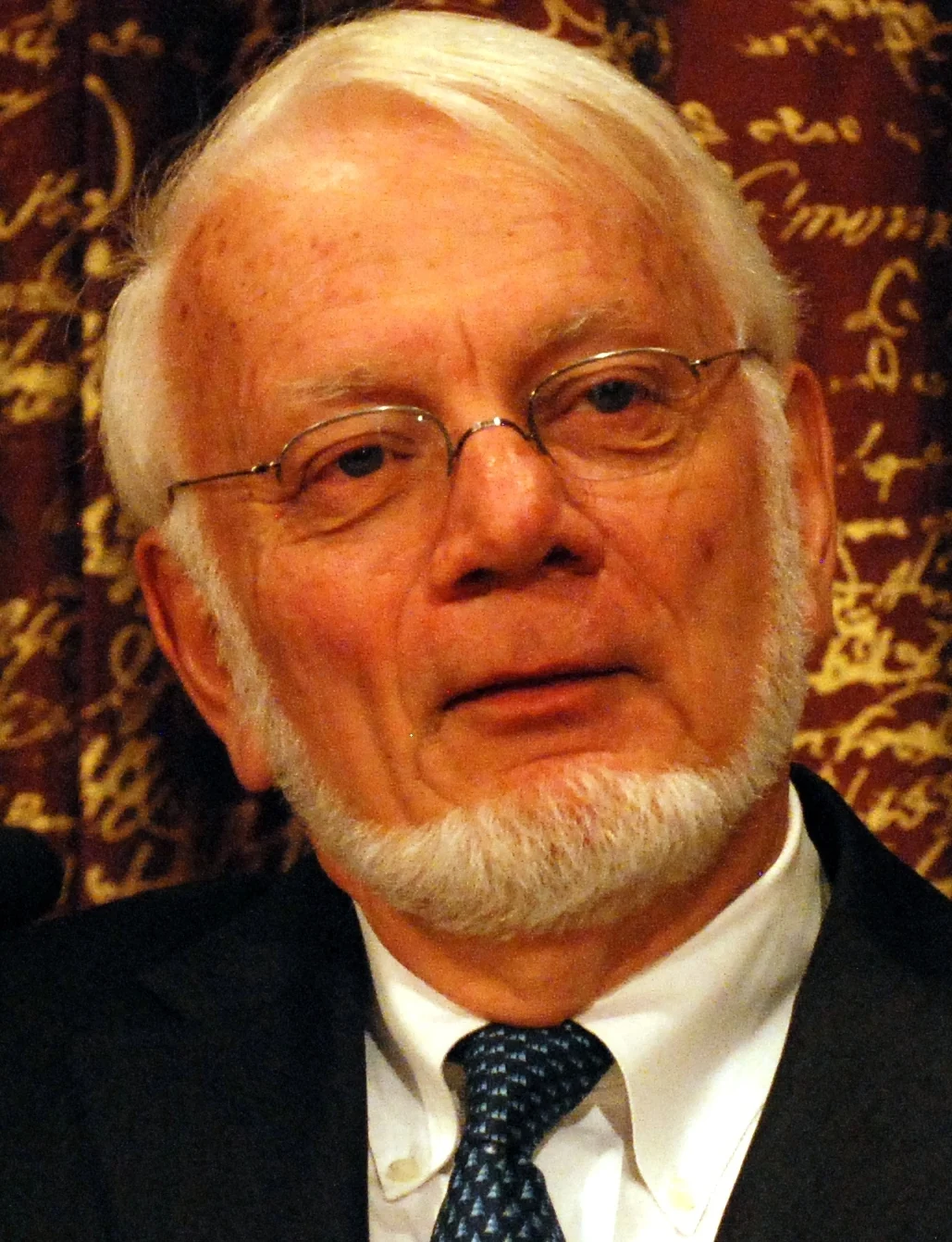
Thomas A. Steitz
Structural biologist and protein crystallographerThomas Steitz used crystallography to investigate biological catalysts, helping reveal the RNA-centred architecture of the large ribosomal subunit.Read biography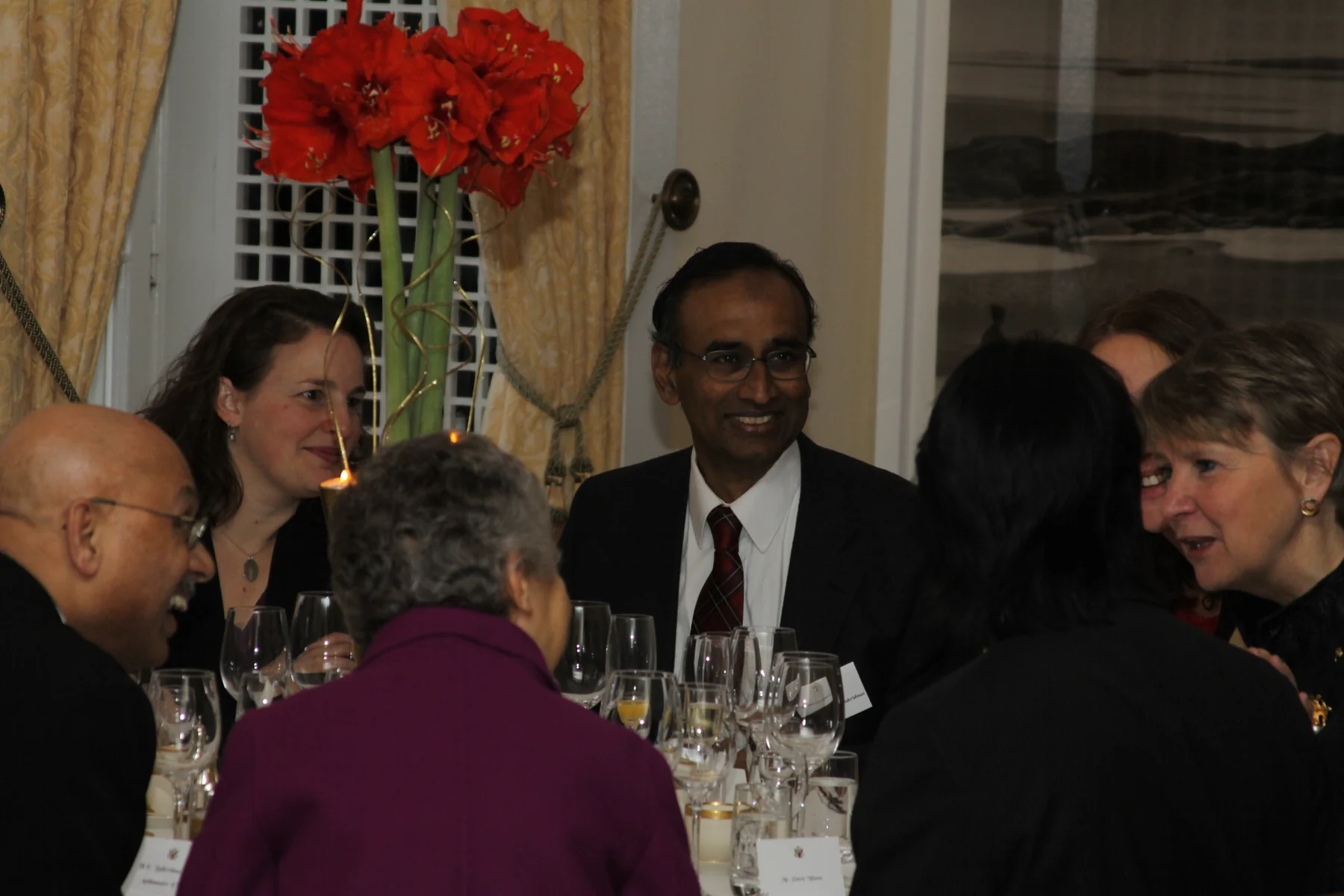
1952–
Venkatraman Ramakrishnan
Structural biologistVenkatraman Ramakrishnan moved from physics to molecular biology and helped determine ribosomal structures, sharing the 2009 Nobel Prize in Chemistry.Read biographyQuick answers
Common questions
- Does an atomic model resolve every component equally?
- No. Disorder and missing components limit particular regions even in a high-resolution reconstruction.
- Does a bound analogue measure a reaction rate?
- No. Positioning and kinetics require different experimental records.
Primary and institutional sources
How this history was checked
The references below distinguish the original study from later explanations. The worked exercise and comparison are newly written for this article. This article was reviewed on 8 November 2026.
- Ban and colleagues, Science, 2000The complete atomic structure of the large ribosomal subunit at 2.4 Å resolution
- Nissen and colleagues, Science, 2000; original paper reproduced in Stanford teaching PDFThe Structural Basis of Ribosome Activity in Peptide Bond Synthesis
- Nobel Prize OutreachThomas A. Steitz — Biographical
- Nobel Prize OutreachThomas A. Steitz — Facts