
The short answer
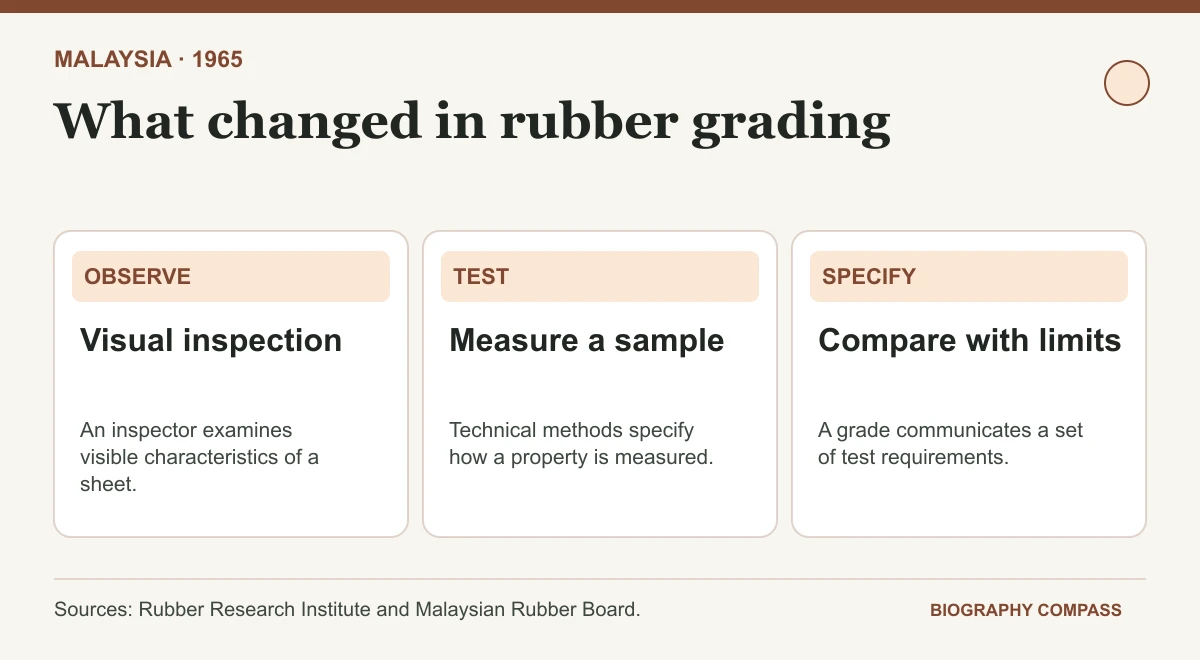
In March 1965, Commerce and Industry Minister Lim Swee Aun announced technical grading for Standard Malaysian Rubber. The scheme described rubber by specified test properties. For a manufacturer ordering a shipment, the grade could carry information about the material that a visual inspection alone could not provide.
Compare the records
What a grade tells a buyer
Visual and technical grading offer different kinds of evidence for a purchase.
| Question | Visual grading | Technical grading |
|---|---|---|
| What is examined? | Visible features of the rubber | Properties measured on samples |
| What gets communicated? | An appearance-based class | A grade defined by stated limits and tests |
| What should a reader check? | The sheet grading rules | The specification and edition applying to the transaction |
Chronology
A timeline of the turning points
Government announces technical grading
Lim Swee Aun explains the rationale for a national scheme.
Institute reviews marketing
R. N. Muthurajah records the rollout and the Chemistry Division’s technical bulletins.
Revised test methods
The Rubber Board catalogue records a later edition of the SMR test manual.
Why appearance had limits for buyers
The appearance of a rubber sheet can convey useful information about its class. A buyer interested in cleaning or processing the material, however, also wants comparable measures such as dirt content or plasticity. The scheme brought such properties into the grading decision and gave suppliers and buyers a common reference. A grade is a statement that a sample meets a defined set of criteria. It is only useful if the people using it know what those criteria measure.
How specifications travelled with the product
The institute’s 1969 account points to four bulletins issued by its Chemistry Division for rubber technologists in consuming countries. Publishing both the requirements and the supporting information made the scheme usable outside the laboratory where it was developed. A purchaser could order to a specification and a laboratory could apply a published method. That meant that an agreed grade could do some of the work previously left to inspection of the material at the point of purchase.
How to read the later records
The Rubber Board lists a revised test manual from 2018. The existence of revised editions matters if you are comparing a historical source with a modern product sheet. A grade name can continue in use while test procedures, the grades offered or their thresholds change. For the launch, the 1969 account is the better starting point. For the method in force at a later date, find the applicable specification and manual.
Continue the chronology
Related history guides
Why Malaysia Set Up RISDA for Rubber Smallholders
Follow replanting support for the smallholders producing the rubber.
Read the timeline1859–2015How Singapore Botanic Gardens Helped Spread Rubber Growing
Follow the earlier history of rubber-growing trials and the distribution of planting material.
Read the timeline1966–1996How Malaysia Built SIRIM from Two Industrial Institutions
Compare the wider institutional history of testing and industrial standards in Malaysia.
Read the timelineConnected biographies
People connected to this history
Quick answers
Common questions
- When was Standard Malaysian Rubber introduced?
- The Malaysian government announced the scheme in March 1965.
- What changed under SMR?
- A grade could be specified through technical tests, including measurements relevant to material quality, alongside the older tradition of grading sheets by appearance.
Primary and institutional sources
How this history was checked
Dates, legal milestones and historical claims are checked against the official and institutional records below. This article was reviewed on 19 November 2026.