
The short answer
A familiar product label tells a buyer what a garment is for. A manufacturing description explains how particular parts are made together. Comparing the two records reveals the work between a home alteration and a reproducible design.
The records answer different questions
Keep the measures separate
The question changes when the object, unit or reporting period changes.
| Record or measure | What it establishes | What it does not establish |
|---|---|---|
| Consumer account | A need and development collaborators. | A complete manufacturing specification. |
| Construction description | How specified components are formed. | An independently tested comfort result. |
| Method sequence | An ordered set of stated stages. | A universal rule for every embodiment. |
Chronology
A timeline of the turning points
Application
The document records a filing.
Issue
The published patent record appears.
The consumer problem is only the beginning
The Inventors Hall of Fame describes a rolling-fabric problem and prototype development with a manufacturer.
The story identifies a use case and a development network. It does not, by itself, show the structure that made repeated production possible. The difference is important: an altered household item and a manufacturable garment may serve the same purpose while requiring different processes.
Sources for this section: [1]
What the selected construction record adds
PDF 5 describes knitted-in leg-band welts and allows subsequent sewing of a cotton crotch. This differs from attaching separate elastic bands.
The distinction concerns which components are formed together. It does not mean every manufacturing operation is identical or that every possible product variant is covered by a single description. The document’s construction detail answers a question the short consumer story leaves open.
Sources for this section: [2]
A preferred account and a method sequence
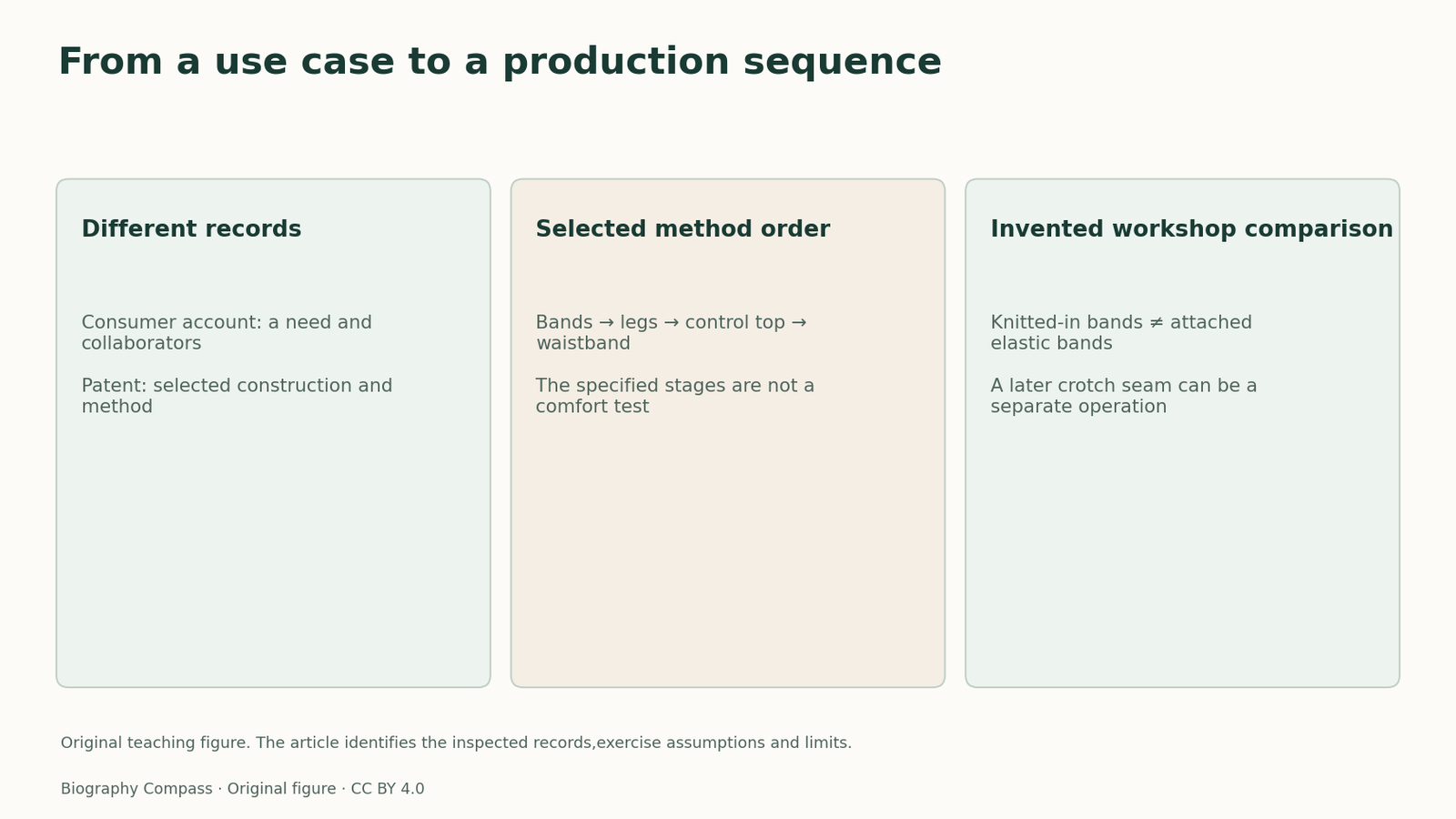
The description presents a preferred sequence but says it is not limited to that order. Method claim 15, visible on PDF 7, specifies knitting leg bands, then leg portions, then the control top and then the waistband.
These passages have different jobs. One explains an embodiment flexibly; the other sets out a particular claimed method. Reading them together is more informative than extracting one sentence and making it a universal rule for every garment. No present patent-status or infringement conclusion follows here.
Sources for this section: [2]
Original production-reading task
Two invented workshop notes describe routes. Route A forms leg-band welts during a continuous knitting sequence, then sews in a crotch. Route B makes the leg portions and later attaches separate elastic bands. Which route matches the selected construction distinction? Draw the supplied method’s four-stage order. Can either note establish superior comfort or freedom from rolling without a test?
Reference answer: A matches the knitted-in distinction, and its later crotch seam does not contradict that limited statement. The specified order is bands→legs→control top→waistband. B instead describes separately attached bands. Neither workshop note proves comfort or performance; those require measurements or trials. This exercise interprets selected construction prose; it does not reproduce a protected drawing, claim to manufacture a garment or offer legal advice.
Continue the chronology
Related history guides
Biography context
Explore United States through connected lives
Connected biographies
The connected careers
Quick answers
Common questions
- Does continuous knitting mean no later sewing?
- No. The selected construction allows a later crotch seam while distinguishing knitted-in bands from separately attached bands.
Primary and institutional sources
How this history was checked
Compare the dated company records with the independent or regulatory context. Original task inputs are labelled separately from reported historical measures. This article was reviewed on 31 October 2026.