
The short answer
An editor assessment and a finished document describe different objects. Reading them together helps identify which checks a report actually supports and which checks remain the document author’s responsibility.
The records answer different questions
Keep the measures separate
The question changes when the object, unit or reporting period changes.
| Record or measure | What it establishes | What it does not establish |
|---|---|---|
| Historical interface sample | A dated conformance assessment. | A verdict on every later export. |
| Export instruction | A conditional authoring workflow. | Proof that a user followed it. |
| Supplied contrast calculation | One numerical criterion under stated assumptions. | Complete document accessibility. |
Chronology
A timeline of the turning points
Assessment
A defined interface sample is examined.
Source reading
The report and current export help are compared.
A dated assessment has a defined object
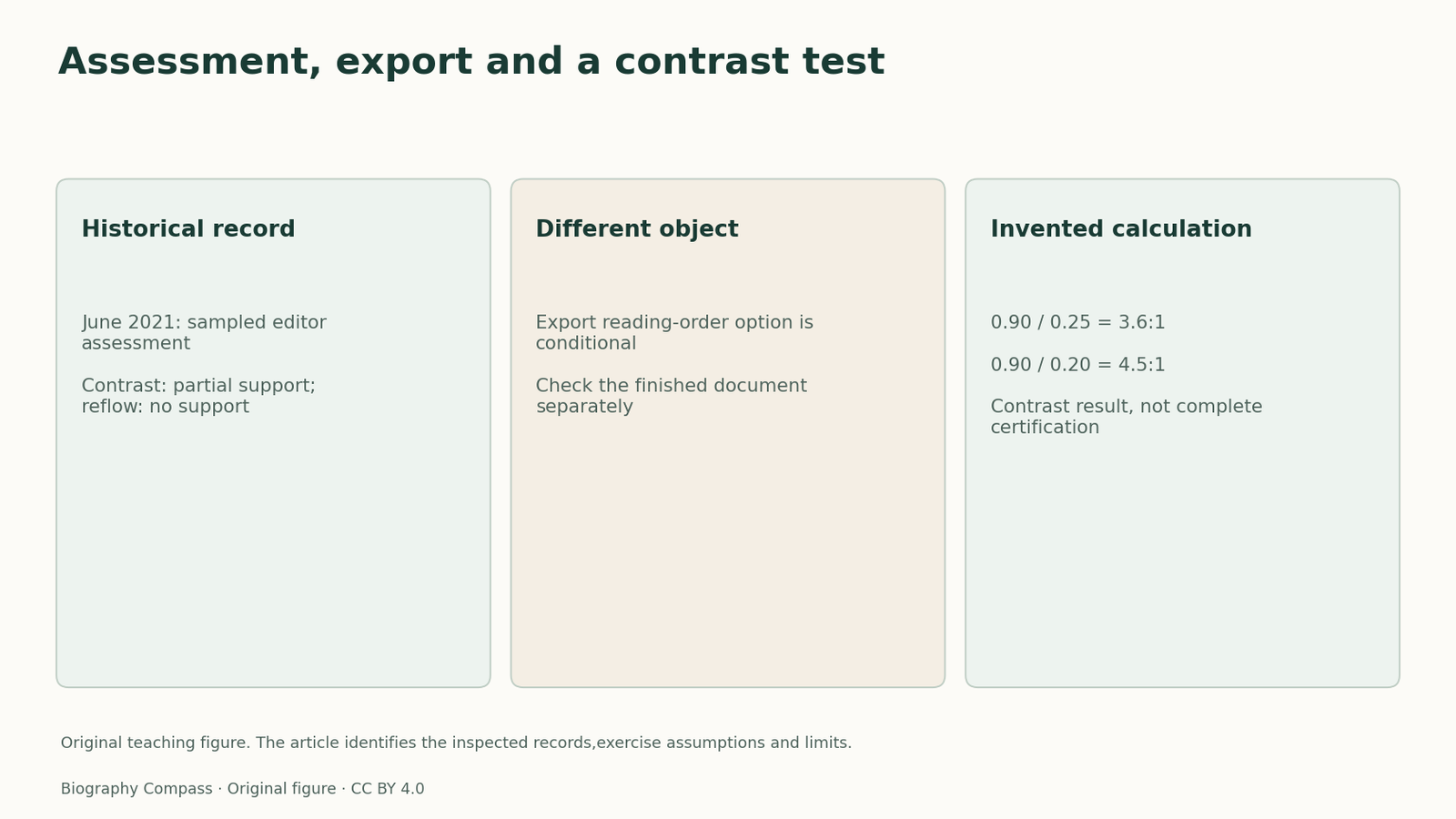
The June 2021 Canva conformance report assesses a representative sample of the live website; it excludes other templates and pages. On PDF 9, minimum contrast partially supports the criterion, with examples of failing interface text. Reflow does not support it at 400% because editor panels can overlap.
These findings concern the sampled interface at that time. They do not establish that every later interface is unchanged, or that a particular exported document meets all accessibility requirements. The date and tested object belong in any accurate description of the result.
Sources for this section: [1]
The export record introduces another condition
Canva’s PDF instructions discuss contrast, alternative text, heading structure and reading order. The reading-order instruction applies when “Match reading order to layer order” is selected during export. The help page also recommends checking the exported PDF with external tools and a screen reader.
An option available in an authoring tool is not evidence that an author selected it correctly. A visually sensible arrangement can still need a different logical reading sequence. The two records therefore complement each other: one assesses parts of an interface; the other describes a workflow for checking a produced document.
Sources for this section: [2]
One numerical test cannot stand for all tests
W3C gives a minimum contrast ratio of 4.5:1 for normal text and 3:1 for large text, with stated exceptions. Its ratio is (Llighter+0.05)/(Ldarker+0.05), using relative luminance.
Contrast can be calculated separately from the order in which information is read. Passing this one criterion cannot supply missing alternative text or repair an illogical document sequence. The source’s exceptions must also be read rather than treating every visible mark as normal text.
Sources for this section: [3]
Original worked example: two decisions
Invented inputs: normal text, no exception, and already linear relative luminances of 0.85 for the lighter colour and 0.20 for the darker one. Calculate the ratio. Then replace the darker value with 0.15. Does the second result prove that an exported PDF is accessible?
Reference answer: 0.90/0.25=3.6:1, below the stated normal-text minimum. The revised ratio is 0.90/0.20=4.5:1, meeting that contrast minimum exactly. It proves only the specified contrast result. Reading order, meaningful text alternatives and other requirements still need separate checks. These supplied values are not measurements of Canva’s interface or any exported file.
Continue the chronology
Related history guides
Biography context
Explore Worldwide through connected lives
Connected biographies
The connected careers
Quick answers
Common questions
- Does the revised ratio certify the whole document?
- No. It answers the supplied contrast calculation, leaving document structure and other requirements to be checked separately.
Primary and institutional sources
How this history was checked
Compare the dated company records with the independent or regulatory context. Original task inputs are labelled separately from reported historical measures. This article was reviewed on 31 October 2026.