
The short answer
What does the ninety-day label fail to tell a reader about the duration and record of detention?
Evidence comparison
Read the records together
The records were created for different purposes and support different kinds of claims.
| Record | What it establishes | Question to keep open |
|---|---|---|
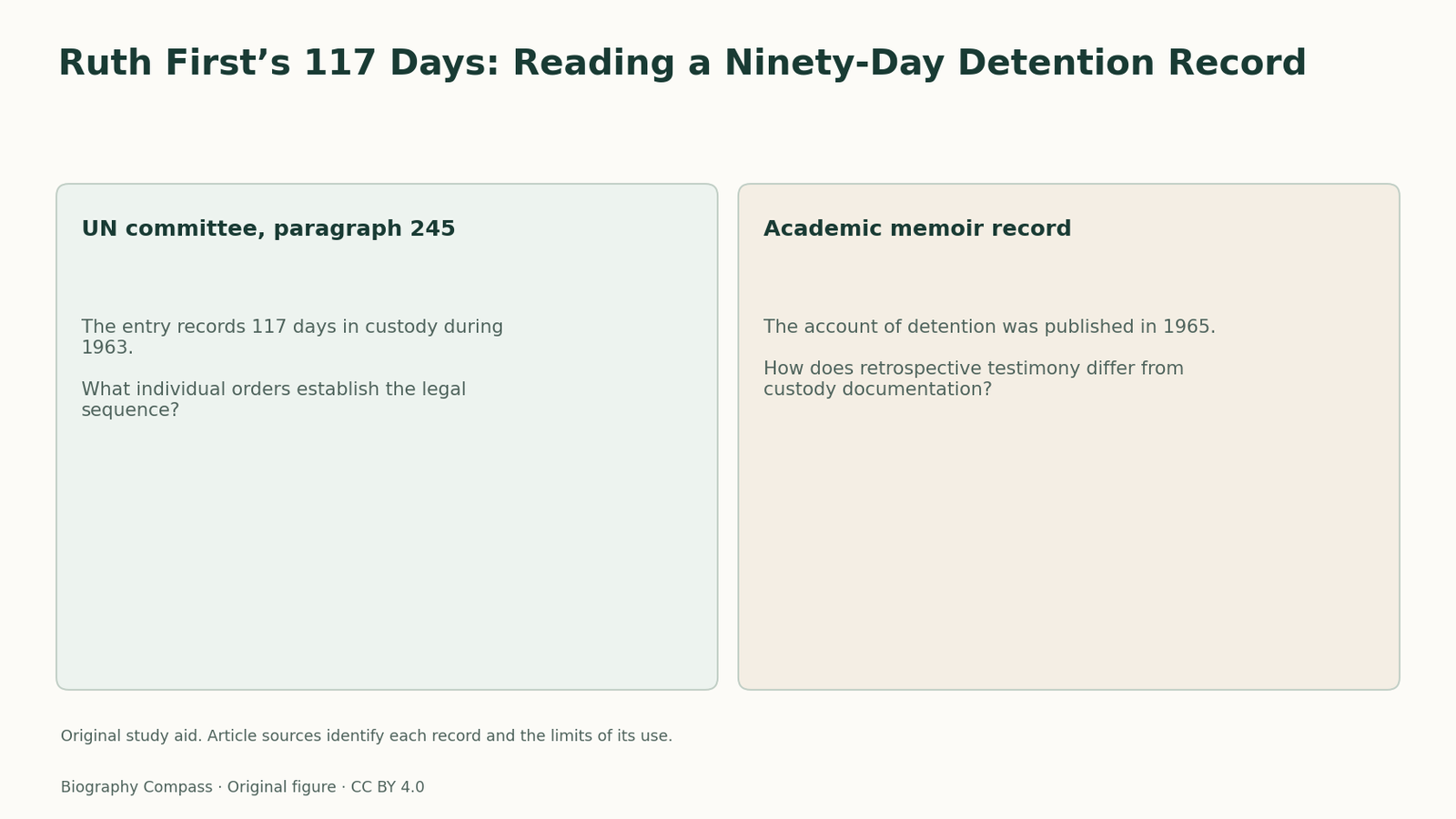
| UN committee, paragraph 245 | The entry records 117 days in custody during 1963. | What individual orders establish the legal sequence? |
| Academic memoir record | The account of detention was published in 1965. | How does retrospective testimony differ from custody documentation? |
Chronology
A timeline of the turning points
Detention
First spends 117 days in custody.
Memoir published
117 Days appears.
UN report
The committee includes her detention in its record.
Separate the label from elapsed time
The United Nations committee’s report identifies First’s detention as lasting 117 days in 1963 while referring to the ninety-day detention law. These numbers answer different questions. One labels a statutory framework; the other records a person’s period in custody. A heading containing ninety days is therefore not sufficient evidence that every person detained under the framework left custody after exactly that interval.
Sources for this section: [2]
Read the correct paragraph and person
The report contains several accounts of detention in sequence. First’s entry must be identified by its paragraph and name rather than borrowing a vivid detail from an adjacent case. Her university biography supplies a separate career context and identifies the central place of solitary confinement. Reading the two together supports a careful summary, while leaving the detailed sequence of particular legal orders to the records that actually document them.
Keep the memoir’s publication separate
The academic bibliographic account dates 117 Days to 1965. That chronology matters because the memoir is a later account of an earlier experience, not an administrative document issued during custody. The UN report’s footnote contains a conflicting publication year; it should not be silently reproduced when a clearer bibliographic record is available. Source comparison can correct a small but consequential error without rejecting every other piece of evidence in the report.
Create a duration and genre exercise
Mark ninety and 117 on a scale and calculate the difference of twenty-seven days. Label the arithmetic as a comparison of durations, not an explanation of the legal mechanism authorising confinement. Then distinguish a committee summary, a bibliographic entry and a personal memoir. A useful answer explains what each can establish and identifies which additional custody documents would be needed to reconstruct the precise sequence. The result is a reading method rather than an unsupported claim about an uninspected statute.
Continue the chronology
Related history guides
Biography context
Explore South Africa through connected lives
Connected biographies
People behind the records
1925–1982
Ruth First
Investigative journalist and social researcherRuth First combined investigative journalism with social research, moving from South African reporting and detention to universities and research in exile.Read biographyQuick answers
Common questions
- Does the ninety-day label prove that First was detained for only ninety days?
- No. The UN entry records 117 days; the statutory label and elapsed custody are different kinds of information.
Primary and institutional sources
How this history was checked
Sources support the chronology and the record comparison. The reading exercise is original. This article was reviewed on 7 November 2026.