
The short answer
Why did completion of Sobukwe’s three-year sentence fail to result in ordinary liberty?
Evidence comparison
Read the records together
The records were created for different purposes and support different kinds of claims.
| Record | What it establishes | Question to keep open |
|---|---|---|
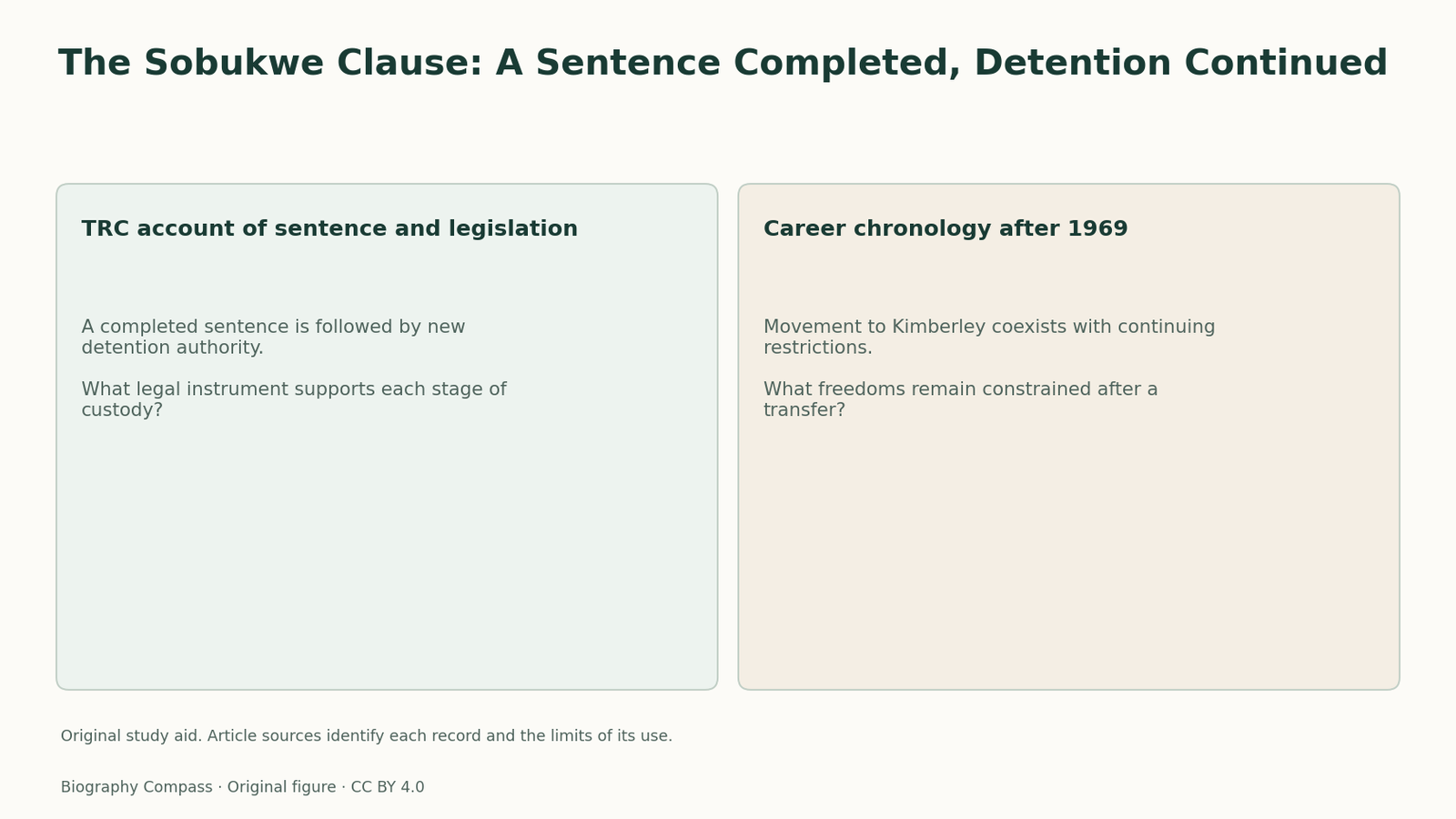
| TRC account of sentence and legislation | A completed sentence is followed by new detention authority. | What legal instrument supports each stage of custody? |
| Career chronology after 1969 | Movement to Kimberley coexists with continuing restrictions. | What freedoms remain constrained after a transfer? |
Chronology
A timeline of the turning points
PAC formed
Sobukwe becomes the organisation’s first president.
Sentence
A three-year term follows the anti-pass campaign.
New detention authority
Custody continues after the sentence.
Kimberley
Restrictions continue after Robben Island.
Begin with the sentence
The TRC report records a three-year sentence imposed in May 1960. A sentence has a starting point and a term; identifying those details establishes what the criminal process required. The political campaign and arrest explain the surrounding events, but they should not obscure the different question raised when that term ended. A reader who merges all custody into one uninterrupted sentence misses the institutional change that followed.
Identify the new authority
The report explains that legislation in 1963 supplied authority to detain Sobukwe after completion of his sentence. The provision became associated with his name. This was continued custody under a different legal basis, not evidence that the original three-year sentence had always been longer. The report places his departure from Robben Island in May 1969, making the distinction between the finite sentence and subsequent detention central to its account.
Sources for this section: [2]
Do not mistake transfer for unrestricted freedom
After Robben Island, Sobukwe lived in Kimberley under restrictions that continued until his death in 1978. A change of location can therefore mark a major change in conditions without establishing complete political liberty. The biographical account supplies the career context, while the TRC passage organises the successive forms of restriction. Neither should be shortened to a statement that he simply served a single prison term and then resumed ordinary public activity.
Draw three distinct bands
Construct a chronology with separate bands for the criminal sentence, post-sentence detention and later restrictions in Kimberley. Place the documented transition years beneath them. Ask students why the phrase released in 1969 requires explanation. A good answer identifies release from a particular place and form of custody, then describes the continuing restrictions. This exercise makes the state’s changing legal mechanisms visible without claiming to reproduce the complete wording or operation of every order.
Continue the chronology
Related history guides
Biography context
Explore South Africa through connected lives
Connected biographies
People behind the records
1924–1978
Robert Sobukwe
Teacher, political organiser and PAC presidentSobukwe moved from teaching and university work to leadership of the PAC; imprisonment and detention restricted his political life for the remaining years.Read biographyQuick answers
Common questions
- Was Sobukwe’s entire custody simply the original three-year sentence?
- No. The TRC distinguishes the sentence from subsequent detention, followed by restrictions after his move to Kimberley.
Primary and institutional sources
How this history was checked
Sources support the chronology and the record comparison. The reading exercise is original. This article was reviewed on 7 November 2026.