
The short answer
A patent license, a working transistor and a radio ready for customers are three different achievements. The TR-55 story shows why each mattered. It also gives a clear way to correct a familiar error: Sony’s 1955 model was Japan’s first transistor radio, while the American Regency TR-1 was already on sale in 1954.
Evidence comparison
Three achievements that a “first” can conceal
This original comparison separates categories that are often compressed into a single invention story.
| Question | Relevant evidence | Careful conclusion |
|---|---|---|
| Where did the component originate? | Bell Laboratories’ transistor work and Western Electric licensing, described in the Smithsonian and Sony histories | The transistor was not invented by Sony. |
| Which radio reached customers earlier? | Regency TR-1 in American stores, 1954; TR-55 in Japan, 1955 | The TR-55 was Japan’s first transistor radio. |
| What did Sony develop? | In-house transistors and a complete five-transistor radio | Licensing and substantial internal development coexisted. |
| When did the company become Sony? | Sony branding on the product; corporate name change in 1958 | Brand use and legal corporate naming have different dates. |
Chronology
A timeline of the turning points
Ibuka pursued transistor rights
Sony’s history dates Masaru Ibuka’s interest in the Western Electric licensing opportunity to this period.
Morita negotiated abroad
Akio Morita pursued the agreement during his first overseas business journey.
Iwama’s observations circulated
Kazuo Iwama sent reports from the United States to the development team in Japan.
An earlier commercial radio
The Regency TR-1 reached American stores before the TR-55.
TR-55
Tokyo Tsushin Kogyo introduced Japan’s first transistor radio.
Sony became the corporate name
The brand preceded the company’s formal name change.
Keep the geographical claim intact
The Smithsonian’s Regency TR-1 record describes collaboration between Industrial Development Engineering Associates and Texas Instruments and places the radio in stores for Christmas 1954. Sony identifies the TR-55 as Japan’s first transistor radio in 1955. Both statements can be true. The distinction does not diminish the Japanese project; it identifies what needs explaining. Sony’s achievement concerned building a product and developing its own components in a particular industrial setting, rather than inventing either the transistor itself or the first commercially available transistor radio anywhere.
A license did not supply a finished factory
Sony’s retrospective distinguishes the founders’ roles. Masaru Ibuka backed the transistor project; Akio Morita pursued the agreement with Western Electric, assisted by the company’s United States representative Shido Yamada. Patent rights opened a legal route to manufacturing, but did not supply a complete production process. Sony still had to build equipment, control materials and make transistors that could operate at the frequencies required for a radio. This makes the licensing step part of the engineering history, rather than an alternative explanation that cancels the team’s work.
Sources for this section: [3]
Iwama’s reports connected observation to experiments
Kazuo Iwama led the development effort and visited the United States in 1954. Sony’s archive describes reports sent back to colleagues in Japan while they experimented with transistor production. The surviving reports matter as evidence of knowledge moving between a visit and a laboratory: the project was neither isolated inspiration nor the simple copying of a complete purchased radio. The public account identifies a leader and a reporting process. It does not give a warrant to assign every circuit decision to the founders or to say that no outside knowledge contributed.
Sources for this section: [4]
From components to a product identity
Sony’s product record says the TR-55 used five transistors developed in-house. Its archive also preserves a radio and a donated original package bearing the Sony brand while the company was still Tokyo Tsushin Kogyo. Packaging is useful evidence here: a customer encountered a named, enclosed product, not an experimental component on a laboratory bench. The corporate name changed in 1958. Consequently, it is appropriate to call the TR-55 a Sony product in 1955 without retroactively claiming that the legal corporate name had already changed.
Distribution and personal listening are distinct questions
Sony records an order from Canadian importer Albert D. Cohen in 1955, following a meeting with Morita. That identifies a route by which a Japanese product reached an overseas market. It does not establish that every teenager immediately owned a TR-55. The Smithsonian’s broader history describes how lower prices, portable sets, earphones and popular music encouraged personal radio listening later in the 1950s. Place that social history beside the product chronology, but keep its subject broad: changing listening habits involved many manufacturers, broadcasters, retailers and listeners.
Practice checking a technology “first”
Take the statement “Sony invented the first transistor radio” and rewrite it as three narrower questions. Who developed the underlying transistor? Which commercial radio reached stores first? What did the TR-55 team design and manufacture? For each answer, identify an appropriate record: a patent or laboratory history, a dated museum object record, or a manufacturer’s engineering account. The comparison below maps those questions to the evidence already reviewed. This method is useful for other product histories because a broad slogan often combines several different kinds of priority.
Connected biographies
People behind the work
1921–1999
Akio Morita
Sony co-founder and business executiveAkio Morita co-founded the company that became Sony with Masaru Ibuka in 1946. He helped connect engineering projects with overseas markets, distribution and a recognizable brand, later championing products including the Walkman.Read biographyQuick answers
Common questions
- Was the TR-55 the world’s first transistor radio?
- No. The Regency TR-1 was already on sale in the United States in 1954. The TR-55 was Japan’s first.
- Did Sony license transistor technology?
- It licensed patent rights from Western Electric. Sony’s account also documents its own work to develop transistors and production methods.
- Why does the guide photograph show a different radio?
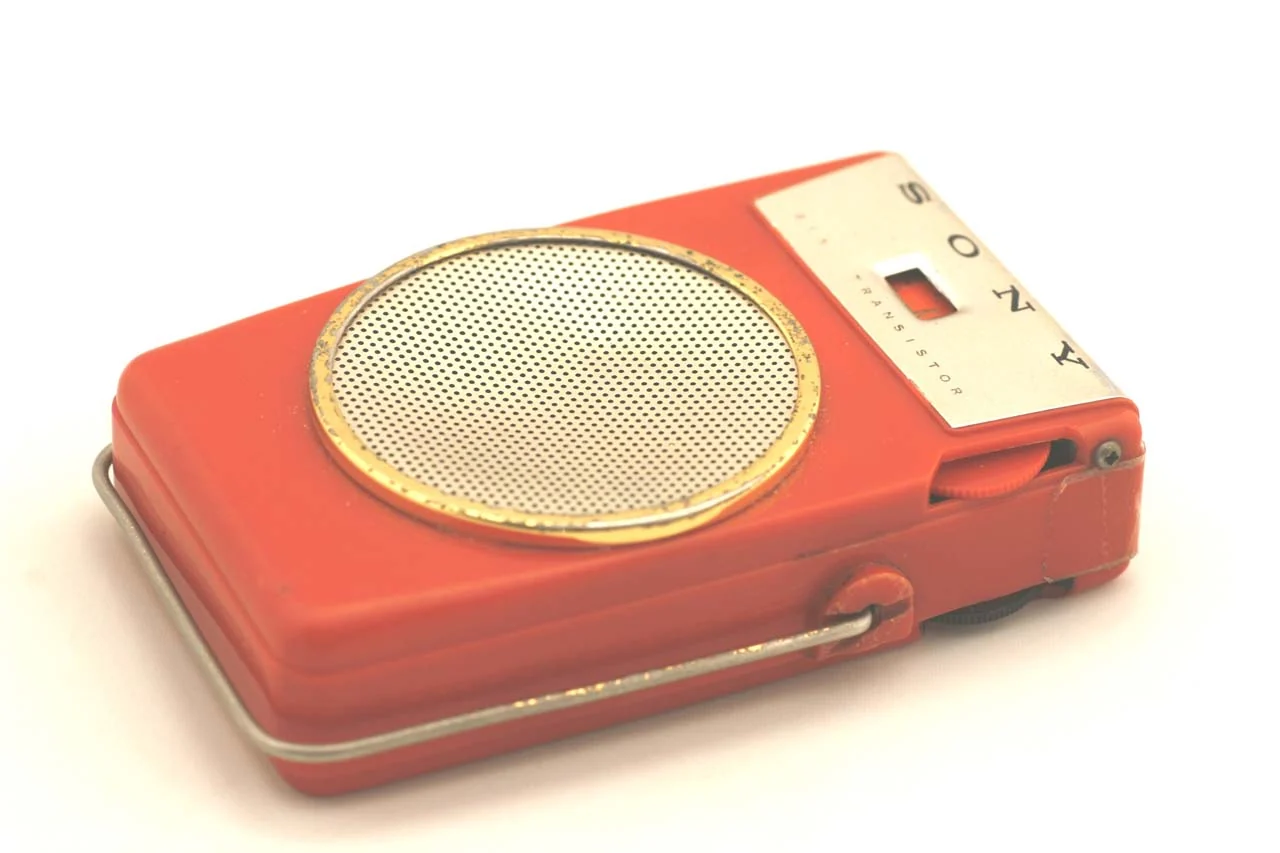
- The licensed museum photograph depicts a later Sony TR-610, dated 1958–1960 by its collection record. It is context for the portable-radio industry and must not be captioned as a TR-55.
Primary and institutional sources
How this history was checked
Sony’s corporate archive explains its product and engineering decisions. The Smithsonian’s dated Regency object record supplies an independent check on the claim of worldwide priority. The account retains 1955 because Sony-associated records disagree on the TR-55’s exact launch month. This article was reviewed on 27 October 2026.
- Smithsonian National Museum of American HistoryRegency Model TR-1 transistor radio: object and production record
- Sony GroupProduct and Technology Milestones: Radio
- Sony GroupSony History, Volume 1 Chapter 3: Developing the Transistor Radio
- Sony GroupTime Capsule Vol. 12: Kazuo Iwama and transistor development
- Sony GroupTime Capsule Vol. 1: the TR-55 and its original package
- Sony GroupTime Capsule Vol. 25: Albert D. Cohen and the first Sony exports
- Smithsonian National Museum of American HistoryIt’s personal!: transistor radios and listening habits
- Tengai Foundation / Akio Morita official websiteAkio Morita chronology