
The short answer
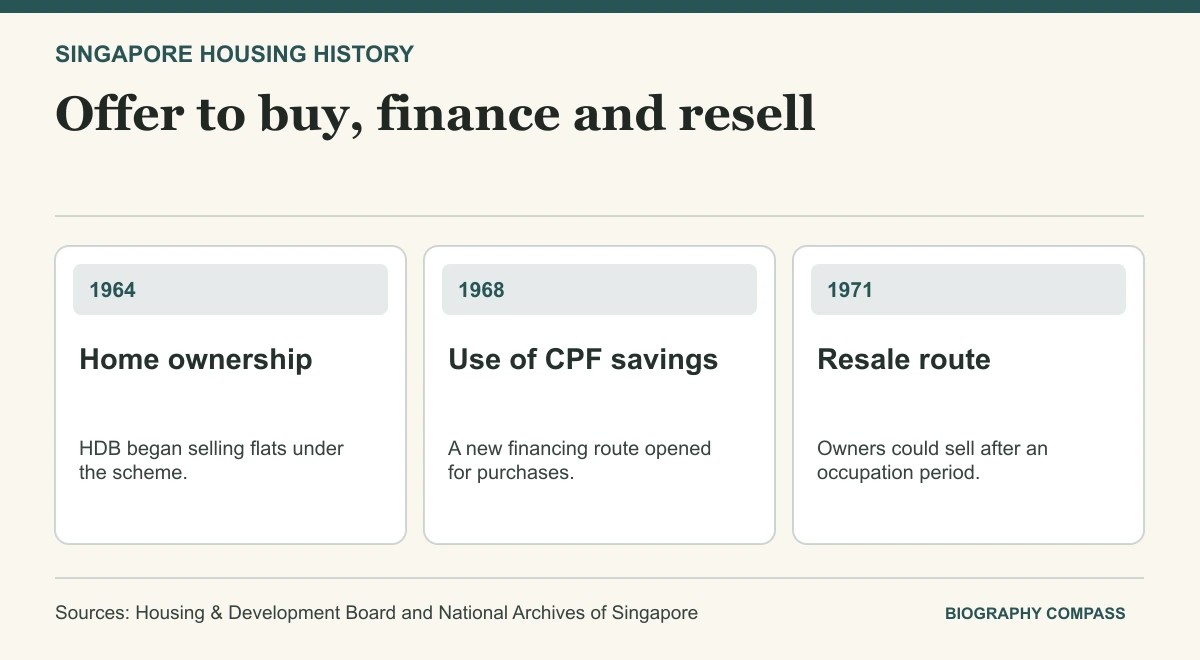
Singapore’s public housing programme had already built rental homes when the Home Ownership for the People Scheme began in 1964. Four years later the government permitted the use of Central Provident Fund savings for eligible purchases. The distinction is between a programme that made flats available to buy and another change that enabled purchasers to use a different source of finance.
Singapore housing history
Offer to buy, finance and resell
The three milestones expanded different stages of the public housing system.
| Step | Change | What it enabled |
|---|---|---|
| 1964 | Home Ownership for the People Scheme | Purchases from HDB |
| 1968 | CPF use for housing | Savings could support a purchase |
| 1971 | Conditional resale | Owners gained an open-market route after occupation |
Chronology
A timeline of the turning points
HDB launched the sales scheme
It added an ownership option to its early rental programme.
CPF amendment
Eligible savings could be used to purchase HDB flats.
Resale allowed
HDB’s history records an initial three-year minimum occupation period.
What the 1964 scheme made available
HDB began by providing rental homes at scale. Its official history places the Home Ownership for the People Scheme in 1964. That brought a new way of taking up an HDB flat. The government’s historical account links the policy to Lee Kuan Yew and explains why counting completed flats alone cannot show the beginning of a programme for purchasing them.
What changed for an eligible household in 1968
The annual report describes the Central Provident Fund amendment that permitted use of CPF savings. The purchase option already existed. The amendment changed how a household with eligible savings could assemble the payment. It is useful to keep ownership policy, the institution providing housing and the financing rule in view separately, even though they operated together for purchasers.
Resale was a further institutional change
HDB records that owners gained an open-market resale option in 1971 after a minimum period of occupation, given as three years at introduction. This concerned the sale of an existing flat by an owner. It followed changes to the original offer and its financing. A chronology that dates all three measures to the middle of the 1960s loses that sequence.
Continue the chronology
Related history guides
Connected biographies
People in this history

1923—2015
Lee Kuan Yew
Founding Prime Minister of Singapore, 1959–1990The lawyer and PAP founder who became prime minister in 1959, led Singapore through independence in 1965 and remained in cabinet after handing power to Goh Chok Tong.Read biographyQuick answers
Common questions
- When did HDB introduce the Home Ownership for the People Scheme?
- 1964.
- When could CPF savings first be used for HDB purchases?
- 1968, following the CPF amendment described by HDB.
Primary and institutional sources
How this history was checked
Dates, legal milestones and historical claims are checked against the official and institutional records below. This article was reviewed on 19 November 2026.