
The short answer
Election returns let readers verify particular contests. A party label and a percentage are useful only when tied to a named candidate, place and year.
Evidence and interpretation
What each record can establish
Read each record in the context in which it was produced.
| Record | Evidence it supplies | Limit of inference |
|---|---|---|
| 1955 Bukit Timah | Lim’s candidacy, party and local result | Support for a party formed later |
| 1963 Nee Soon | Chan’s local result and candidate totals | A direct vote transfer from the earlier contest |
| Party publication | Evidence of the organisation’s public record | A constituency tally |
Chronology
A timeline of the turning points
Bukit Timah
Lim appears in the published return as a PAP candidate.
Party formation
Barisan Sosialis emerges after the PAP split.
Nee Soon
The published return lists candidates under several party labels, including BS.
Keep the row with its heading
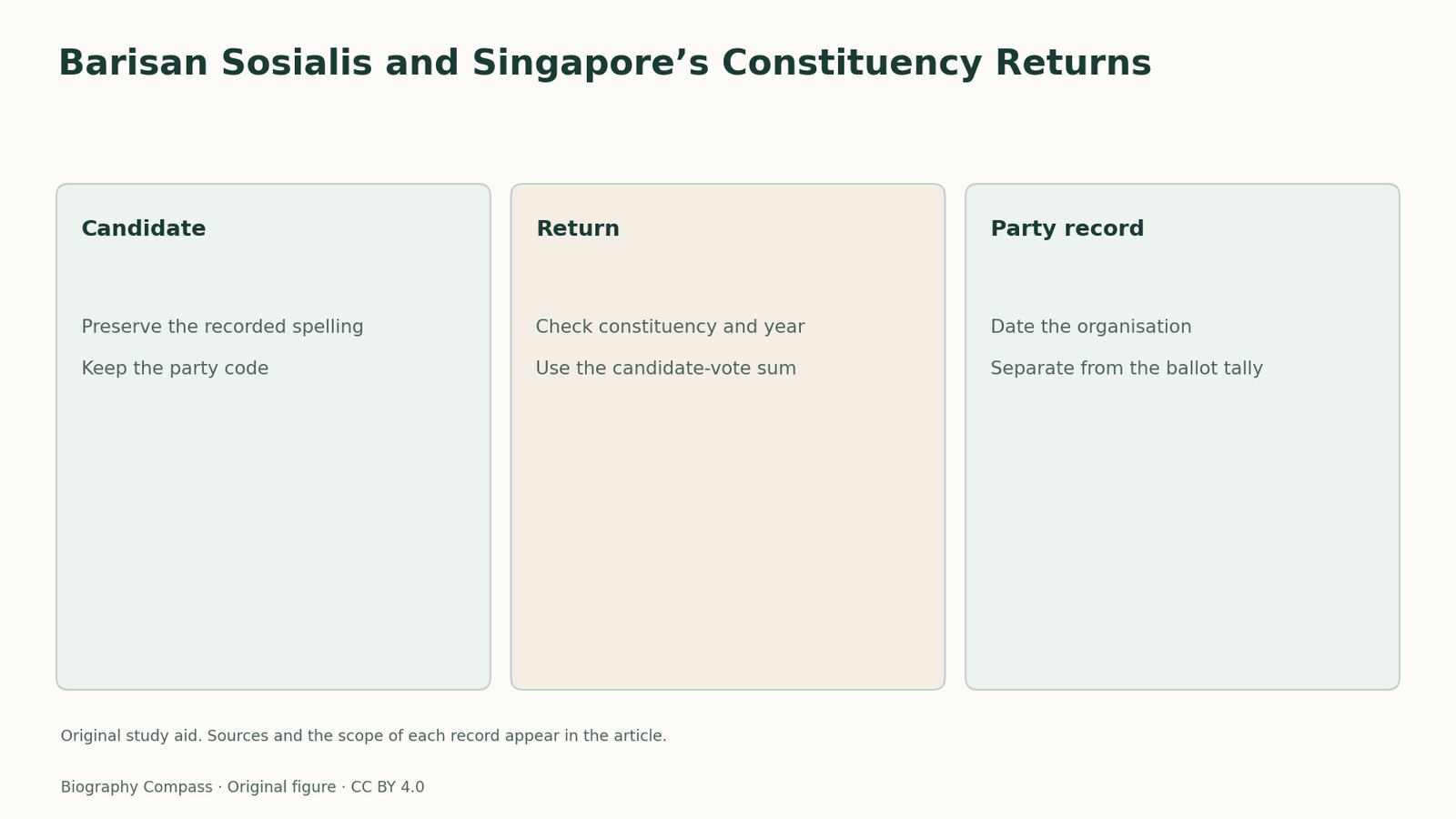
The Bukit Timah return gives Lim, listed as Lim Ching Siong, 3,259 votes under the PAP label in 1955. Record that row with its constituency and election year. It establishes his candidacy and result there. It does not retrospectively put Barisan Sosialis on the ballot, since the party was formed later. Preserve the original spelling when transcribing and note the standard form beside it.
Sources for this section: [1]
Check the percentage with the right denominator
In 1963 the Nee Soon return gives Chan Sun Wing, listed under BS, 4,914 votes. The five candidate totals add to 9,574. Dividing his total by that sum produces the listed share to two decimal places. The return separately lists 10,064 electors. Dividing by electors answers a different question and does not reproduce the published share.
Sources for this section: [2]
Use the object for a different claim
The National Heritage Board catalogue identifies a period publication associated with Barisan Sosialis and describes its emergence in 1961. That is evidence about the party and its printed presence. It cannot replace the constituency return, which supplies individual results. Conversely, the return does not describe how the party organised meetings, recruited members or framed its programme.
Sources for this section: [3]
Try an identification test
Write a record with fields for person, election, constituency, party code and votes. Fill it for the 1955 and 1963 examples. Test a claim that the second percentage measures the first candidate’s changing support. The years, people and constituencies differ, so the comparison cannot track an individual’s voters. A party history needs other evidence to connect local results across elections.
Continue the chronology
Related history guides
Biography context
Explore Singapore through connected lives
Connected biographies
People behind the records
1933–1996
Lim Chin Siong
Trade union organiser and political leaderLim became a leading union organiser, won Bukit Timah for the PAP and later helped lead Barisan Sosialis.Read biographyQuick answers
Common questions
- Can a constituency share be reproduced by dividing by all electors?
- The published candidate share here uses the sum of the candidates’ votes. The number of electors is a separate figure.
Primary and institutional sources
How this history was checked
The records below support the chronology and the evidence comparison. The reading exercise is original. This article was reviewed on 5 November 2026.