
The short answer
Recommendations reveal what an organisation thought it needed to change. A second set of records is necessary to establish what it actually delivered.
Evidence and interpretation
What each record can establish
Read each record in the context in which it was produced.
| Record | Evidence it supplies | Limit of inference |
|---|---|---|
| Recommendation | The action participants wanted | Whether the action was delivered |
| Later recollection | The importance assigned to the seminar | A contemporaneous delivery record |
| Implementation evidence | A named service, merger or payment | The entire movement’s long-term effects |
Chronology
A timeline of the turning points
Modernisation seminar
Union leaders and invited speakers meet at Singapore Conference Hall.
Recommendations
The seminar sets out proposed organisational changes and shared services.
Read the recommendation as an action
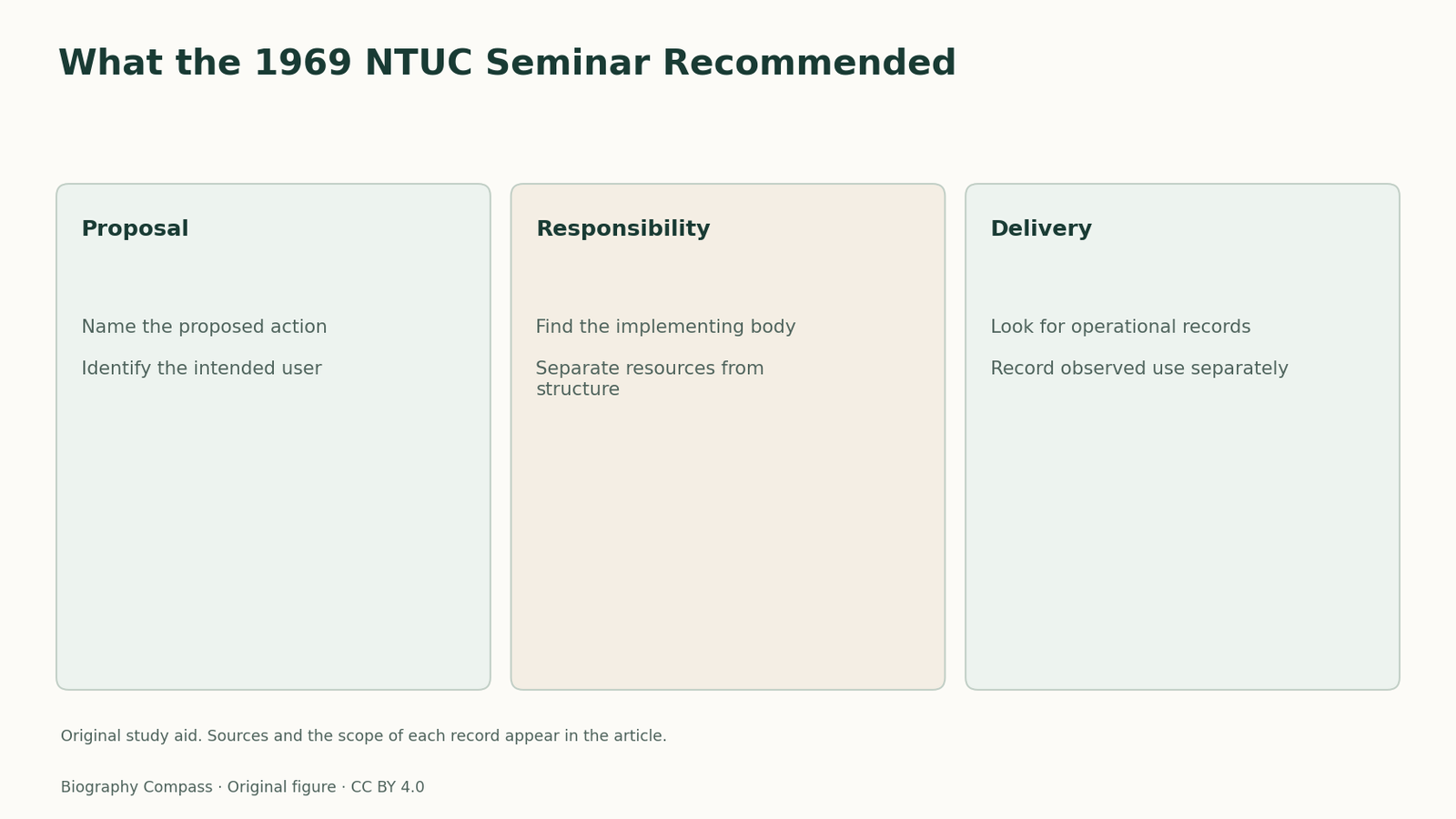
The NTUC archive reproduces recommendations from the 1969 seminar. Some are proposals about the structure of the labour movement, such as amalgamating small unions where possible. Others concern shared resources, including a development fund. Separate an organisational change from a service that could be used by members. Each proposal has a different actor and a different test of completion.
Sources for this section: [1]
Locate the problem the group was trying to solve
The congress’s account places the seminar against a decline in membership. Nair was then an adviser and chaired the event. A published record of the meeting shows which problems were raised and which responses participants endorsed. It does not provide an independent count of how many workers later enrolled or whether the same problem persisted in different industries.
Put later recollection in a second column
At Nair’s memorial, Lim Boon Heng recalled the seminar as foundational to the modern NTUC. His speech helps identify how the organisation remembered the event. Its purpose differs from the original recommendation sheet. A historian looking for delivery could seek audited accounts, incorporation records or contemporaneous membership reports for a named service.
Build a delivery ledger
Choose a proposal for a training programme and one for merging two small unions. In separate columns write the decision, the actor who would implement it and the first independent record showing completion. If all you have is a later anniversary speech, mark that as evidence of memory and keep the delivery field open. This prevents a plan from becoming a result through repeated retelling.
Continue the chronology
Related history guides
Biography context
Explore Singapore through connected lives
Connected biographies
People behind the records
1923–2005
Devan Nair
Trade union leader, parliamentarian and presidentNair helped found the NTUC, pursued labour reform after representing a Malaysian constituency, and became president of Singapore.Read biographyQuick answers
Common questions
- Do seminar recommendations prove that new services were already operating?
- They identify proposed changes. Operating records are needed to verify delivery and use.
Primary and institutional sources
How this history was checked
The records below support the chronology and the evidence comparison. The reading exercise is original. This article was reviewed on 5 November 2026.