
The short answer
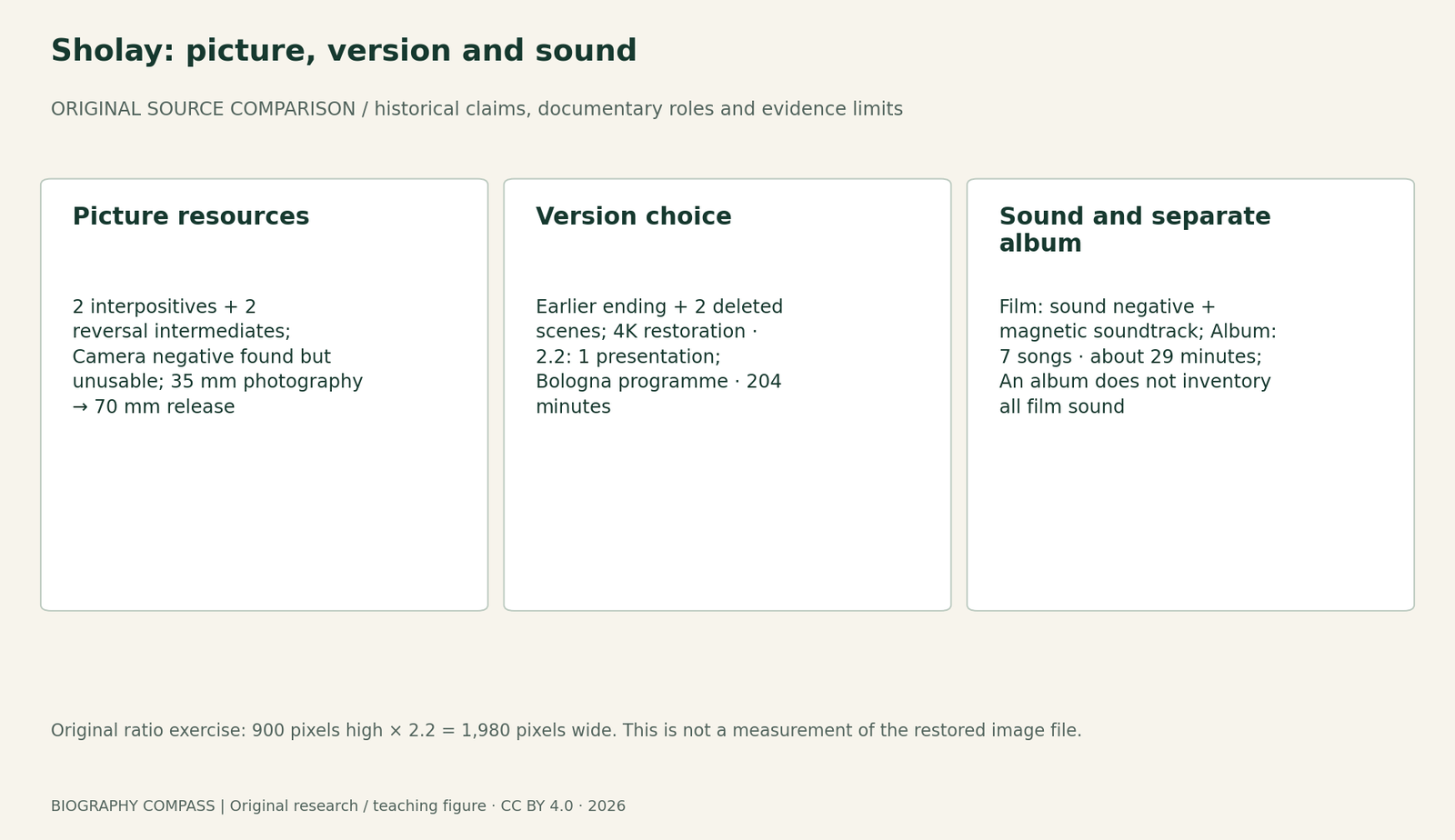
Film restoration can involve decisions about which version to present as well as the recovery of image and sound. Film Heritage Foundation’s account of Sholay identifies several surviving materials and the recovery of an earlier ending with two deleted scenes. Bologna’s screening record and Apple Music’s soundtrack listing describe different objects connected with that work. Comparing them shows why a sharp digital image, a historical release format and an album cannot be treated as the same thing.
Compare the evidence
What changes when the question changes?
Read each record for the claim it can support, then test the inference in the exercise.
| Record or example | What it supplies | How to use it |
|---|---|---|
| FHF restoration account | Materials, damage, image and sound sources, and restoration choices. | Follow the actual route from surviving elements to the restored presentation. |
| Bologna screening record | A programmed 204-minute version and an account of the changed ending. | Describe the event’s version without generalising its runtime to every release. |
| Apple soundtrack listing | Seven songs, about twenty-nine minutes, under Burman’s name. | Treat this as an album record rather than an inventory of all film sound. |
Chronology
A timeline of the turning points
Original film
Sholay was photographed on 35 mm and enlarged for a 70 mm release.
Restoration initiative
FHF’s account dates the approach from Shehzad Sippy to this year.
Bologna premiere
The restoration premiered at Il Cinema Ritrovato, according to FHF.
Restored version
An earlier ending and two deleted scenes were included in the 4K version.
Separate capture format, release format and restoration format
FHF records that Sholay was photographed on 35 mm and enlarged to 70 mm for release. Its 2025 restoration was digital, in 4K, with a 2.2:1 aspect ratio. Bologna’s programme also distinguishes 35 mm photography from the 70 mm release. These statements can coexist: they concern different stages of production and presentation. Calling the restoration 4K does not establish that a surviving 70 mm print supplied the image. Both records state that no such print survives, so the route back to the release presentation required other evidence.
Read the surviving elements as a set of resources
The restoration account identifies two interpositives and two colour reversal intermediates. The camera negative survived but was too badly deteriorated to use. Material from the United Kingdom and Mumbai therefore supplied different resources for the reconstruction. FHF also describes consultation with cinematographer Kamlakar Rao about the framing used during production. The important inference is practical: discovery, preservation and usability are separate questions. Finding a camera negative does not guarantee that it can supply the restored image, and one surviving element need not answer every question about framing or content.
Sources for this section: [1]
A recovered ending makes the result a version decision
Bologna’s screening account places the altered ending in the context of censorship at the original release. It describes recovery of the earlier ending and two deleted scenes for the restoration. This changes the question from how clean the image looks to which sequence of material a viewer will encounter. A programme should therefore identify the restored version as well as the original film year. The 204-minute screening record is useful for that event’s presentation; it should not silently become a universal duration for every historical print, broadcast or recorded release.
The soundtrack album is not the film’s whole sound record
FHF says the sound restoration used the original sound negative and magnetic soundtrack. Apple’s Sholay listing instead identifies a seven-song album, approximately twenty-nine minutes long, issued under R. D. Burman’s name. Its January 1975 date is platform metadata for that album listing, not proof of the film’s precise premiere day. The contrast is about scope. A soundtrack album can circulate selected music independently, whereas a film sound record also serves the moving-image presentation. Neither the album’s track count nor its duration describes every dialogue, effect and musical passage in the restored film.
Exercise: build a fictional decision map
Imagine an unrelated restoration with four inspected image elements: two interpositives and two reversal intermediates. One reversal element contains an earlier ending. Two separate sound sources survive. Mark the camera negative as found but unusable, and draw three branches: picture selection, version selection and sound reconstruction. If an original presentation frame is 2.2:1, calculate its width when the displayed height is 900 pixels. Explain why an album marked twenty-nine minutes cannot establish the duration of the film’s complete soundtrack. These quantities and decisions form a learning model, not measurements from Sholay’s actual restoration files.
Worked answer: connect evidence to each decision
The picture branch compares the four usable image elements; the unusable negative remains in the preservation record rather than becoming an image source. The version branch records the decision about the recovered ending and discloses that choice in the programme. The sound branch compares the two sound sources with the chosen picture version. At 900 pixels high, the frame width is 2.2 × 900 = 1,980 pixels. The album’s duration describes a separate release, so it supplies no total for the film’s dialogue, effects and music. A complete plan records sources and choices together.
Continue the chronology
Related history guides
Did Premchand’s realism leave room for fantasy?
Read selected passages of Premchand’s 1936 address, compare its literary tests with its textual history, then assess two original story outlines.
Read the timeline1934–1939Was Sher-Gil’s return to India a break with Europe?
Compare Sher-Gil’s reproduced 1934 letter with museum and exhibition accounts, then write a label that distinguishes artistic intention from later interpretation.
Read the timelineBiography context
Explore India through connected lives
R. D. Burman biography
Read the wider working life behind this focused question.
Explore the biographiesAmitabh BachchanAmitabh Bachchan biography
Read the wider working life behind this focused question.
Explore the biographiesRelated learning guideDid Premchand’s realism leave room for fantasy?
Read selected passages of Premchand’s 1936 address, compare its literary tests with its textual history, then assess two original story outlines.
Explore the biographiesRelated learning guideWas Sher-Gil’s return to India a break with Europe?
Compare Sher-Gil’s reproduced 1934 letter with museum and exhibition accounts, then write a label that distinguishes artistic intention from later interpretation.
Explore the biographiesConnected biographies
People behind the records
1939–1994
R. D. Burman
Film composer, music director and singerR. D. Burman developed a major career in film composition through work with singers, lyricists and production teams. Known as Pancham, he connected Hindi cinema with a wider musical practice that also included Bengali songs.Read biography
1942–
Amitabh Bachchan
Actor, television presenter and producerAmitabh Bachchan became central to Hindi cinema’s 1970s angry young man and later rebuilt his career through television and older leading characters.Read biographyQuick answers
Common questions
- Was the restored image scanned from a surviving 70 mm print?
- FHF says no 70 mm print survives and identifies other image elements used in the restoration.
- Is the 1,980-pixel frame a measurement from the restored film?
- No. It is an original calculation using the stated ratio and an invented 900-pixel height.
Primary and institutional sources
How this history was checked
Read the historical records and the stated translation or catalogue contexts alongside the original learning exercise. This article was reviewed on 27 October 2026.