
The short answer
Premchand’s opening argument at Lucknow asks literature to engage with human life. Yet one passage explicitly allows an imaginative setting to express life’s realities. Read together, those claims make a more demanding test than sorting stories into realistic and fantastic scenery. Frances Pritchett’s resource supplies an English translation of the opening seven pages of a later Urdu edition, along with a separate account of the address’s textual witnesses. The exercise below uses invented outlines rather than a Premchand story.
Compare the evidence
What changes when the question changes?
Read each record for the claim it can support, then test the inference in the exercise.
| Record or example | What it supplies | How to use it |
|---|---|---|
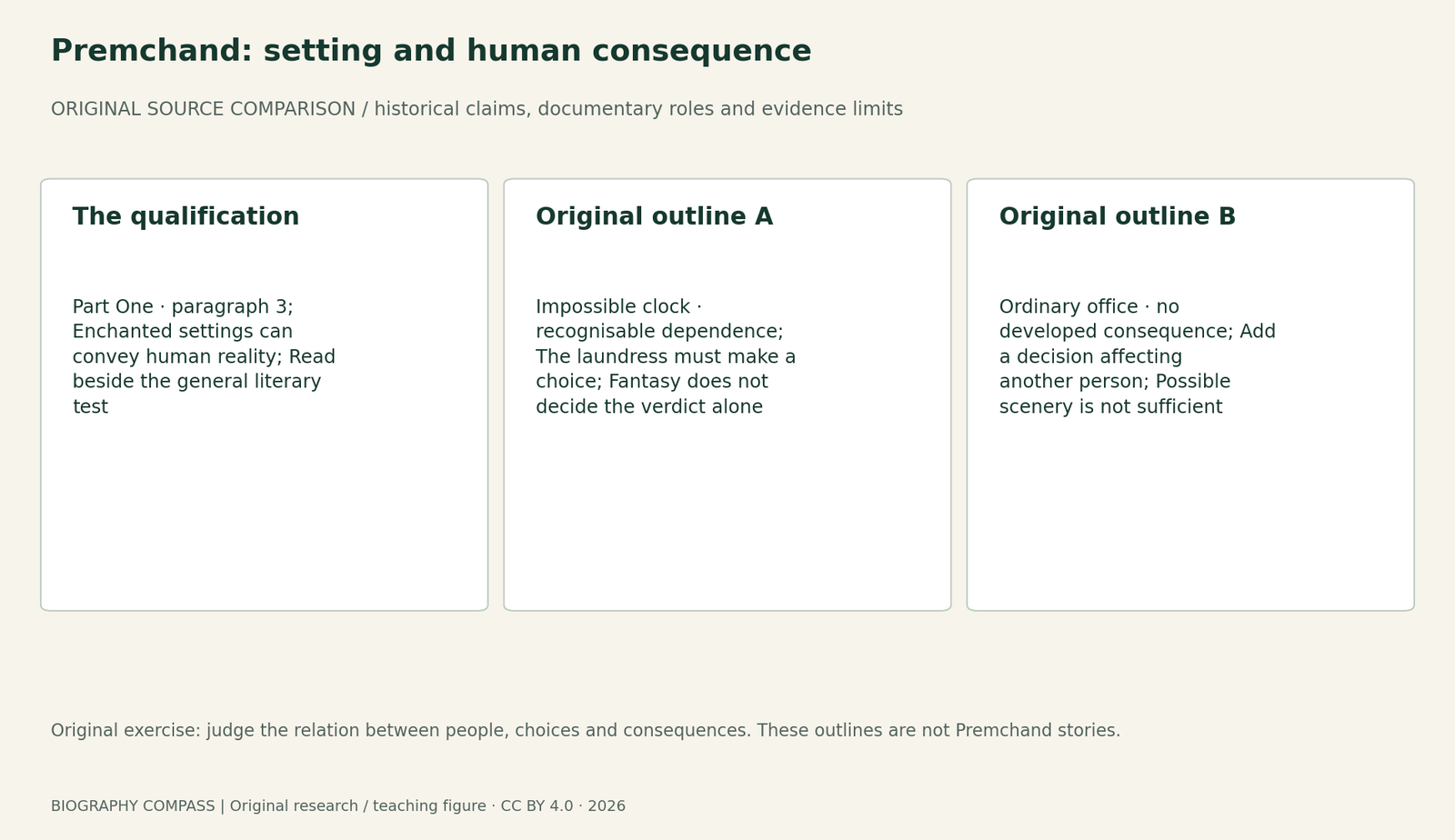
| Part One, paragraph 3 | Permission to convey human reality through an enchanted setting. | Check the qualification before declaring a prohibition. |
| Parts Two to Four | A programme linking literature to life, feeling and observation. | Ask what a story accomplishes through its people and choices. |
| Textual-source note | A publication history and uncertainty about the delivered language. | Identify the translation route without inventing a spoken transcript. |
Chronology
A timeline of the turning points
Lucknow address
Premchand presided over the newly founded writers’ association gathering.
Hindi textual witness
The source note identifies publication in Hans.
Urdu textual witness
The source note identifies publication in Naya Adab.
Later Urdu edition
The transcription used by Pritchett follows Qamar Rais’s edition, opening pages 234–240.
Begin with the apparent contradiction
In Pritchett’s Part Two, Premchand proposes “criticism of life” as a definition of literature and challenges writing that serves only diversion. But Part One, paragraph three, says an accomplished author can convey human reality through tales of enchantment or princely romance. These statements operate at different levels. One asks what writing does; the other permits different settings in which it might do it. A reader who converts the first statement into a ban on fantastic material loses the qualification already supplied by the second.
Feeling and observation are part of the proposed test
Part Three distinguishes literature’s appeal through feeling from the reasoning and instruction of ethics. Its image of advocacy also rejects exaggeration used merely to win a case. Part Four turns towards observation and believable human behaviour. Together, the selected passages suggest questions about effect, judgment and character, rather than a checklist of permitted scenery. This does not make Premchand’s position a universal law for all literature. It identifies a particular argument that can be tested against what an imagined story actually makes its people do.
The textual record limits what can be claimed about delivery
The resource’s source note, drawing on Carlo Coppola, identifies a Hindi version in Hans in July 1936 and an Urdu version first published in Naya Adab in 1941. Later editions and English translations supplied further routes of access. Coppola explicitly leaves uncertain whether Premchand delivered the address in Hindi or Urdu. The English passages used here are Pritchett’s translation of a transcription of the opening seven pages of the 1960 Urdu edition. They support this local reading; they are not an audio transcript or a reading of the complete address.
Exercise: assess two original story outlines
Outline A: Every evening a town clock borrows one hour from its poorest residents. A laundress discovers that wealthy households receive those hours. She must decide whether to expose the exchange when her daughter depends on one of those households for work. Outline B: A clerk enters an entirely ordinary office, files twelve forms and goes home. No decision, relationship or consequence is developed. Which outline could better meet the selected address’s test? Explain the difference between plausible human pressures and a physically possible setting, then propose one revision that would strengthen the weaker outline.
Worked answer: fantastic machinery can expose a human pressure
A can meet the proposed test despite its impossible clock: unequal exchange, dependence and a difficult choice create a recognisable human problem. Its success would still depend on how the story develops the laundress and the household, rather than merely announcing a moral. B gains no automatic advantage from its ordinary office. One revision would make a form deny a neighbour a service and require the clerk to decide whether to question it. The distinction is between scenery and dramatic consequence. This is an original application of the selected argument, not a claim that Premchand read or endorsed either outline.
Use a comparison to keep the conclusion proportionate
The strongest conclusion is that the selected passage permits fantastic material under a demanding account of literary effect. It does not establish that every fantasy satisfies that account, or that the rest of the address contains no further qualification. A useful next reading would follow a complete, identified edition and compare its treatment of the same point. For the present exercise, the evidence is sufficient to reject a simple equation between realism and physically possible scenery. That result comes from reading a qualification beside a general statement, then checking both against an explicit example.
Continue the chronology
Related history guides
Was Sher-Gil’s return to India a break with Europe?
Compare Sher-Gil’s reproduced 1934 letter with museum and exhibition accounts, then write a label that distinguishes artistic intention from later interpretation.
Read the timeline1975 · 2025What did restoring Sholay require beyond a sharper image?
Compare Sholay’s restoration record, screening programme and soundtrack listing, then map surviving image and sound elements into an original restoration plan.
Read the timelineBiography context
Explore India through connected lives
Premchand biography
Read the wider working life behind this focused question.
Explore the biographiesR. K. NarayanR. K. Narayan biography
Read the wider working life behind this focused question.
Explore the biographiesRelated learning guideWas Sher-Gil’s return to India a break with Europe?
Compare Sher-Gil’s reproduced 1934 letter with museum and exhibition accounts, then write a label that distinguishes artistic intention from later interpretation.
Explore the biographiesRelated learning guideWhat did restoring Sholay require beyond a sharper image?
Compare Sholay’s restoration record, screening programme and soundtrack listing, then map surviving image and sound elements into an original restoration plan.
Explore the biographiesConnected biographies
People behind the records
1880–1936
Premchand
Hindi and Urdu novelist, short-story writer and editorPremchand wrote fiction in Urdu and Hindi while working as a teacher, administrator, editor and publisher. His stories brought ordinary households and rural inequalities into a literary career shaped by colonial rule and the independence movement.Read biography1906–2001
R. K. Narayan
Novelist, short-story writer, essayist and reteller of epicsR. K. Narayan built a long English-language writing career around Malgudi, an imagined South Indian town. Novels, stories, memoir and retellings of older narratives gave that small fictional world a wide international readership.Read biographyQuick answers
Common questions
- Does this guide claim that Premchand approved every kind of fantasy?
- No. It reads a specific permission in the opening portion beside his stated tests for literary effect.
- Were the two outlines taken from his stories?
- No. They are original examples created for this exercise.
Primary and institutional sources
How this history was checked
Read the historical records and the stated translation or catalogue contexts alongside the original learning exercise. This article was reviewed on 27 October 2026.
- Frances W. PritchettPremchand’s 1936 Presidential Address: textual sources
- Premchand / Frances W. Pritchett, transcription and translationOn the textual sources for Premchand’s speech
- Premchand / Frances W. Pritchett, transcription and translation1936 address: Our language has developed a literature
- Premchand / Frances W. Pritchett, transcription and translation1936 address: The best definition of literature
- Premchand / Frances W. Pritchett, transcription and translation1936 address: Our literary taste is changing
- Premchand / Frances W. Pritchett, transcription and translation1936 address: How the modern author writes