
The short answer
Separate accounts can accumulate without meeting. Changing the last section’s form can make their people share a space, while a screenplay must decide what an audience can actually see or hear.
Selected passages and original choices
Make the change visible
The historical example and the new writing plan have different jobs.
| Choice | Selected creative question | Original station plan |
|---|---|---|
| Separate parts | Four independent novellas were planned. | Four purposes lead toward one event. |
| Change of form | A play ending became a screenplay. | Choose what can be seen and heard. |
| Limit | A particular writer’s reported choice. | Test this scene rather than rank all forms. |
Chronology
A timeline of the turning points
Gross interview
Competing explanations discussed.
Stovel conversation
A change of planned form recalled.
A plan that changed
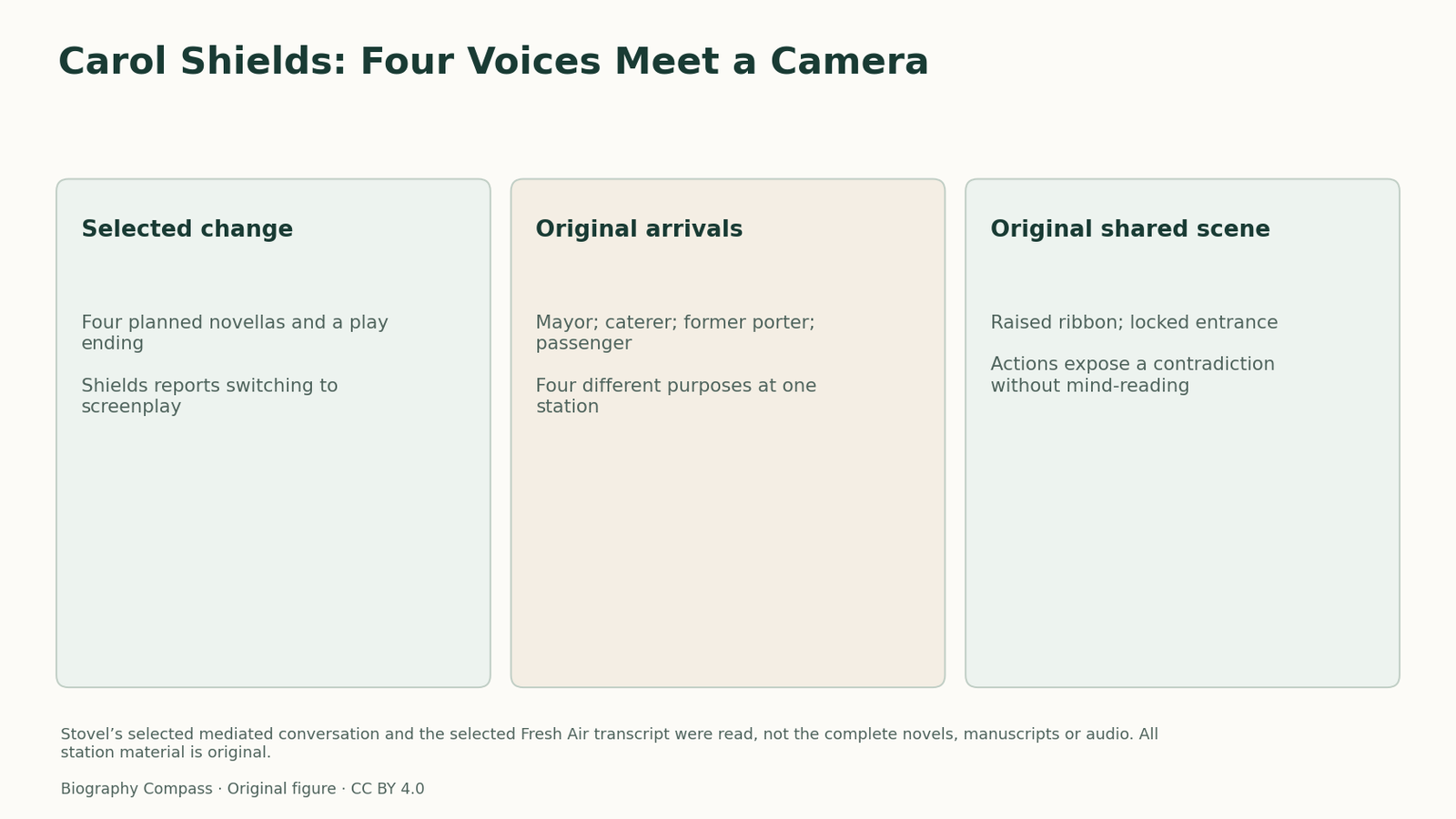
In Stovel’s record of their 2003 conversation, Shields says she planned Swann as four independent novellas with a play at the end. She found the play format too confined and switched to screenplay.
That is an account of a creative change, not evidence that stage plays are inherently less capable than films. A screenplay can specify shifts of place, viewpoint and attention differently. The relevant question is what the new form permits this particular ending to do.
Compare statements about different books
In her 2002 conversation with Terry Gross, Shields discusses the competing explanations of a daughter’s behaviour in Unless. She does not reduce the character’s situation to one of them.
The two conversations concern different novels, but both make a useful demand on a new exercise: several accounts should not be made identical merely because they enter the same scene. A final scene can expose a relation among them without announcing one person as the source of every truth.
Original task: four arrivals at one station
Plan four short independent accounts of a station reopening: a mayor preparing a speech, a caterer packing flasks, a former porter returning to the platform and a passenger who needs the step-free entrance. Give each one a distinct immediate purpose. Then write a short screenplay-like ending in which they share the station. These people and events are ours, not characters or incidents from Swann.
Reference scene: EXTERIOR. STATION. AFTERNOON. The mayor raises the ribbon for a photograph. A sealed flask rattles in the caterer’s trolley. The former porter points toward the platform. Across the forecourt, the passenger stops at the locked ramp gate. The camera returns to the raised ribbon before anyone speaks. MAYOR: “We are open.” PASSENGER: “Which entrance?”
Reference answer: what the camera can establish
The visible contradiction is between a ceremony of opening and a gate that remains locked. The passenger’s question makes the shared event less complete than the mayor’s declaration suggests. The scene supplies actions and objects rather than a direction saying that the mayor secretly dislikes access.
There are four preparatory accounts and one final shared block in this invented plan. That is not a chapter count for the source novel. Try returning instead to a single account: which other purposes disappear? Try a stage version with the same visible actions: if it works, the exercise has not disproved Shields’s report of finding her own proposed play too confined. A form’s usefulness remains tied to its particular design.
Continue the chronology
Related history guides
Biography context
Explore Canada through connected lives
Connected biographies
The wider writing life
1935–2003
Carol Shields
Novelist and playwrightA novelist, playwright and teacher who experimented.Read biographyQuick answers
Common questions
- Are the station people characters from Swann?
- No. The accounts, scene, dialogue and block count are original.
Primary and institutional sources
How this history was checked
The selected passages below ground this study. The exercises and reference responses are original. This article was reviewed on 31 October 2026.