
The short answer
A political subject does not determine one film style. An edit can challenge a statement, redirect it or postpone the information needed to judge it. Two accounts of Sen’s changing practice make that separation worth testing in a new sequence.
Source comparison and original decisions
Compare the evidence with the new plan
The source statements and the invented planning choices have different jobs.
| Question | Evidence or device | Original implication |
|---|---|---|
| Critical description | Devices are identified in a career account. | A device alone does not fix political meaning. |
| Participant memory | Experimentation is emphasised. | Do not convert intention into every viewer’s response. |
| Shot order | Our footage is invented. | Extra information changes how the sentence can be read. |
Chronology
A timeline of the turning points
A formal departure
BFI discusses Bhuvan Shome.
Kharij at Cannes
Jury Prize and differentiated credits.
Retrospective accounts
Critic and son offer distinct perspectives.
A critical account of a formal departure
The BFI describes Bhuvan Shome through montage, jump cuts and freeze-frames. Its account of the subsequent films connects formal disruption with political upheaval, then identifies a later movement towards more restrained domestic scrutiny.
This is a critic’s interpretation of a career. It gives specific devices to investigate, but does not mean a jump cut is inherently left-wing or that restraint removes political meaning.
Sources for this section: [1]
A participant’s account of repeated change
Kunal Sen stresses his father’s desire to experiment rather than settle into a successful pattern. He also distinguishes political perspective from films explicitly about politics.
The Kharij record separately credits direction and screenplay, cinematography and music. A film’s argument emerges through differentiated work, even when discussion centres on the director.
Read these records together: an account of intention, a critical description of form and a credit record answer different parts of the production question. They should not be collapsed into one proof of a viewer’s response.
Original task: nothing is wasted
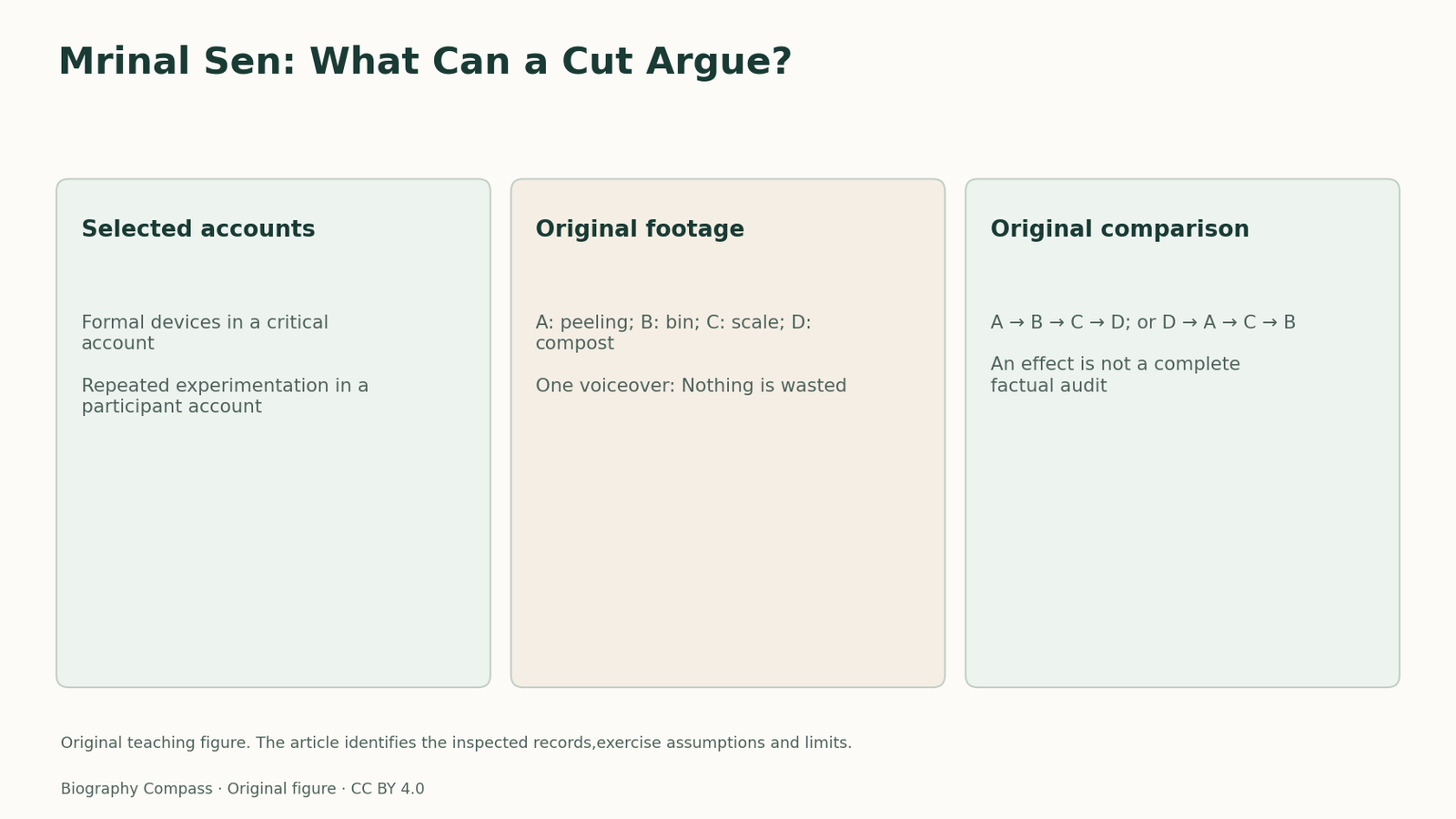
Use one invented voiceover sentence: “Nothing is wasted.” Available shots are A: hands peeling vegetables; B: a full bin of peelings; C: peelings weighed on a scale; D: a gardener turning compost. Make two edits using the same sentence and all four shots once. One should initially undermine the sentence; the other should make its meaning more conditional. Explain where the audience receives the crucial extra information.
Sources for this section: [1]
Reference edits and their limits
Edit 1 plays the sentence across A→B, then cuts to C→D. The full bin initially invites contradiction; the composting later reopens the claim. Edit 2 starts D→A→C→B, with the sentence over D. That order offers a reuse frame first, but the final bin can still trouble a claim about every discarded item.
Neither arrangement proves that all waste is recovered: the shots do not establish a complete material flow. A freeze-frame on the scale could focus attention on measurement, but cannot supply missing data. The example shows how timing changes an argument without turning an editorial effect into a factual audit. No Sen sequence or film dialogue is reproduced.
Sources for this section: [1]
Continue the chronology
Related history guides
Biography context
Explore India through connected lives
Connected biographies
The related working life
Quick answers
Common questions
- Are the kitchen shots from a Sen film?
- No. The shots, voiceover and edits are original teaching material.
Primary and institutional sources
How this history was checked
Read the selected records and their stated publication contexts. This article was reviewed on 31 October 2026.