
The short answer
A portable panel can later enter a museum as a discrete object. Its original task may have depended on neighbouring pictures, architecture and a crowd moving through a site. The Haripura records connect those two scales of making.
Source comparison and original decisions
Compare the evidence with the new plan
The source statements and the invented planning choices have different jobs.
| Question | Record scale | Original making decision |
|---|---|---|
| Object | Caption identifies a portable panel. | State panel size separately from opening size. |
| Environment | Later account describes a wider setting. | Test spacing as well as the isolated image. |
| Labour | Colleagues and assistants are named. | Credit design, painting and support construction separately. |
Chronology
A timeline of the turning points
Object caption
Singawala is dated in the museum record.
Congress setting
Commission context in the accompanying text.
Later interpretation
Selected NGMA journal discussion of environment and replication.
An object date and a setting
NGMA’s Singawala caption gives 1937, tempera on paper and 59.7×62.5 cm. Its accompanying text places the commission at the 1938 Haripura Congress and names several colleagues and students.
The later journal account describes panels conceived with temporary structures and replicated by assistants. Its account of broad colour areas and black finishing lines connects individual motifs with an overall environment.
Keep different descriptive scales in view
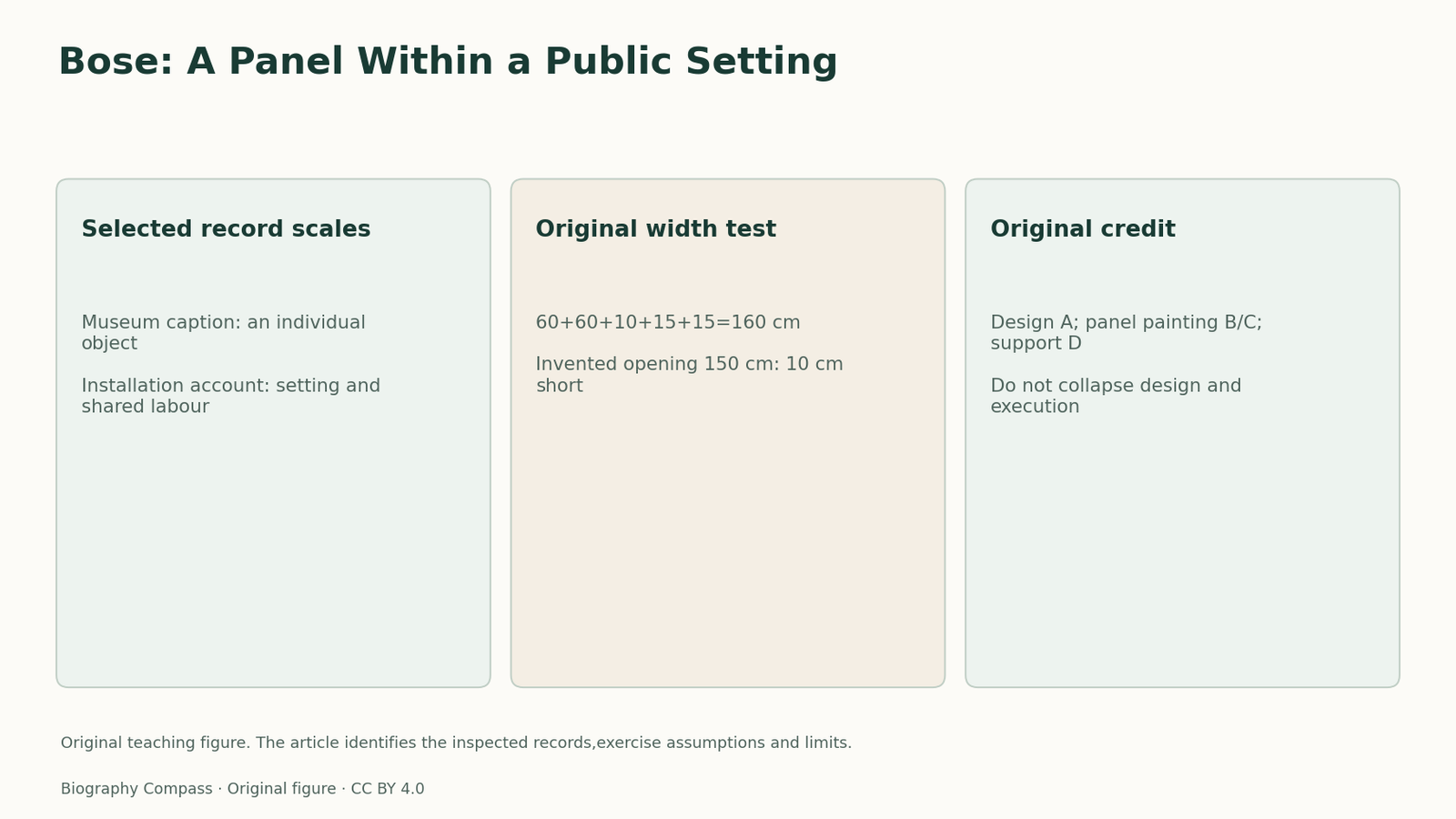
A caption identifies an object. An installation account describes how objects worked together and how more than one person made the setting possible. A making date need not equal the event year. These records do not, however, provide a complete installation plan from which every original position can be reconstructed.
For a new commission, distinguish the design, the execution of each panel and the construction of its support. A credit reading only “decorations by one artist” could conceal replication or building work. A layout that looks clear on a small desk may also need a different viewing-distance test in a public passage.
Sources for this section: [1]
Original task: fit and attribution
Plan a temporary skills-fair display. An invented opening is 150 cm wide. Two square panels are each 60 cm wide, with a 10 cm gap between them and 15 cm clearance at each outer edge. Do they fit? The designer supplies the drawings, two assistants paint the panels and a carpenter builds the support. Write a concise credit that identifies those different contributions.
Sources for this section: [1]
Reference layout and label
The pair needs 60+60+10+15+15=160 cm, so it exceeds the opening by 10 cm. Keeping the panels and gap unchanged requires a wider opening or smaller outer clearances; neither modification should be silently assumed. A single panel fits with the stipulated clearances.
Reference credit: “Design: A. Panel painting: B and C, after A’s drawings. Support construction: D.” These are invented names and roles for the exercise. Test the layout with plain geometric blocks, not reproductions of Haripura paintings. This calculation checks stated width only; it is not a structural or public-safety assessment.
Sources for this section: [1]
Continue the chronology
Related history guides
Biography context
Explore India through connected lives
Connected biographies
The related working life
Quick answers
Common questions
- Is the 150 cm opening a historical measurement?
- No. All layout dimensions are invented; the museum caption’s dimensions are separately identified.
Primary and institutional sources
How this history was checked
Read the selected records and their stated publication contexts. This article was reviewed on 31 October 2026.