
The short answer
A signal can be radioactive without telling the observer which element produced it. Follow the historical distinction first, then test whether a fictional time series behaves like one component.
Original record and worked interpretation
Two questions for one sample
Ask what kind of conclusion each piece of information supports.
| Question | Evidence used here | Conclusion permitted |
|---|---|---|
| One fixed halving ratio? | Two equal-interval ratios | The fictional sum fails that condition. |
| Which element? | Chemical discrimination in the historical record | Not supplied by the invented time series. |
| Exact historical halving periods? | No complete underlying dataset inspected | No values reconstructed. |
Chronology
A timeline of the turning points
Identification records
Chemical evidence distinguishes activities.
Original exercise
An invented mathematical mixture.
What separated activity from an assignment
Perrier and Segrè’s Nature abstract describes an irradiated molybdenum plate supplied by Lawrence. It reports more than one radioactive component and chemical exclusions of zirconium, niobium, molybdenum and ruthenium before proposing atomic number 43.
The reproduced JCP opening also identifies multiple activities. The historical investigation did more than notice a decaying signal: it combined that signal with chemical discrimination. No laboratory separation procedure is reproduced here.
Define the invented time series
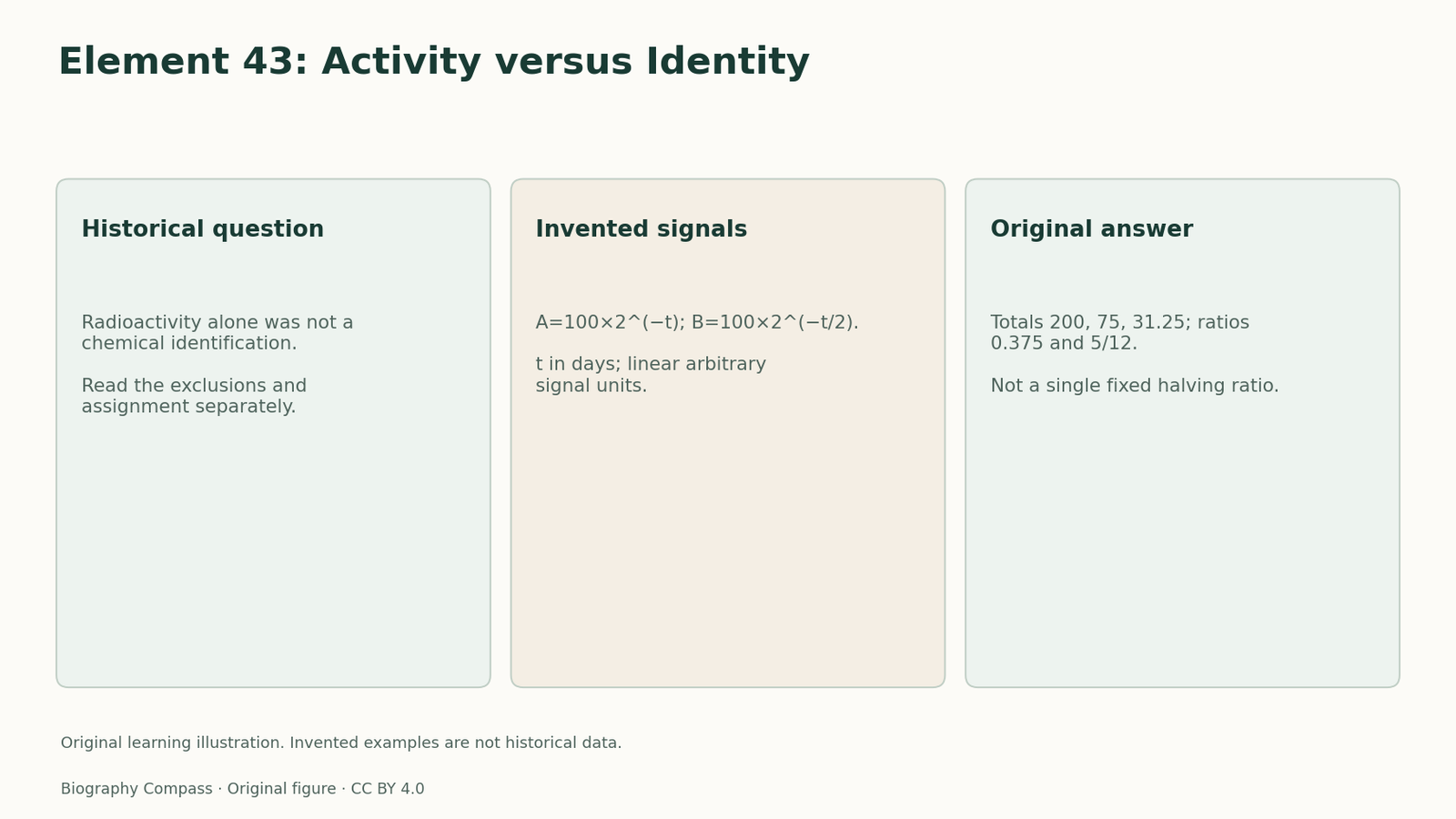
Let t be time in days. Define two fictional detector-signal components by A(t)=100×2^(−t) and B(t)=100×2^(−t/2), in arbitrary signal units. Thus A halves each day and B every two days. Assume the detector adds them linearly with no background or daughter contribution.
Find their sum at t=0, 2, 4. Does the combined signal lose the same fraction in each two-day interval? The stipulated signals are not numbers of atoms, and their halving intervals are not historical measurements from the paper.
Sources for this section: [1]
Reference answer: the changing ratio
At t=0 the sum is 200. At t=2 it is 25+50=75. At t=4 it is 6.25+25=31.25. The successive two-day ratios are 75/200=0.375 and 31.25/75=5/12≈0.416667. They differ.
Under this idealised, noiseless fixture, the sum is therefore not a single component with one fixed halving ratio over these intervals. A slower component accounts for a growing share of what remains. That diagnosis still does not assign an atomic number to either component.
Sources for this section: [1]
Keep the evidential tasks distinct
A time pattern can challenge a one-component model under its assumptions. Chemical identity is a different conclusion requiring different evidence. Conversely, failure of this simple two-component fixture would not by itself identify the missing cause: background, changing detection or a more complicated decay chain could also matter. The exercise establishes none of those alternatives as a fact about the historical sample.
Sources for this section: [1]
Continue the chronology
Related history guides
Biography context
Explore Palermo through connected lives
Connected biographies
The researcher behind the record
Quick answers
Common questions
- Do the invented signals represent atom counts?
- No. They are detector-signal components stipulated to add linearly.
- Does a changing ratio reveal an atomic number?
- No. It tests the stated time-series model, not an elemental identification.
Primary and institutional sources
How this history was checked
Historical claims use the selected records below. Invented inputs and worked interpretations are labelled; they are not reconstructed experiments. This article was reviewed on 31 October 2026.