
The short answer
An unusual concentration can motivate an explanation without identifying every part of that explanation by itself. This lesson keeps the observation, the inference and a deliberately simplified mixture calculation separate.
Original record and worked interpretation
Observation, inference and model
Do not exchange one kind of statement for another.
| Statement | What it provides | What remains open |
|---|---|---|
| Historical enrichment | A contrast to background | Its full causal explanation. |
| Proposed impact mechanism | An explanation to test | All evidence needed for its separate steps. |
| Two-material fixture | A conditional mass fraction | Whether its assumptions describe a real layer. |
Chronology
A timeline of the turning points
Primary article
Iridium observations and an impact hypothesis.
Original fixture
A two-material calculation, not a reconstructed sample.
What the primary record reports
The abstract compares boundary sediments in Italy, Denmark and New Zealand, reporting iridium enrichment above local background. Alvarez, Alvarez, Asaro and Michel propose an extraterrestrial source and an asteroid-impact explanation.
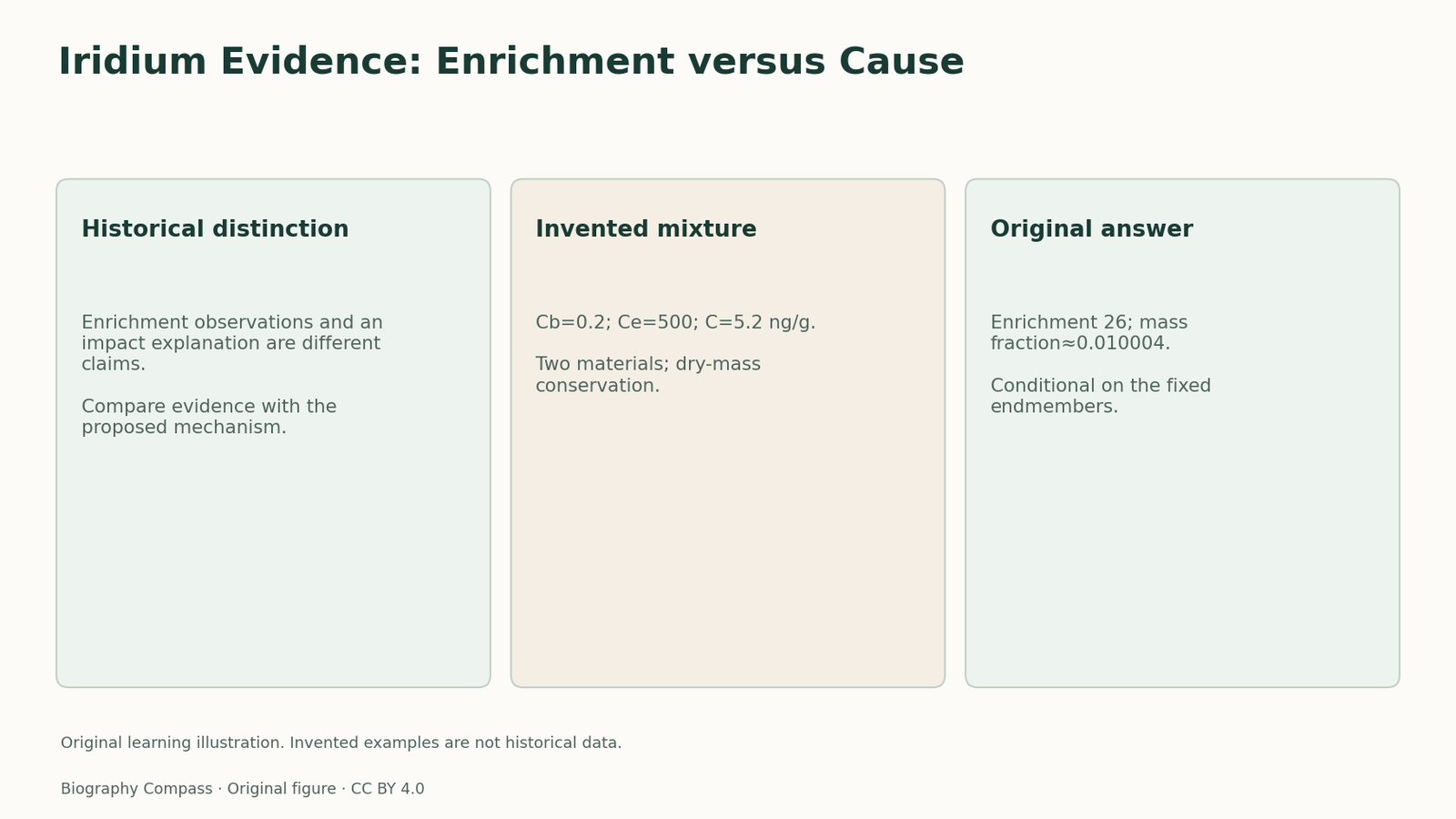
The measured contrast and the proposed mechanism are different propositions. Repeated enrichment across locations strengthens a question about a widespread event; it does not make a chemical concentration alone a complete account of transport, biological consequences or timing.
Sources for this section: [1]
An explicitly invented mass balance
Suppose a fictional layer is made only from background material and a second material. Their concentrations are Cb=0.2 ng/g and Ce=500 ng/g; the mixed layer has C=5.2 ng/g. Assume dry-mass mixing, fixed endmembers, no loss or additional source, and perfectly known values.
Let x be the mass fraction of the second material, with 0≤x≤1. Conservation of the counted element gives C=(1−x)Cb+xCe. Find x and compare it with the layer’s enrichment factor C/Cb. These are invented values, not concentrations transcribed from the historical abstract.
Sources for this section: [1]
Reference answer and an underdetermination test
The enrichment factor is 5.2/0.2=26. The mass fraction is x=(5.2−0.2)/(500−0.2)=5/499.8≈0.010004, about 1.0004%. A 26-fold concentration increase therefore does not mean a 26-fold increase in the mass of the second material.
Now remove the assumption that Ce is known. The same C can fit many combinations of x and Ce. A single concentration no longer determines a unique fraction. Adding a third source or allowing material loss creates further alternatives.
Sources for this section: [1]
What the calculation cannot settle
The fixture supplies a simple conservation relation; it does not identify a real source, determine a real impactor’s size or establish the cause of an extinction. Read it as a way to expose assumptions that an evidential argument must support. The historical article’s abstract was inspected; its complete tables and calculations were not.
Sources for this section: [1]
Continue the chronology
Related history guides
Biography context
Explore United States through connected lives
Connected biographies
The researcher behind the record
Quick answers
Common questions
- Is a concentration ratio a material mass fraction?
- No. The reference answer obtains 26 for one and about 0.010004 for the other under the stated assumptions.
- Was the complete historical paper read?
- No. The retained original abstract and metadata were inspected; the full-paper requests were blocked.
Primary and institutional sources
How this history was checked
Historical claims use the selected records below. Invented inputs and worked interpretations are labelled; they are not reconstructed experiments. This article was reviewed on 31 October 2026.