
The short answer
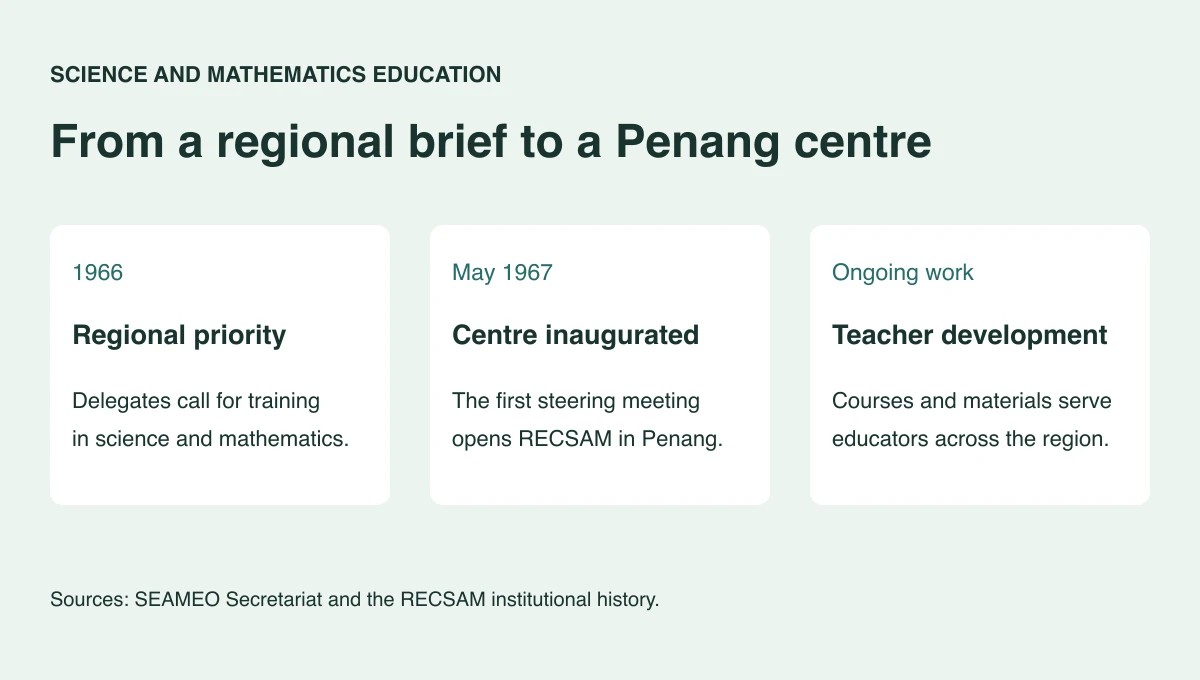
Delegates from six Southeast Asian countries met in Kuala Lumpur in 1966 and identified science and mathematics teacher development as a regional priority. They chose Penang for a joint centre. In May 1967 the first steering meeting inaugurated the Regional Centre for Education in Science and Mathematics, known as RECSAM.
What the centre was built for
Preparing teachers across several systems
A regional centre can offer training and resources while schools and ministries decide how to use them locally.
| Level | Contribution | Evidence to look for |
|---|---|---|
| Regional steering | Sets the centre’s purpose and brings countries together. | Founding chronology and committee records. |
| Training centre | Runs programmes and develops materials for educators. | Course descriptions and centre publications. |
| Home schools and ministries | Use or adapt approaches in local settings. | Reports of classroom use, training follow-up or local adoption. |
Chronology
A timeline of the turning points
Delegates meet in Kuala Lumpur
A regional workshop puts science and mathematics teacher training high on its agenda.
RECSAM opens
A first steering meeting inaugurates the centre in Penang.
The centre develops courses and resources
Training focuses on educators able to use or share the methods at home.
Why the proposal focused on teachers
The steering idea was to improve the teaching of science and mathematics through educators already working in national systems. Delegates from Indonesia, Malaysia, the Philippines, Singapore, Thailand and Vietnam identified training as a priority at the 1966 workshop.
That decision defined a practical audience for the centre. A teacher or supervisor could take part in training and then share methods locally. The work depended on follow-through after the regional course.
Why Penang was chosen
Penang offered premises connected with an existing teacher-training institution in Gelugor. The institutional history describes the use of the site for the regional programme rather than beginning with a new university campus.
The first steering meeting formally inaugurated the centre in May 1967. The dates distinguish the workshop where the countries proposed the centre from the point when an identifiable institution began work.
How to judge what cooperation delivered
The SEAMEO Secretariat describes the centre’s work in training, research and the development of resources. Those activities are observable through course records, publications and attendance. They establish what the centre provided.
To measure a lasting change in classrooms, a reader would need follow-up evidence about how teachers used the material and what their pupils learned. The founding record and a later course brief explain the method of cooperation without measuring all its outcomes.
Continue the chronology
Related history guides
How SEAFDEC Split Early Fisheries Work Across Countries
Compare how another regional body divided training and scientific work among host countries.
Read the timeline1957–1967How a SEATO Engineering School Became AIT
Compare a different form of regional education cooperation, through postgraduate engineering.
Read the timelineConnected biographies
People connected to this history
Quick answers
Common questions
- When was RECSAM inaugurated?
- The centre’s history dates the inauguration to May 1967 at its first steering committee meeting.
- Who was the centre designed to serve?
- It was established to support regional educators in science and mathematics through training and related professional resources.
Primary and institutional sources
How this history was checked
Dates, legal milestones and historical claims are checked against the official and institutional records below. This article was reviewed on 19 November 2026.