
The short answer
How can a brief scan distinguish a source on the sky from background radiation?
Read the evidence
Different claims from an X-ray scan
The original detection, positional refinements and later surveys should be kept distinct.
| Record | Claim | What remains open |
|---|---|---|
| Count-rate peak | A preferred direction produces excess counts | Physical identity of the emitter |
| Widespread counts | An extended component may contribute | Instrument and environmental backgrounds |
| Repeat observation | Tests location and repeatability | Detailed source mechanism |
The sky is not visible at every wavelength from the ground
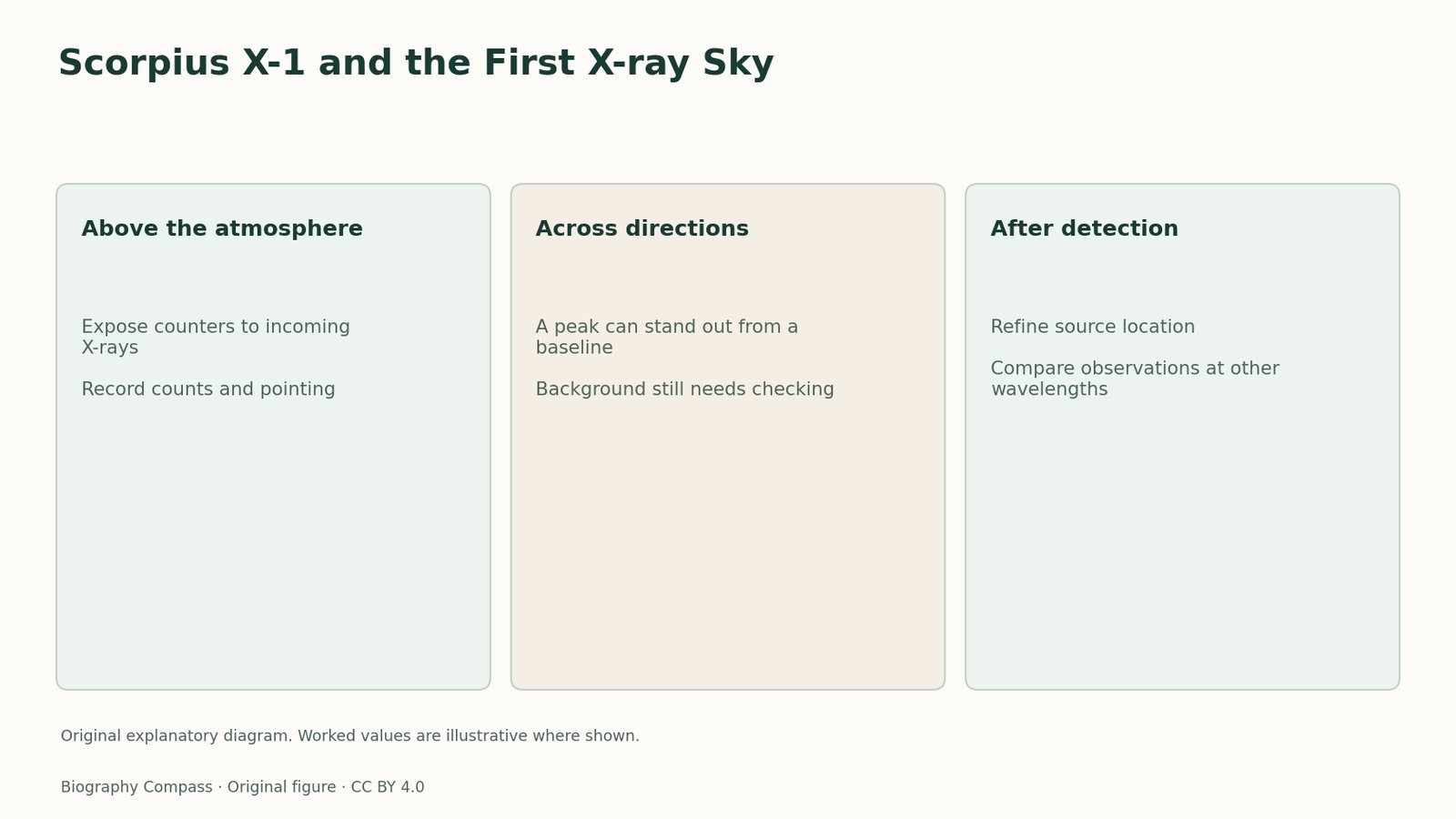
An X-ray counter at ground level cannot generally observe the same sky as a counter above the absorbing atmosphere. A rocket flight created a short interval in which the detectors could see external X-rays. The instrument recorded counts as it swept different directions. The question was how those counts changed with pointing, after the investigators considered the instrument and the environment. Because the observation was brief and the detector viewed a wide region, it did not produce a modern image. Instead it supplied a pattern of response from which directions and kinds of emission could be inferred.
Sources for this section: [2]
A peak has a different shape from a baseline
A localized source can raise the count rate when it enters the instrument’s field of view. A more extended signal can contribute across a wider part of a scan. Giacconi, Gursky, Paolini and Rossi reported a directionally concentrated source and evidence of more general X-ray emission. In interpreting the scan it mattered that the directions and timing of a peak could be compared with potential sources. The target region was not identical to the object eventually inferred. A detection can redirect an investigation when the pattern of counts is incompatible with the original proposed location.
An invented scan with five positions
Imagine a counter with readings of 10, 11, 27, 12 and 10 counts in five equal exposures. If neighboring positions usually produce about 10 or 11 counts, the middle direction contains a conspicuous excess. The pattern suggests where a localized contribution might enter the view. It does not yet prove that the excess is extraterrestrial. A repeated scan, instrument background checks and pointing information are needed to test alternatives. These are invented counts, not observations from the flight. Their purpose is to distinguish the role of a direction-dependent peak from the role of a level present across the whole scan.
Sources for this section: [2]
Source position is a separate inference
The 1962 observation identified a region of the sky, not the full physical nature of the emitter. A subsequent Nature report on Scorpius and Sagittarius considered where the earlier emission lay and used further observations. A refined direction can separate nearby candidates or narrow the region in which a counterpart should be sought. A small enough region can permit comparison with observations at other wavelengths. Those later tasks depend on the first detection but add evidence of their own. A broad counter response and the later localization should not be treated as the same measurement.
What an orbiting instrument changes
An orbiting survey can revisit the sky, compare directions at many times and accumulate more exposure than a short rocket trip. A focusing telescope can place the radiation on a detector in a way that records a more detailed image. Each advance changes what can be asked. The original rocket result was evidence that a sky of extrasolar X-ray sources existed. A source catalogue and an investigation of what makes an individual source emit X-rays are later achievements with different observing requirements. The early record is strongest when read as the start of that chain rather than as a fully resolved map.
Continue the chronology
Related history guides
Biography context
Explore United States through connected lives
Connected biographies
Researchers and collaborators
1931–2018
Riccardo Giacconi
X-ray astronomer and observatory directorRead Riccardo Giacconi’s path from Milan to American Science and Engineering, the Uhuru and Einstein missions, and the development of X-ray astronomy.Read biography1914–2006
Raymond Davis Jr.
Radiochemist and solar neutrino researcherRead Raymond Davis Jr.’s path from chemistry to the Homestake experiment, with John Bahcall’s predictions and the significance of the solar neutrino deficit.Read biography
1926–2020
Masatoshi Koshiba
Experimental particle physicistMasatoshi Koshiba helped build the experimental programme that turned a deep-underground water detector into an instrument for neutrino astronomy. His career connects cosmic-ray training, international collaboration and the observation associated with supernova SN 1987 A.Read biographyQuick answers
Common questions
- Why carry an X-ray detector above the atmosphere?
- Much cosmic X-ray radiation is absorbed before it reaches the ground.
- Was the 1962 result a focused image?
- The flight reported directional count evidence from rocket-borne detectors.
Primary and institutional sources
How this history was checked
Dates, legal milestones and historical claims are checked against the official and institutional records below. This article was reviewed on 13 November 2026.
- Nobel Prize OutreachRiccardo Giacconi — biographical account
- Nobel Prize OutreachRiccardo Giacconi — Nobel lecture
- Giacconi, Gursky, Paolini and Rossi, Physical Review Letters, 1962Evidence for x Rays From Sources Outside the Solar System
- Nature, 1964Two Sources of Cosmic X-rays in Scorpius and Sagittarius