
The short answer
A payment date and a service period answer different questions. This guide follows one historical subscription business to show why receiving cash does not automatically mean earning the entire contract fee that day.
A bounded comparison
Keep the measures separate
The question changes when the object, unit or reporting period changes.
| Record or measure | What it establishes | What it does not establish |
|---|---|---|
| Cash receipt | Money collected. | Every service already delivered. |
| Recognised revenue | Income assigned to supplied service. | The customer’s entire payment received that period. |
| Deferred balance | An amount awaiting recognition. | Total contract value in every billing arrangement. |
Chronology
A timeline of the turning points
Dated policy
The notes distinguish collection and recognition.
The historical business model
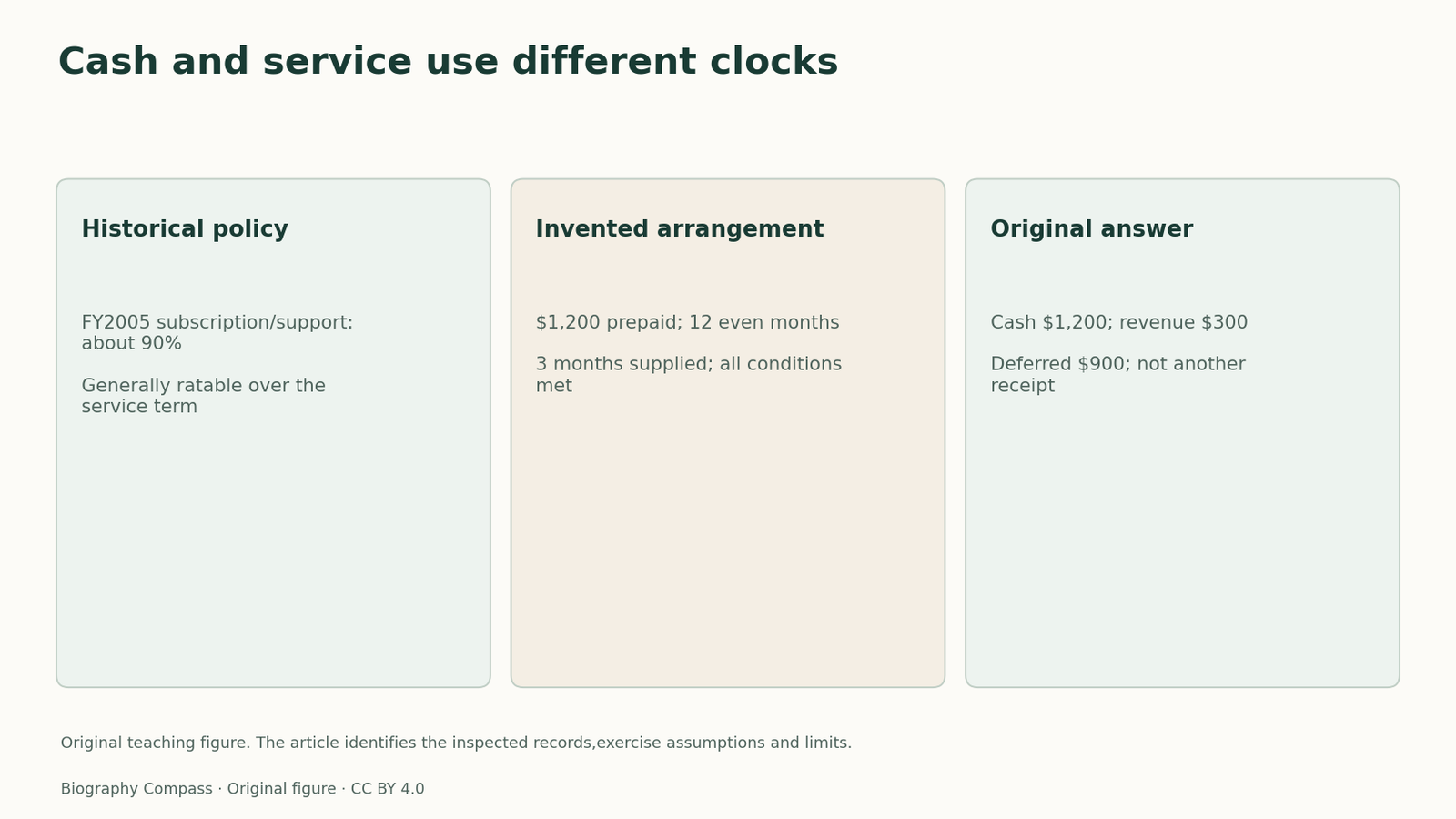
Salesforce reported that subscription and support supplied about 90% of FY2005 revenue. Its notes generally recognised those fees ratably from service commencement over contracts lasting twelve to twenty-four months.
That model connects a stream of service to a stream of recognised income. A headline about cash collection alone cannot show how much service has been supplied or how much of the fee has entered the income statement.
Sources for this section: [1]
Conditions and the balance that remains
The policy required evidence of an arrangement, service provision, probable collection and fixed or determinable fees. Annual or quarterly invoicing meant deferred revenue did not represent total contract value. Professional services had separate recognition rules.
The SEC’s beginner guide distinguishes a balance-sheet snapshot from an income statement’s period and the cash-flow statement’s account of cash movements. This is why “cash,” “revenue” and “remaining obligation” cannot be used as synonyms. The historical company policy should not be presented as universal current accounting advice.
An original service-period example
Fictional assumptions: a customer prepays $1,200 for twelve months of one evenly delivered service. All recognition conditions are met when service starts. There are no other deliverables, refunds, taxes, discounts or collection doubts. Three complete months have elapsed. Calculate cash received, recognised revenue and the remaining deferred amount.
Reference answer: cash received is $1,200. Each service month represents $100, so three months produce $300 of revenue and leave $900 deferred. The $900 is not an additional cash receipt. Nor is the $300 the change in bank balance. These values follow the supplied simplified assumptions; they are not an actual Salesforce contract or a reconstruction of an account in the annual report.
What to ask when the assumptions change
Now imagine that the same fee also buys a separately described installation service. The original calculation is no longer justified merely because the total cash is unchanged. The reader would need the arrangement’s service terms and the applicable allocation and recognition policy before assigning income to a period.
A useful review therefore starts with questions rather than a memorised ratio: what was promised, when was it supplied, what amount was invoiced, and what conditions remain? The historical notes provide a concrete example of those distinctions; the original exercise makes their consequences visible without pretending to audit a real customer.
Continue the chronology
Related history guides
Biography context
Explore United States through connected lives
Connected biographies
The connected careers

Quick answers
Common questions
- Does collecting a fee mean recognising it all immediately?
- No. Under the historical policy, recognition depended on the service supplied and the stated accounting conditions.
Primary and institutional sources
How this history was checked
Compare the dated company records with the independent or regulatory context. Original task inputs are labelled separately from reported historical measures. This article was reviewed on 31 October 2026.