
The short answer
The same percentage can describe a money commitment or a change in the number of people employed. During a crisis, keeping the denominator attached to the number is essential to understanding who was promised what.
A bounded comparison
Keep the measures separate
The question changes when the object, unit or reporting period changes.
| Record or measure | What it establishes | What it does not establish |
|---|---|---|
| Host support | A share of policy entitlement. | A share of the full booking price. |
| Workforce reduction | A share of employees. | A monetary compensation measure. |
| Public commitment | An announced obligation. | Proof of each completed payment. |
Chronology
A timeline of the turning points
Host letter
Support uses cancellation-policy entitlement.
Workforce letter
The percentage concerns employees.
The host-support denominator
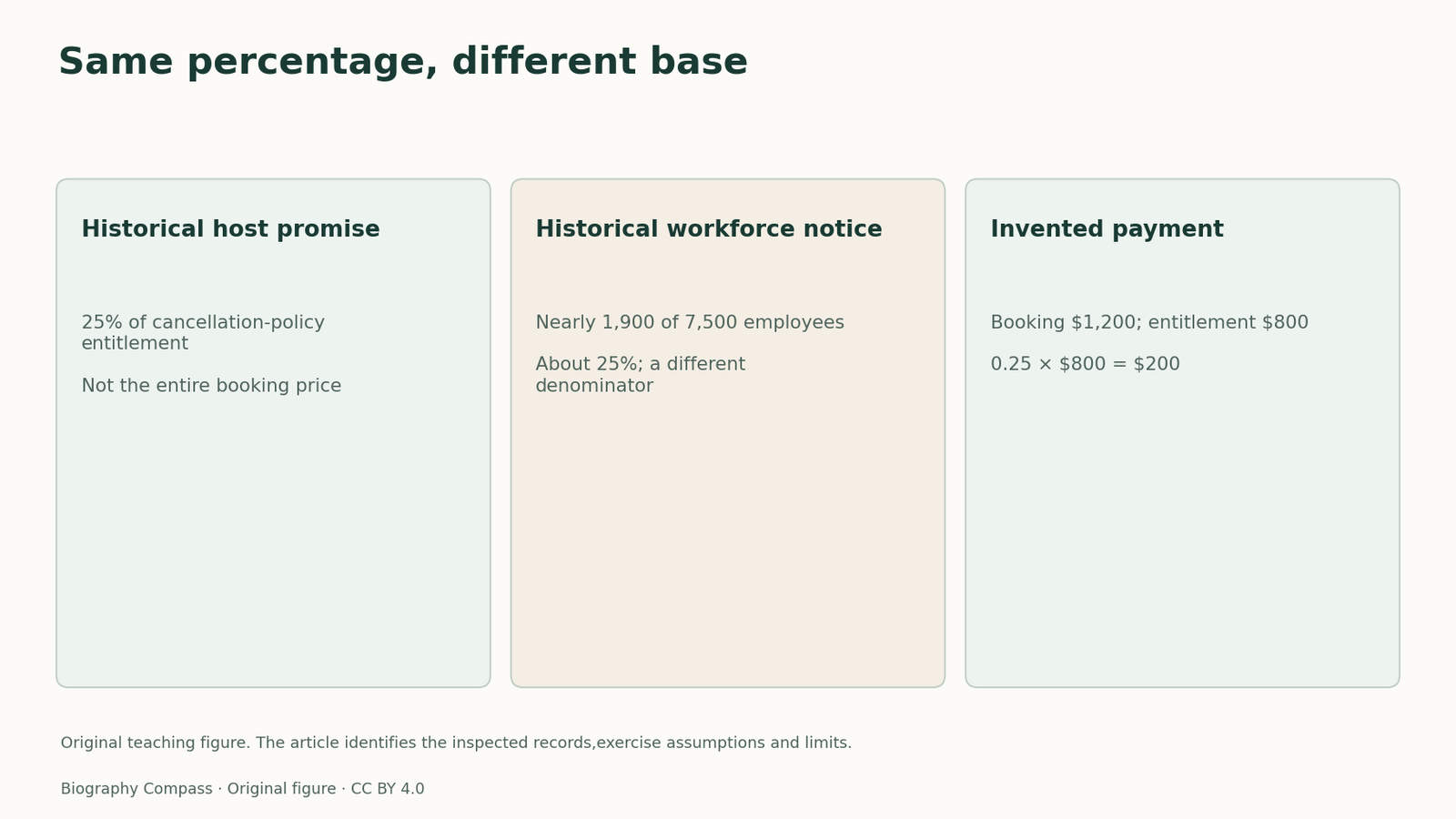
The 30 March letter committed $250 million to host support. For eligible COVID-related cancellations with check-ins from 14 March to 31 May, it promised 25% of what the host would normally receive under the cancellation policy, not 25% of the booking price.
Axios situated the announcement after host objections to refunds. That independent context helps explain the dispute; the participant letter supplies the precise promised calculation. Neither proves that every announced payment was eventually made.
A similar percentage in another letter
On 5 May Chesky announced nearly 1,900 departures from 7,500 employees, describing the reduction as about 25% of the workforce.
Here the denominator is people employed, not a cancellation-policy entitlement. “Nearly” and “about” also matter: dividing a rounded departure count by a stated workforce is a reasonableness check, not a licence to replace the letter with an invented exact headcount. The two percentages should not be merged into one measure of how the company shared losses.
Sources for this section: [2]
An original payment calculation
Fictional inputs: a booking price is $1,200. Under the host’s applicable cancellation policy, an eligible cancellation would normally produce $800 for the host. Assume the announced quarter-rate applies exactly and no further adjustments. What is the support amount? Explain what additional fact would be needed before claiming that the payment had actually occurred.
Reference answer: 0.25 × $800 = $200. Multiplying by the booking price gives $300 and uses the wrong base. The original booking value is context, not the promised support denominator. A commitment letter alone cannot establish disbursement; payment records or an appropriate later account would be needed. This example supplies eligibility rather than attempting to reconstruct the complete historical rules.
Sources for this section: [1]
A better crisis-reporting caption
An accurate comparison identifies the affected group, the denominator, the date and whether the statement is a promise or a completed outcome. A host-support commitment and a workforce announcement can both be consequential without becoming interchangeable evidence.
The letters also show the limits of a chief executive’s account. They explain intended actions and reasons from inside the business. Independent reporting can supply context and affected parties’ objections. Comparing those records is more informative than treating a public letter as either a complete audit or an inherently worthless statement.
Continue the chronology
Related history guides
Biography context
Explore United States through connected lives
Connected biographies
The connected careers
Quick answers
Common questions
- Was host support a quarter of the booking price?
- No. The announced base was the amount normally due under the applicable cancellation policy.
Primary and institutional sources
How this history was checked
Compare the dated company records with the independent or regulatory context. Original task inputs are labelled separately from reported historical measures. This article was reviewed on 31 October 2026.