
The short answer
A parameter assembled from several quantities is a consistency test, not a second measurement of each ingredient. This lesson separates the historical comparison from a deliberately invented audit of dependent inputs.
Historical record and original analysis
Audit the invented inputs
All numerical rows below are fictional teaching cases.
| Case | Inputs(r, q) | Calculated rho |
|---|---|---|
| A | 0.8,0.36 | 1 |
| B | 0.8,0.20 | 0.8 |
| B repaired at fixed q | √0.80,0.20 | 1 |
Chronology
A timeline of the turning points
Dated comparison
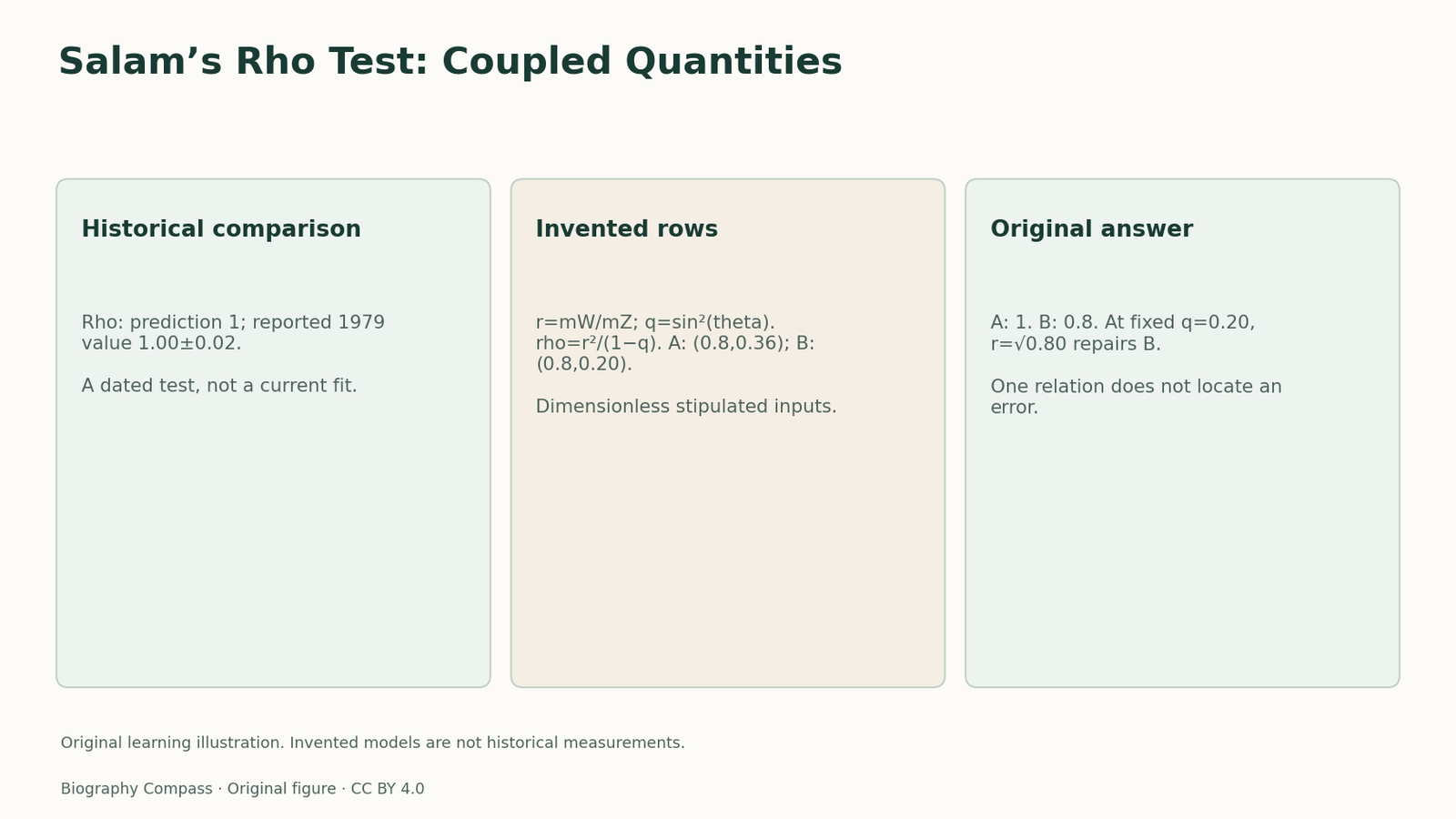
Lecture compares predicted and experimental rho.
Original audit
Invented dimensionless inputs, not a current fit.
What was being compared
Salam’s lecture defines rho=[mW/(mZ cos(theta))]², using boson masses mW, mZ and mixing angle theta. It compares the Higgs-isodoublet prediction rho=1 with an experimental value 1.00±0.02, inferred from neutral-to-charged-current cross-section ratios.
The lecture is a 1979 record. Its table of expectations and measurements cannot be silently promoted into a current precision assessment. The important historical distinction is between a model relation and the different experimental observations used to test it.
Sources for this section: [1]
Make the dependence explicit
For this exercise set r=mW/mZ and q=sin²(theta), so rho=r²/(1−q). Both are dimensionless. Assume positive masses and 0≤q<1. The calculation applies the stated relation without radiative corrections, uncertainty propagation or a fit to real observations.
Construct two invented rows with r=0.8. Row A has q=0.36; row B has q=0.20. An analyst labels both rows “rho=1” because their mass ratios are identical. Test the label and identify what can be repaired.
Sources for this section: [1]
Reference answer: one constraint, several choices
Row A gives 0.64/0.64=1. Row B gives 0.64/0.80=0.8. Holding r fixed requires q=1−r²=0.36 to obtain rho=1. Alternatively, holding row B’s q=0.20 fixed requires r=√0.80≈0.894427.
These are two different repairs of the invented row. The relation by itself does not tell us which input a real experiment got wrong, or whether a mismatch instead reflects a model limitation. Independent measurements and their uncertainties would be needed to decide.
The same reasoning explains why deriving several quantities from one consistency relation does not create several independent confirmations. Shared inputs can generate shared agreement.
Sources for this section: [1]
The historical claim remains bounded
The toy audit isolates one relation from that much larger programme. It does not derive electroweak theory, reproduce the historical cross-section analysis or revise measured masses. Its useful result is narrower: a dependent parameter cannot be assigned independently while its defining inputs are held fixed.
Sources for this section: [1]
Continue the chronology
Related history guides
Biography context
Explore United Kingdom through connected lives
Connected biographies
The researcher behind the record
Quick answers
Common questions
- Are the invented values the lecture’s particle masses?
- No. They are dimensionless classroom inputs; the lecture’s historical experimental comparison is identified separately.
- Does a single relation identify which measurement caused a discrepancy?
- No. Additional independent evidence is required to distinguish input error from an inadequate assumption.
Primary and institutional sources
How this history was checked
Selected original records are identified below. Invented inputs and calculations are labelled separately from historical observations. This article was reviewed on 31 October 2026.