
The short answer
The instrument reports motion along the line of sight. A rotation curve asks a different question: how fast matter moves around a galactic centre. The bridge between them is geometry plus a motion model.
Record comparison
Three steps, three objects
Keep the historical record distinct from the stipulated model.
| Question | Record or stipulated input | Consequence and limit |
|---|---|---|
| Observation | 100 km/s invented systemic-subtracted difference | A line-of-sight quantity. |
| Geometry | 30° or 60° assumed inclination | 200 or 115.47 km/s circular speed. |
| Additional mass model | Spherical mass proxy only | A separate assumption, not the historical disk fit. |
Chronology
A timeline of the turning points
Joint survey
The selected Andromeda paper appeared.
What Rubin and Ford separated
The 1970 survey reports spectra of 67 Andromeda emission regions. Its projection equation includes circular and expansion components; with expansion set to zero, the authors use an adopted inclination and position in the disk to infer rotation. Their subsequent mass interpretation is a disk model.
The observation and the inference are therefore distinguishable even before any discussion of unseen matter. Uncertainty about orientation does not have the same meaning as uncertainty in a measured spectral line.
Sources for this section: [1]
An explicitly simplified geometry
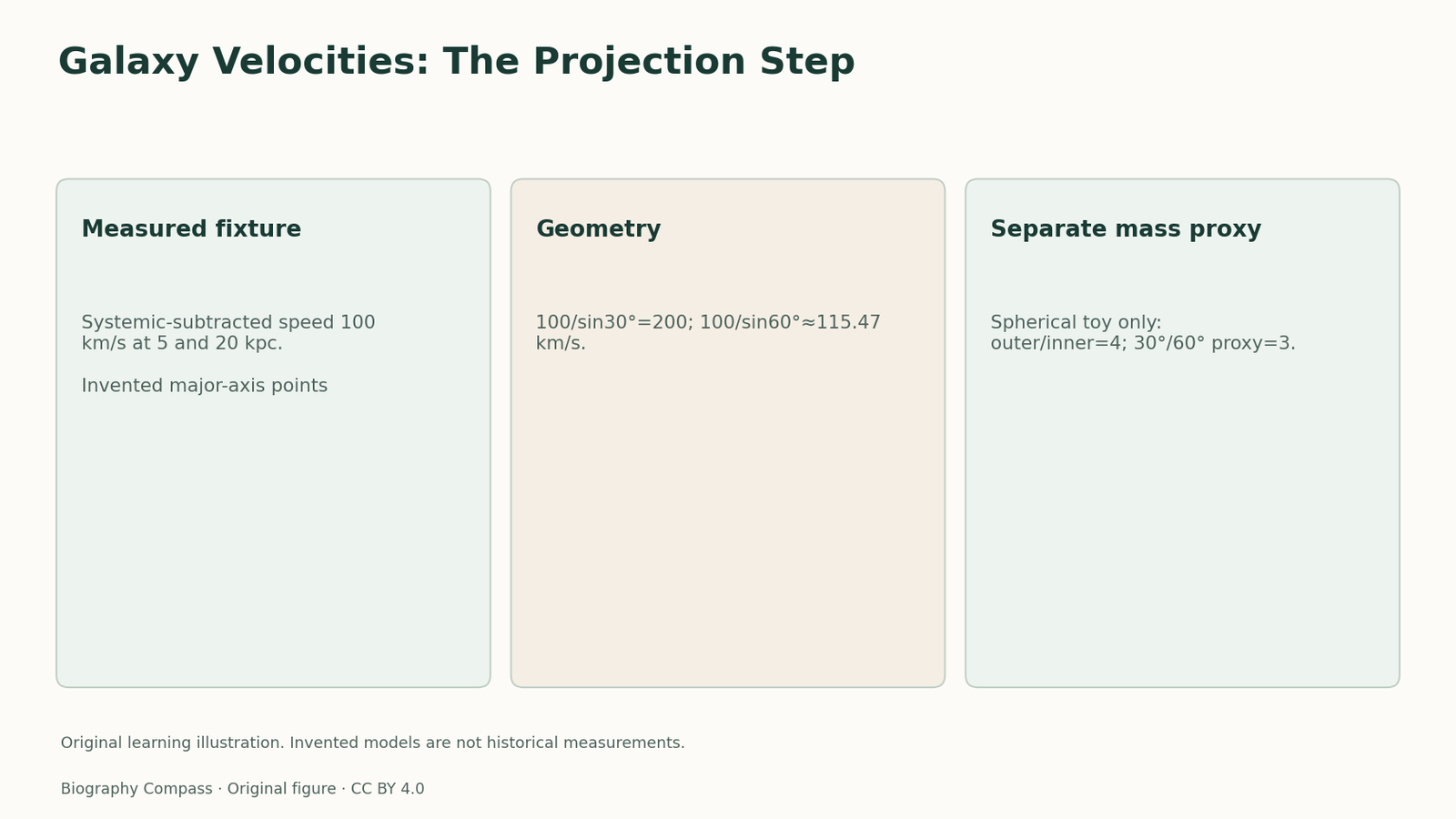
Invent two points exactly on a galaxy’s projected major axis, at physical radii 5 and 20 kpc. Both have a line-of-sight speed difference of 100 km/s after subtracting systemic motion. Assume circular planar motion and an inclination i measured from face-on. Then the invented model gives speed=100/sin(i) km/s.
On this major axis, changing the assumed inclination does not change the stipulated physical radii. Away from that axis, deprojection of position also matters. The historical equation includes that positional factor; the fixture deliberately chooses a case where it becomes one.
Sources for this section: [1]
Reference answer and a second assumption
At i=30°, the circular speed is 200 km/s. At i=60°, it is 200/√3≈115.47 km/s. Both radii have the same speed under either assumed inclination. The observation alone cannot choose between these two stipulated geometries.
Now add a separate spherical toy assumption: enclosed mass is proportional to r×speed². The outer-to-inner mass ratio is 20/5=4. At a fixed radius the mass proxy inferred with 30° is three times that inferred with 60°, because the squared-speed ratio is three. This spherical proxy is not Rubin and Ford’s disk calculation.
Sources for this section: [1]
A limited but useful conclusion
A constant observed speed difference can still yield different inferred speeds and mass scales when the geometry changes. The exercise does not identify a particle, measure a real halo or show that every possible mass distribution is spherical.
The useful habit is to retain the observation while recording each extra assumption. That makes disagreements about a model distinguishable from disagreements about what the instrument measured.
Sources for this section: [1]
Continue the chronology
Related history guides
Biography context
Explore United States through connected lives
Connected biographies
The working life behind the record
Quick answers
Common questions
- Is the spherical proxy the original paper’s mass model?
- No. It is a separate invented teaching assumption.
- Does this isolate every observational uncertainty?
- No. The fixture fixes position, systemic motion and all other measurement errors.
Primary and institutional sources
How this history was checked
Selected records support the historical discussion. Invented inputs and original answers are labelled; no complete uninspected work is claimed. This article was reviewed on 31 October 2026.